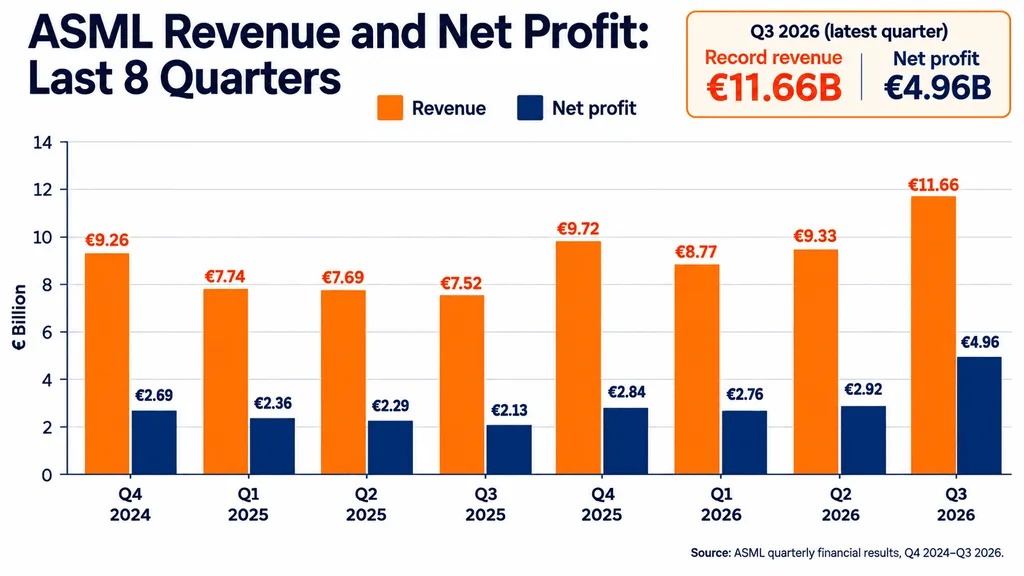
ASML The stock price faced pressure in the morning session on October 14th, despite the Dutch semiconductor equipment giant announcing quarterly profits of nearly 5 billion euros, raising its annual sales forecast, and warning that demand for advanced chip manufacturing equipment could exceed its production capacity by 2028.
According to the quarterly performance of ASML, revenue increased by approximately 55% year-on-year to 11.66 billion euros, with a gross margin reaching 57.5%. However, this performance also highlights an old issue with the highly valued AI stock: strong profitability does not always satisfy investors.
Why is the stock price of ASML still falling despite strong performance?
Despite quarterly profits significantly exceeding expectations, the revenue of 11.66 billion euros was still slightly lower than analysts' forecast of around 11.85 billion euros. The reason why this small gap is significant is that the stock price of ASML has risen by about 60% to 70% since the beginning of 2026.
The strong performance of the stock price earlier on has pushed valuations to a relatively high level, making investors more sensitive to unexpected earnings, production capacity constraints, and changes in growth expectations.
Another factor contributing to the decline is the broader sell-off in the semiconductor sector. The PHLX Semiconductor Index has fallen by about 5% in October, and companies such as NVIDIA, AMD, and Micron are also under pressure due to increased AI investment in sustainability and intensified competition.
This has created an unusual situation: the core business of ASML is still expanding rapidly, but investors have become more cautious about the prices they are willing to pay for such growth.
ASML believes that the demand for AI chip devices will continue until 2030.
The company's outlook stands in sharp contrast to market concerns.
ASML has raised its revenue forecast for 2026, with current estimates for annual sales ranging between 44 billion euros and 45 billion euros. Revenue for the fourth quarter is expected to be between 14.2 billion euros and 15.2 billion euros.
CEO Christophe Fouquet also revealed that some customers have already begun to express interest in equipment orders for 2029 and 2030, which reflects market expectations that AI infrastructure investments will continue for a considerable period of time.
More importantly, ASML now believes that its planned production capacity for 2027 and 2028 will not be sufficient to meet the expected customer demands.
The company previously proposed a plan to increase the production capacity of certain advanced lithography systems by 30% by 2027 and is currently studying further production expansion plans for 2028.
Such devices are crucial for semiconductor manufacturers, including TSMC, Samsung, and Intel, which produce or develop advanced chips used in the computing infrastructure of AI.
This also makes ASML an important indirect beneficiary of the expansion of NVIDIA AI, although NVIDIA usually relies on manufacturing partners rather than directly purchasing ASML devices.
With the acceleration of investment in AI, can the stock price of ASML rebound?
The performance of ASML indicates that the demand for semiconductor equipment remains strong, but the future performance of this stock will not depend solely on quarterly profit growth.
Investors need to assess whether capacity expansion can support expected orders, whether customers will maintain their investment plans, and whether the current valuation has already taken into account the exceptional growth expected over the next few years.
The broader financial environment also presents another challenge. Higher borrowing costs and renewed concerns about inflation have made investors more selective regarding expensive technology companies, even though these companies' profits are still improving.
As explained by the relationship between Treasury bond yields and the valuation of tech stocks, rising interest rates may put pressure on growth stocks even before the fundamentals of companies have significantly deteriorated.
For ASML, the core issue is whether the accelerated demand for devices by 2030 can be translated into sufficient earnings growth to support the significant increase in profits seen in 2026.
Ethan Mercer
Ethan Mercer is a financial journalist who covers cryptocurrency, stocks, and the global economy. He studied economics and finance before turning to market reporting, with a particular focus on Bitcoin, stocks, monetary policy, and investor sentiment. His writing focuses on explaining daily market fluctuations and the broader trends behind them.