

The National Air and Space Museum in the United States, located in Washington, is one of the most visited museums in the country. However, this building is not large enough to display all of the aircraft and spacecraft in its collection.
That is the purpose of the Steven F. Udvar-Haz Center. This lesser-known second location is situated in Chantilly, Virginia, and looks like an hangar from the outside. It provides 340,000 square feet of exhibition space, displaying more than 200 aircraft and spacecraft.
"What you'll see is the first one, the last one, the only one, the last surviving one, the most important one. So in terms of collectibility, it's an A+ grade," Holly Williamson, the museum's public affairs specialist, told Business Insider.
I visited the Udva-Haz Center in January 2026. Here are some of the coolest things I saw there.
The Steven F. Udawa-Haz Center, located in Shanty Bay, Virginia, is situated on the property of Washington Dulles International Airport.
Unlike the National Air and Space Museum's main campus in Washington, which manages large crowds of visitors with time-limited admission tickets due to limited space, the Udvar-Haz Center does not require reservations.
This museum is about 25 miles from Washington, and admission is free. The parking fee is $15.
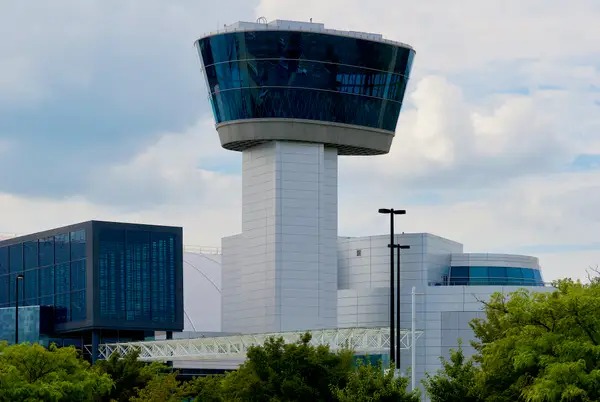
Taking advantage of its proximity to the airport, the museum has established the Donald D. Engen Observation Tower.
This observation tower, standing 164 feet tall, introduces visitors to the history of air traffic control and offers a 360-degree panorama of modern airport operations.
Inside the tower, I listened to the real-time air traffic control audio while watching the planes take off and land at Washington Dulles International Airport.
Mary Baker Engen's restoration work at the hangar allows visitors to glimpse behind the scenes of how museums restore historic aircraft.
Visitors can stand on the balcony with floor-to-ceiling windows and watch the restoration work inside the hangar in real time.
The projects that were under repair during my visit included the “Flak-Bait” aircraft, which is a Martin B-26 “Bomber” that carried out 202 combat missions during World War II and participated in the D-Day landing in Normandy; there was also a Sikorsky JRS-1 seaplane that was parked there on December 7, 1941, during the attack on Pearl Harbor.
The bomber Enola Gay, with the identifier B-29, is also part of the museum's collection. This aircraft dropped the atomic bomb on Hiroshima during World War II.
On August 6, 1945, the Boeing B-29 "Superfortress" bomber Enola Gay dropped the first atomic bomb in history during the war on Hiroshima, resulting in at least 70,000 deaths.
This atomic bomb, named "Little Boy," weighed 9,700 pounds, so the plane had to remove most of its protective and defensive weapons in order to carry this massive bomb.
When the "Enola Gay" exhibit was first displayed in 1995, it sparked controversy. At that time, veterans' groups and anti-war activists debated how to present the historical narrative of the use of atomic bombs.
The Boeing 367-80 jet transport was the only prototype manufactured in its class, and it played a key role in the development of the Boeing 707 jet airliner.
In the 1950s, Boeing began working on the development of a jet aircraft that could be used as both a passenger plane and a cargo plane, as well as an aerial refueling tanker.
Boeing began manufacturing this prototype jet in 1952, and it had its first test flight two years later. It was 100 miles per hour faster than the De Havilland Comet, the world's first jet airliner developed by the United Kingdom, and had a range of over 3,500 miles, revolutionizing air travel.
The improved version of this aircraft was known as “Dash 80”, which later became the first jet airliner to be put into use in the United States: the Boeing 707.
The museum also displayed a Concorde supersonic airliner operated by Air France.
The governments of the UK and France collaborated to develop the first batch of supersonic airliners, which were put into commercial operation between 1976 and 2003.
Flying at twice the speed of sound enables these aircraft to cross oceans at unprecedented speeds. The fastest Concorde flight from New York to London took only 2 hours, 52 minutes, and 59 seconds.
This Concorde airliner in the museum once served French Airlines. It has a body length of 202 feet 3 inches and a wingspan of 83 feet 10 inches.
Other retired Concorde airliners can also be seen in museums in New York, Seattle, Paris, the United Kingdom, and other places.
One of the core exhibits in the museum is the Lockheed SR-71A “Blackbird,” which is the fastest jet-powered aircraft in the world.
The Lockheed SR-71A is a supersonic reconnaissance aircraft designed to fly high and fast enough during the Cold War to evade Russian missiles. It is capable of flying at altitudes over 85,000 feet and at speeds exceeding three times the speed of sound, which is approximately 0.7 miles per second.
Due to the black coating designed to absorb radar signals, this aircraft was nicknamed "Blackbird".
During its 24-year service life, this "Blackbird" accumulated 2,801.1 hours of flight time and was retired in 1990.
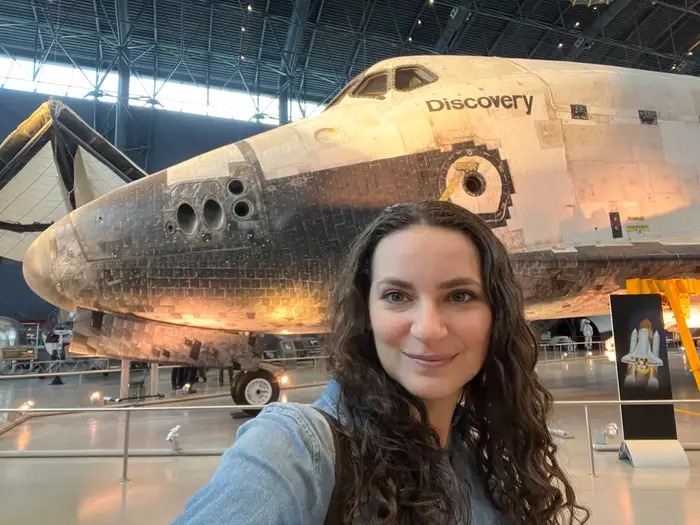
At the entrance of the James S. McDonnell Space Hangar, the space shuttle "Discovery" was placed right in the center, which made me stop in my tracks immediately.
It's difficult to fully convey the scale of the "Discovery" spacecraft through photographs, but seeing such a massive and historically significant spacecraft with one's own eyes is still truly awe-inspiring.
This space shuttle is 122 feet long, 78 feet wide, and 57 feet tall, standing tall above the other exhibits in the hangar. When fully loaded for a mission, the orbiter weighs about 250,000 pounds.
The "Discovery" is the orbiter with the longest service time among NASA, having carried out a total of 39 missions.
Its first mission began in 1984, and its last mission ended in 2011, with a total of 365 days spent in space.
Among its many historical achievements, these include the deployment of the Hubble Space Telescope in 1990, as well as becoming the first space shuttle to dock with the International Space Station in 1999.
Hanging above the "Discovery" is the jetpack used by astronaut Bruce McCandless during his first untethered spacewalk in 1984.
This mechanical device is a backpack propulsion system powered by nitrogen gas jets, which allowed McCardleis to fly about 300 feet away from the Challenger space shuttle.
His un tethered spacewalk was captured in a iconic photograph: a lonely astronaut floating above Earth.
The Udva-Haz Center is worth a detour from National Square to visit.
On the day of my visit, my phone recorded nearly 10,000 steps. There are so many places to walk around and so many exhibits to see here.
I can't believe that when planning my trip to Washington, I had no idea that there was a second location for the National Air and Space Museum. Now, I will recommend it to all aerospace enthusiasts I know.
Editor's Note: This report was initially published in March 2026, and the most recent update was in October 2026.