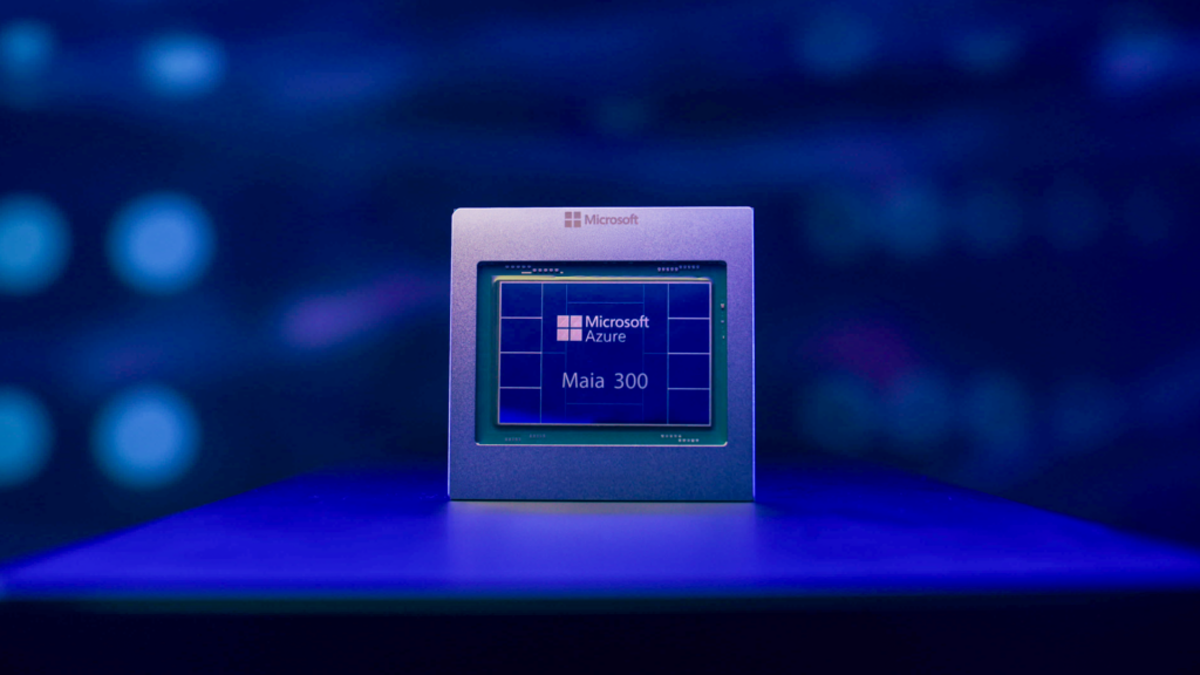


On October 12th, Microsoft disclosed its deployment plans for the new generation of Azure Maia 300. The most eye-catching term in the headline is “terawatts,” but the timeline is even more important: the production deployment of Maia 300 is expected to begin in 2027, with plans to scale up to terawatt levels following that. The current generation, Maia 200, has already been put into production and is used for Copilot related tasks; Microsoft also stated that the use of GitHub Copilot and Foundry will follow later this year. If these stages are mixed together, it’s possible to mistakenly describe a future expansion plan as a fact that has already been implemented today.
For Microsoft, the Maia series is not an isolated chip used to showcase technical prowess, but rather an integral part of the overall design of Azure data centers. Generative AI inference is growing rapidly, and what companies ultimately pay for is not the number of transistors, but rather the power consumed per output, the rack space required, as well as network and operational maintenance costs. Suppliers can continue to purchase external accelerators while developing their own chips in order to configure more suitable systems for different workloads. The significance of Maia 300 must be understood within this multi-source computing power strategy.
From a single chip to the efficiency of an entire cabinet, what is Microsoft really comparing?
The parameters provided by Microsoft include a memory bandwidth of 18TB per second for HBM4, a chip power consumption of 950 watts, as well as a system configuration with 96 accelerators per cabinet and approximately 167 kilowatts of power. High bandwidth is crucial to ensure that data can be delivered to the computing units in a timely manner during large model inference; power and cabinet density determine how the data center will be powered, cooled, and wired. It is easy to assess the peak performance of a single chip, but the challenge lies in maintaining the utilization rate of the entire cabinet of equipment under continuous load, while also ensuring that failures, network congestion, and maintenance do not undermine the theoretical benefits.
According to officials, compared to the leading GPU system they defined, Maia is expected to increase the production of token by 40% per megawatt; compared to Maia's 200, the cabinet throughput target has been increased by seven times. There are at least two limitations that cannot be overlooked: the first is Microsoft's performance expectations for the future system, and the baseline for comparison is set by the company itself; the second is a comparison at the system level across generations and cabinets, not a direct seven-fold increase in the speed of a single chip. Without publicly available complete test conditions, real workload combinations, and third-party retests, these figures are more suitable as design targets rather than universally applicable conclusions in the industry that have already been achieved.
Why is the specification of “per megawatt token” so important? In the past, chip releases often competed based on floating-point operations per second or single-card benchmark scores. Today, cloud providers need to offer enterprises continuous and available inference services. Data center power quotas, access cycles, and peak-valley load patterns collectively limit the upper limit of revenue. Even if the chips themselves are inexpensive, if expensive networks, storage, liquid cooling, or frequent downtime are required, the total cost per unit of output may not be lower. Conversely, a system designed specifically for a fixed set of models and scheduling systems may perform well on certain workloads, but it may not suit the training and experimental needs of all developers.
The pictures of physical chips displayed by Microsoft indicate that the design has reached the hardware stage, but this does not prove that large-scale deployment has been completed. Semiconductor products, from sample chips to reliable production, still need to go through software stack adaptation, yield rate optimization, heat dissipation, power supply, and supply chain verification. There may also be several data center construction cycles between the start of deployment in 2027 and subsequent multi-gigawatt capacity expansions. Clearly stating the planned milestones in reports not only preserves the significance of this investment but also avoids mistaking the roadmap for already delivered computing power.
Self-developed chips are not about 'abandoning GPU', but rather about reassigning the right to choose.
After the release of Maia, a common misconception is that Microsoft will immediately switch from external GPU suppliers. However, the reality is likely to be more parallel: there are significant differences in the needs for training, cutting-edge experiments, general-purpose cloud instances, and large-scale inference, and different hardware has its own advantages. Azure not only needs to support applications that customers have already built on the GPU toolchain but also hopes to migrate its stable, high-volume product loads to more cost-effective systems. Self-developed chips give Microsoft more leverage in negotiations and scheduling, but only if software compatibility and actual operational data keep up can this option translate into financial benefits.
For corporate purchasers, the question to ask now is not whether “Maia 300” is faster than a certain “GPU”, but rather factors such as available regions, service levels, model support, billing methods, and migration costs. “Maia 200” is already running in the “Copilot” environment and can provide real operational feedback for the technical roadmap; “Maia 300” has not yet entered the production phase mentioned in the announcement, so customers cannot schedule its launch date based on future capacity plans. If suppliers report lower unit推理 costs in the future, it is also necessary to verify whether these costs include network, power, depreciation, and fault redundancy, rather than just comparing chip power consumption.
Microsoft's choice to announce this plan now also reflects that the direction of competition in AI infrastructure is changing. The industry is no longer just competing to "who gets more chips first," but also to see who can turn chips, cabinets, networks, models, and applications into economically sustainable services. The parameters of Maia 300 are clear enough to be worth continuous monitoring; however, the real test will come when production and deployment begin in 2027, to see if it can deliver the promised megawatt output under actual loads and transparent conditions. For now, the most accurate assessment is that Microsoft has announced a system roadmap with quantifiable goals, rather than declaring multiple gigawatts of Maia. The Maia 300 cluster is already in operation.
Another easily overlooked aspect of testing is software migration. Replacing chips does not necessarily mean that models will run faster automatically; compilers, operator libraries, monitoring tools, and failover mechanisms all need to be adapted accordingly. For a global cloud provider, if only a few of its models can benefit from these improvements, the scale effect will be limited. However, if in the future more customers can achieve similar efficiency through stable interfaces, then the value of hardware investment becomes clearer. What Microsoft has disclosed so far is its hardware roadmap and internal load planning; it has not yet provided a complete list of products that would allow ordinary customers to directly choose Maia 300 instances. Both reporting and procurement decisions should take this distinction into account.