Beneath the apparent calm of the U.S. stock market, there are turbulent undercurrents. Although the S&P 500 index is less than 1% away from its historical high, the degree of divergence within the market has reached its worst level since the bursting of the internet bubble. Institutional investors are flocking to "safe assets" at a pace not seen since the impact of the COVID-19 pandemic.
According to the latest report by Goldman Sachs' fund flow strategist Lee Coppersmith, the Goldman Sachs Quality Factor (GS Quality Factor) has seen a cumulative increase of over 16% in the past 8 weeks, a trend that has not been observed since the impact of the COVID-19 pandemic in 2020. At the same time, there has been a sharp reversal in the flow of funds towards technology stocks – the technology sector, which had topped the list of net purchases for several consecutive weeks, suddenly turned into the sector with the largest net sales last week, with the long-short ratio falling to the 17th percentile in five years.
Goldman Sachs believes that despite the significant increase in risk aversion within the market, an extremely concentrated market structure has not historically been a bearish signal, and the S&P 500 index is still expected to continue to rise over the next 1 to 3 months. Oil prices and interest rate trends represent the main downside risks at present.
Indices Conceal the Truth: Intra-market Diversification at Its Worst Since the Internet Bubble
The calm facade of the S&P 500 index is masking a deep-seated structural divergence.
Goldman Sachs data shows that the median stock of the S&P 500 components has currently fallen by 16% from its own high, while the index as a whole is still less than 1% away from its historical high. Measured by Goldman Sachs' preferred market breadth indicator, the current market breadth has deteriorated to the lowest level since the bursting of the internet bubble.
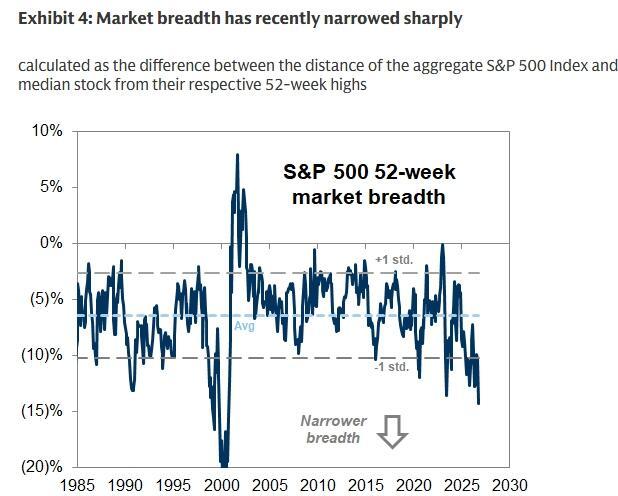
Lee Coppersmith pointed out that the clearest manifestation of this differentiation is the ongoing 'mass exodus of high-quality assets.' Goldman Sachs' quality factor has risen by more than 16% in the past 8 weeks, a rate that usually only occurs during periods when the market is under significant pressure, rather than when the index is hovering at historical highs. 'Below the surface, there is a much greater sentiment of risk aversion than what the index suggests,' he wrote.
Tech stocks see a sharp reversal in capital flows, while industrial stocks welcome the fastest buying momentum of the year so far.
The capital flow in the technology sector has seen a turning point that is of the most notable concern in this round of market trends.
Goldman Sachs Prime data shows that tech stocks led net buying for four out of the previous five weeks, but last week they suddenly turned into the sector with the largest net selling volume, with selling activities on both the long and short sides – there were both long positions being closed and new short positions taken. The long-to-short ratio for tech stocks has dropped to 1.8, which is at the 17th percentile over the past five years. It is worth noting that the total position size in this sector is still at the 97th percentile over the past five years, indicating that the capital stock remains substantial, but the enthusiasm of marginal buyers has significantly diminished.
At the same time, the industrial sector has seen its fastest buying pace since January of this year (+1.8 standard deviations), with almost all of it coming from new long positions. Previously, this sector had experienced net selling for five consecutive weeks. The financial sector also attracted capital inflows, while the software sector exhibited relative strength. Goldman Sachs believes that this is an initial sign that capital is beginning to look for opportunities outside of the mainstream leading sectors, and whether this will evolve into a sustained trend is worth continued observation.
In addition, the essential consumer goods sector saw net selling in seven out of the past eight weeks, with the long-short ratio dropping to the 3rd percentile over the past five years; the biotechnology sector experienced the largest cumulative reduction in total holdings over an eight-week period in more than five years.
The position is extremely light, and historical data supports the index continuing to reach new highs.
Despite a strong sentiment of risk aversion within the market, Goldman Sachs believes that the current position structure actually constitutes potential upward support.
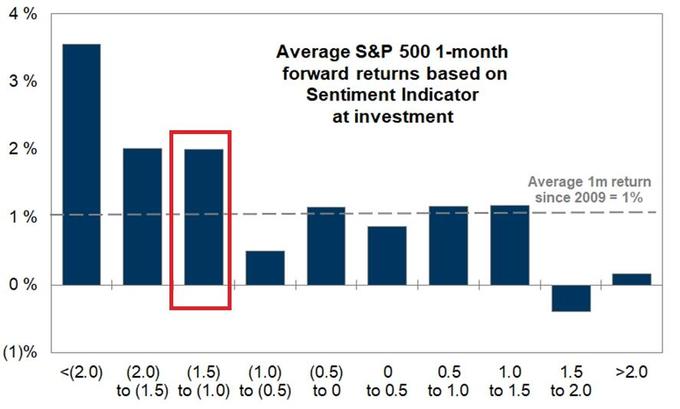
Goldman Sachs' US stock sentiment indicator ( GS US Equity Sentiment Indicator ) currently reads at -1.3, which is within a range where historical forward returns have been relatively impressive. The net leverage ratio of global fundamental long-short funds is at the 60th percentile over the past year (and at the 20th percentile when considering only the US), while the overall net leverage ratio of hedge funds is at the 10th percentile. Although the total position size is still relatively high, there is a clear lack of confidence in directional judgments.
In terms of historical patterns, Bloomberg has recorded 13 instances since 1995 where the index with equal weights of the top ten constituents of the S&P 500 outperformed by more than 8%. In the six months following such periods, the median return for the S&P 500 was +10.1%, and over a 12-month period, it was +19.6%, both of which are higher than the historical medians of +6.9% and +15%. The current performance gap is 855 basis points. Lee Coppersmith indicates that "an extremely concentrated market leadership structure is historically completely compatible with sustained index gains."
Oil prices and interest rates remain the biggest tail risks
Goldman Sachs believes that the key variables restricting further improvement in market sentiment are still oil prices and interest rates.
After the yield on 10-year U.S. Treasury bonds broke through 5%, Goldman Sachs' interest rate team believes that the asymmetry in yields has shifted downward, and interest rate volatility has also begun to decline. For the U.S. stock market, a significant rebound in Treasury bonds is not necessary; merely a stabilization of interest rates is sufficient to provide support.
However, oil prices and geopolitical situations constitute significant interfering factors. Goldman Sachs' commodities team expects Brent crude oil to fall back to $90 per barrel in December and average $80 in 2027, but they also emphasize that the recent risks are clearly tilted upwards. There is still a risk premium of over $20 per barrel embedded in current oil prices, and the risk of supply disruptions remains; thus, oil prices represent the greatest potential threat at present.
In addition, Goldman Sachs has also noticed a signal in the options market: NVIDIA's implied volatility has dropped to a low level not seen since before the COVID-19 pandemic. As the world's largest company by market value and a core underlying asset for AI trading, Goldman Sachs believes this presents an "opportunity right in front of our eyes" for investors who wish to hedge against the risk of closing AI trades or the risk of quality factor crowding.