IT News on October 13th: Market research firm CounterPoint Research published a blog post yesterday (October 12th) stating that due to ongoing memory shortages affecting shipments from most OEM manufacturers worldwide, global smartphone shipments in the third quarter of 2026 decreased by 20% year-on-year, reaching the lowest level for a third quarter since 2012.
The report indicates that the prices of DRAM memory and NAND flash memory have continued to rise, exacerbating the cost impact on storage chips in the third quarter. This has led to a significant increase in the proportion of DRAM and NAND in the material costs ( BOM ) of smartphones. The institution estimates that in the foreseeable future, the shortage of memory supply will further expand and will significantly disrupt the shipment plans of most OEM smartphone manufacturers.
In terms of pricing, as the prices of DRAM memory and NAND flash memory have risen, the manufacturer of the OEM smartphone has had to pass on the increased component costs to consumers. Since 2026, the global retail price of smartphones has risen by 20%, and the average market price (ASP) has also increased accordingly, further increasing the purchasing pressure on price-sensitive consumers.
In terms of brands, Samsung maintains its position as the global leader with a market share of 23%, although shipments decreased by 3% year-on-year. The Galaxy Z Fold8 series saw strong demand in the early stages, and a stable supply of components supported the sales of its mid-range A series in emerging markets.
Apple's market share reached 22%, breaking through 20% for the first time in the third quarter; however, its shipments decreased year-on-year. The lack of entry-level iPhone models led to lower supply to channels in the month of launch compared to last year's iPhone period when the entire series was on the market. Nevertheless, iPhone and Pro performed strongly in the Chinese and Indian markets in iPhone and Pro.
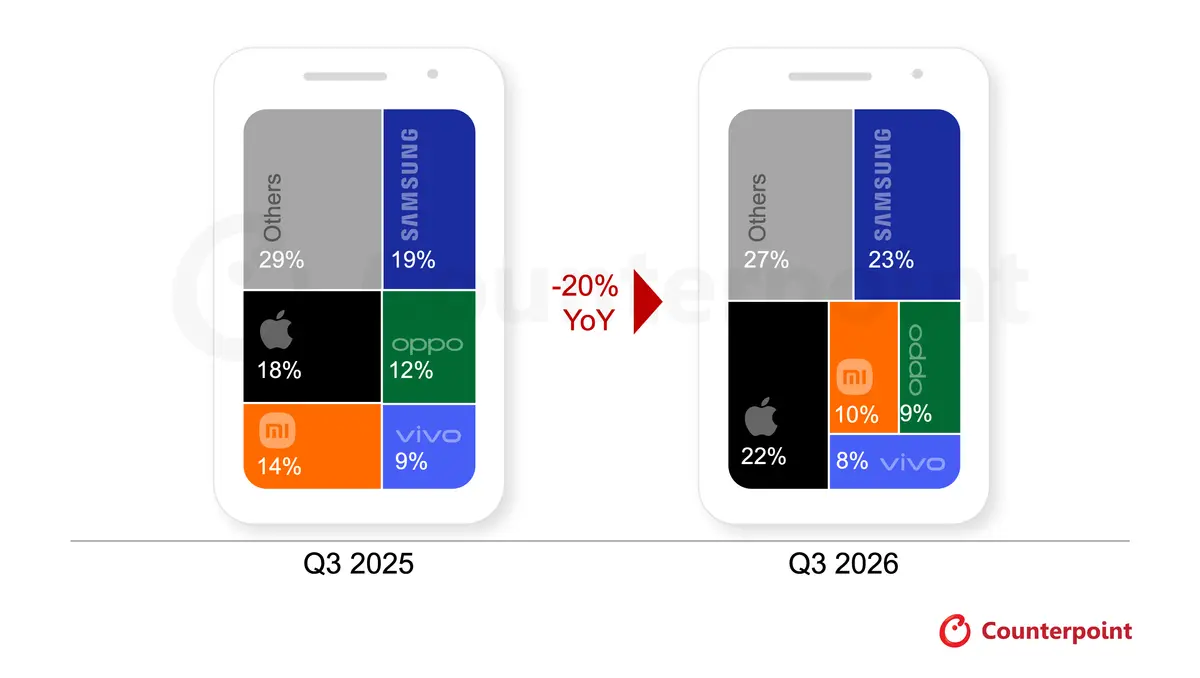
Xiaomi's shipment volume decreased by more than 30% year-on-year, and its market share dropped from 14% to 10%. The company has reduced investment in low-priced products and non-core overseas markets, increased the average selling price, and tightened its shipment plans; both OPPO and vivo saw a decline in shipment volumes of over 20%, with market shares of 9% and 8% respectively.
IT's home, with reference addresses attached: Global Smartphone Shipments Hit, New Low, with 20%, YoY Decline, Lowest, in 14, Years, as, Continued Memory Constraints Tighten Supply.