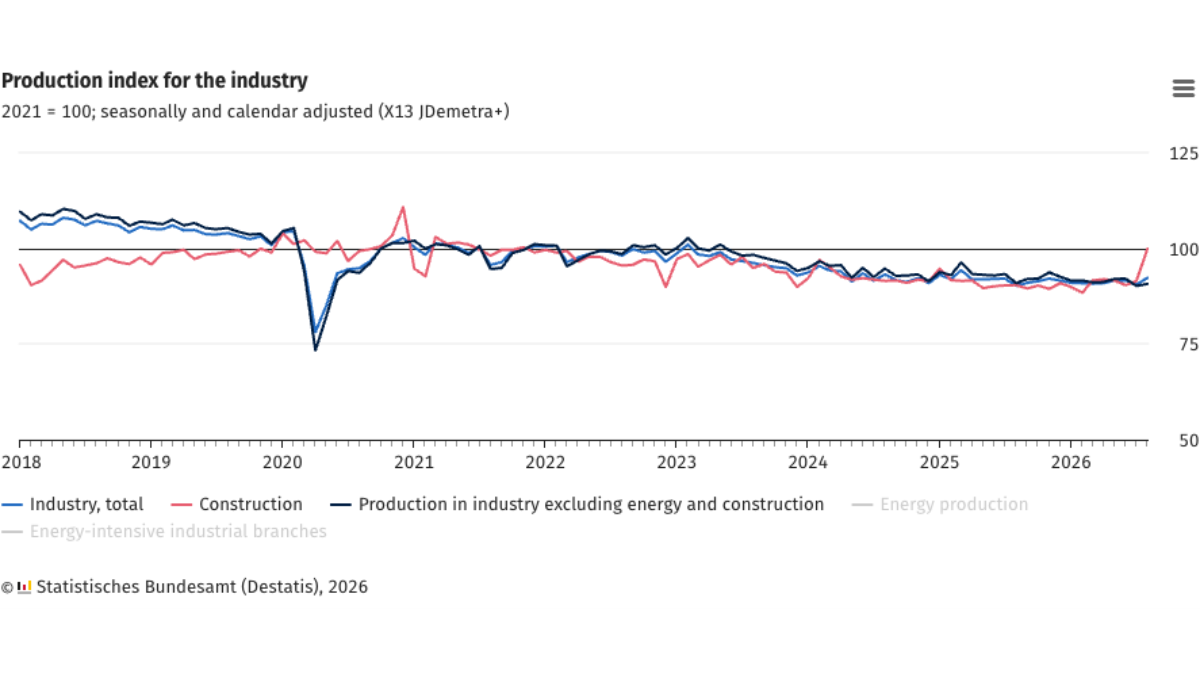


Preliminary data released by Germany's Federal Statistical Office on October 7th showed that industrial production in August increased by 2.0% on a month-on-month basis after excluding price, seasonal, and calendar factors. This figure is much more favorable than the revised decrease of 1.2% in July, and it leads one to conclude that "factories have returned to growth." However, just a day prior, the same institution reported that new orders in manufacturing in August decreased by 10.6% on a month-on-month basis. If only one of these indicators were used to headline the news, it would suggest that German industry is experiencing both a strong rebound and a rapid decline simultaneously. These two figures are not necessarily contradictory: one reflects the actual production completed this month, while the other reflects future demand that has been newly received, and they affect different aspects of the industry, cover different sectors, and have different implications for large orders.
The year-on-year comparison of production data also needs to be considered separately. In August, industrial production increased by 2.3% after calendar adjustment compared to the same period last year; when looking at the combined figures for June to August, which are less affected by fluctuations in a single month, it was 0.4% higher than the previous three months. These figures support the claim that there was a recovery in August, but they are not sufficient to declare that a sustained expansion has been established. The statistical bureau has clearly marked these as preliminary results, and the month-on-month data for July has also been revised from a decrease of 1.1% to a decrease of 1.2%. After future surveys and the completion of administrative data, the figures for August itself may still be revised, so readers should not regard the decimal places as an unchangeable conclusion.
Production and orders refer to different times.
Production statistics record the products that have already been manufactured by the factories, which may come from orders placed months ago, inventory replenishments, or project deliveries. Order statistics, on the other hand, are more indicative of the workload over a subsequent period and are also affected by the timing of contract signings, as well as large-scale orders for aircraft, ships, railway vehicles, etc. The main reason for the 10.6% decline in new orders in August was the drop in "other transportation equipment" orders after a particularly high base in July. Such orders decreased by 61.5% month-on-month in August, whereas in July they had more than doubled due to large contracts. Excluding large orders, new orders in August only decreased by 0.1%, showing a completely different trend from the overall decline. To interpret the 10.6% decrease as a sudden cessation of purchasing by all factory customers would ignore the most critical aspect of these statistics.
Even excluding large orders, it cannot be said that demand is without concerns. A comparison of orders over three months shows that from June to August, the total was 1.3% higher than in the previous three months, but after deducting large orders, it actually decreased by 2.6%; domestic orders fell by 17.3% in August, and foreign orders fell by 5.4%. Orders for capital goods decreased by 15.3%, intermediate goods by 2.6%, and consumer goods by 7.3%. These sub-items indicate that broader demand still deserves vigilance; however, the intensity of the "cliff-like decline" has been magnified by a few large contracts. The rebound in production during the same month may be due to digesting existing projects, and whether growth will continue in the future will depend on new orders, unfinished orders, and the monthly utilization of production capacity.
Another dimension that can easily cause confusion is turnover. According to the statistical bureau, in August, the actual turnover of manufacturing after adjusting for prices, seasonality, and calendar effects showed a month-over-month increase of 0.0%, while year-over-year it increased by 0.9% after calendar adjustments. Production, turnover, and orders have different timing points for recording and statistical scopes, so it is not reasonable to expect them to follow the same trend every month. A batch of equipment may be produced in August, but orders may have been received earlier, and invoices issued later; exports and domestic sales may also occur in different months. Macro reports present these figures side by side to cross-check each other, rather than insisting on consistency. The fact that industrial production is increasing while orders are declining actually provides an opportunity to observe whether this weakening trend will be transmitted to output in the future.
What more evidence is needed for a one-month rebound?
To determine whether German industry has truly emerged from a weak position, at least the next few sets of data need to answer three questions. First, whether the growth is spread across multiple industries, or whether it is driven by a few automotive, equipment, or energy projects; second, whether the new demand after excluding large orders can become stable; third, whether the three-month average will continue to rise, rather than relying solely on a low base in one month. In August, industrial production increased by 2.3% year-on-year and by 0.4% month-on-month, indicating improvement, but the magnitude, sustainability, and structure still need to be verified. On the contrary, if order data continues to be weak, it does not necessarily mean that production will turn negative next month, as the backlog of orders will keep factories operating for some time.
German data must also be considered in conjunction with the external environment. Energy costs, trade demand, the transformation of the automotive industry, and corporate investment decisions all affect production and new orders, but the statistics for this period alone cannot determine a definitive causal sequence for these factors. For example, the concentrated signing of large orders in July was sufficient to change the overall index for that month, but it does not imply that trade or industrial policies have changed by the same extent. News reports should first clarify the verifiable figures and methodologies before discussing possible transmission chains, rather than using month-over-month comparisons to prove the industrial direction for an entire year.
For those who follow the European economy, the practical significance of these contrasting indicators is "improved near-term activity, but subsequent demand still needs to be confirmed." The rebound in production in August indicates that factories had more actual production that month; however, the significant drop in total orders includes the effect of large orders, but the trend over the three months after excluding these large orders remains weak. Future releases will test whether this improvement continues, and it is also possible that current conclusions may be revised. Until then, describing 2.0% as a full recovery or 10.6% as a collapse in orders for all enterprises would both exceed the range supported by official data.
Enterprises and investors should also note that "level" and "growth rate" are not the same thing. After several months of weakness, a 2.0% increase in one month only indicates a relative improvement compared to the previous month and does not necessarily mean that output has returned to earlier high levels. Conversely, a double-digit decline in orders due to large orders does not necessarily mean that the actual workload of all production lines has also decreased by the same amount. If production continues to recover in the next period and regular orders also improve, then the judgment of recovery will be more substantiated; if production weakens again and orders excluding large orders continue to decline, this rebound is likely to be just a temporary fluctuation. The initial official figures provide a starting point for observation, not a final conclusion.