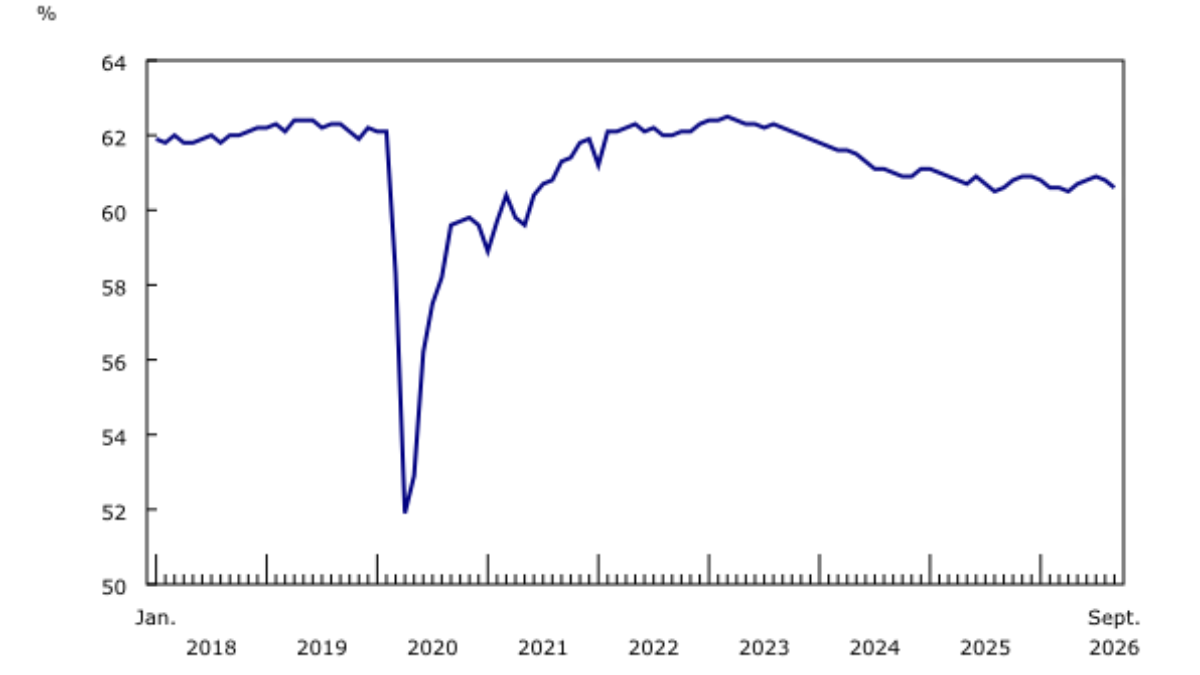


The Canadian Statistics Agency released its September labour force survey on October 9th, presenting a less-than-encouraging set of figures to the market: the number of employed persons decreased by 68,000 compared to the previous month, representing a month-on-month decline of 0.3%; the employment rate fell to 60.6%, while the unemployment rate rose by 0.1 percentage points to 6.5%. This is the second consecutive month of declining employment, following a decrease of 42,000 in August. If one looks solely at the unemployment rate, the change may seem modest; however, when considering job vacancies and labour participation rates, the cooling of the labour market is more evident. Macroeconomic analysis cannot simply pick one of these three indicators as the most favorable.
This set of data is an estimate from a household sampling survey conducted in mid-September and does not represent complete administrative records for individual job positions within companies. The Statistics Bureau also reminds that while monthly data is adjusted for seasonality, wage figures are not seasonally adjusted; therefore, data from different sources cannot be directly added together. In September, the average hourly wage increased by 2.3% compared to the same period last year, reaching C$37.64, which is slightly faster than the 2.0% increase in August. The rise in wage growth occurring alongside weakening employment trends is not sufficient to prove that inflation will accelerate further, nor can it simply indicate that corporate demand has completely collapsed. It seems more like a turning point that needs to be analyzed by age, industry, and region.
Where is the concentration of job cuts?
In September, there was a decrease of 35,000 full-time jobs and 33,000 part-time jobs, with each accounting for nearly half of the total reduction. Employment among youths aged 15 to 24 decreased by 48,000, representing a decline of 1.8%; employment among women aged 25 to 54 decreased by 28,000, with a decline of 0.4%. The Bureau of Statistics noted that youth employment has been on the decline for two consecutive months, with a cumulative reduction of 67,000 jobs, which offset some of the growth seen from April to July. However, the youth unemployment rate remained relatively stable at 13.0% that month. One reason for this is that fewer youths are entering the labor market. Therefore, the fact that "the youth unemployment rate did not rise" does not mean that youth employment is not a problem; changes in the denominator can often alter the apparent conclusions.
In the industry, there is a shortage of 35,000 jobs in education services, 23,000 in healthcare and social assistance, and 13,000 in manufacturing; however, other service industries have seen an increase of 17,000 jobs. Education services had remained relatively stable for seven consecutive months before showing a noticeable decline in September. Healthcare and social assistance experienced their first month-on-month decrease since December 2022, but they still have 93,000 more jobs than a year ago. It would be inaccurate to describe a single monthly decline as a long-term trend of recession, especially in an industry that has contributed significantly to new employment over the past year. Manufacturing added 22,000 jobs in August but then saw a reduction of 13,000 in September, reminding readers not to equate short-term fluctuations in a single month with a definite trend in factory orders or production.
Regional differences are also evident. Quebec saw a decrease of 49,000 jobs, British Columbia by 20,000, and Manitoba by 4,400; Alberta, on the other hand, added 23,000 jobs. Since the beginning of the year, Quebec has seen a cumulative decline of 130,000 jobs, with the unemployment rate rising to 6.0% in September; Alberta's unemployment rate, however, dropped to 6.4%. The national average obscures the different trends in resource provinces, manufacturing regions, and large cities. This regional structure may be more useful than the national unemployment rate (which is accurate to one decimal place) for analyzing corporate hiring, consumer spending, and housing demand, but it still needs to be confirmed over subsequent months. It is not possible to infer the entire industrial chain based on a single regional map.
In September, the employment rate dropped by 0.2 percentage points to 60.6%, which is more worthy of continuous monitoring than the rise in the unemployment rate. The employment rate is the proportion of employed people among those aged 15 and above and is less affected by the definition of "whether one is currently looking for a job." Meanwhile, the labor participation rate fell by 0.2 percentage points to 64.8%, with the statistical bureau stating that this is the lowest level since December 1997, excluding the special period of 2020. The unemployment rate did not rise significantly, partly due to changes in the number of job seekers rather than stable job demand. The report indicates that the job-seeking rate is 30.6%, lower than the 32.8% from a year ago and the average level from several years before the pandemic, suggesting that the speed at which unemployed individuals find new jobs is slowing down.
Aging explains part of the participation rate, but it cannot account for the pressures throughout the entire cycle.
The statistical bureau specifically discussed the population age structure. On September, the population aged 65 and above accounted for 23.2% of the population aged 15 and above, which is higher than the 20.5% in September 2019; the average participation rate among older age groups is lower. If the population age composition were to remain unchanged from 2019, the participation rate in September 2026 would be virtually the same compared to the previous year, but in reality, it decreased by 0.4 percentage points. This counterfactual calculation indicates that long-term aging is an important factor contributing to the decline in participation rates. However, this does not mean that the reduction in job opportunities that month was merely a mechanical result of the population structure: changes in the participation rates of young people, women of core working ages, and certain industries over time are still real short-term signals.
For policymakers and investors, the next question is not whether “6.5%” will immediately change interest rates, but whether this round of employment decline will continue to spread. Employment surveys can have sampling errors, and monthly data may also be revised. What is worth comparing is whether employment rates, job-seeking success rates, total working hours, private sector hiring, and wage growth rates will change in the same direction over the following months. In September, public sector employment decreased by 70,000, while the private sector remained roughly the same as the previous month; this composition could also lead to different interpretations for future months. If the temporary adjustments in the public sector end while the private sector weakens, the apparent national employment numbers may remain similar, but the economic implications would have changed.
What can be confirmed so far is that in September, employment in Canada declined for the second consecutive month, with the unemployment rate rising slightly. The youth population and certain service industries are under pressure; at the same time, the year-on-year growth rate of wages is slightly faster, but this is not consistent across different regions. The labor force survey conducted by the statistics bureau provides timely evidence to help determine the direction, but it is not a forecast of future consumption, inflation, or central bank decisions. Only by including the denominator, industries, and time frames in the report can we get a more accurate picture of the situation than just stating "employment has collapsed" or "unemployment rate is stable."
Another point of verification is whether the recruitment plans announced by companies in the coming months can be corroborated by the household survey data. The decline in the number of employed individuals may be due to a temporary lack of replacements after employees left their jobs, or it could result from voluntary layoffs. These two processes have different impacts on consumer confidence. The unemployment rate reported by the statistical bureau for that month was 0.7%, which is close to the average rates from a year ago and before the pandemic; this data does not support the claim that a nationwide wave of layoffs has already occurred based on a single month's figures. By considering the net changes in job positions, the unemployment rate, and the job-seeking rate together, what becomes apparent is a cooling of recruitment and re-employment activities, rather than a simultaneous and dramatic deterioration of all employment risks.