


A stock traded at a price-earnings ratio of 20 times may seem expensive or cheap, depending on how much return investors can obtain elsewhere.
Earnings yield makes this comparison easier. It shows how much profit a company generates each year relative to its stock price.
The formula is very simple:
It is also the reciprocal of the price-earnings ratio.
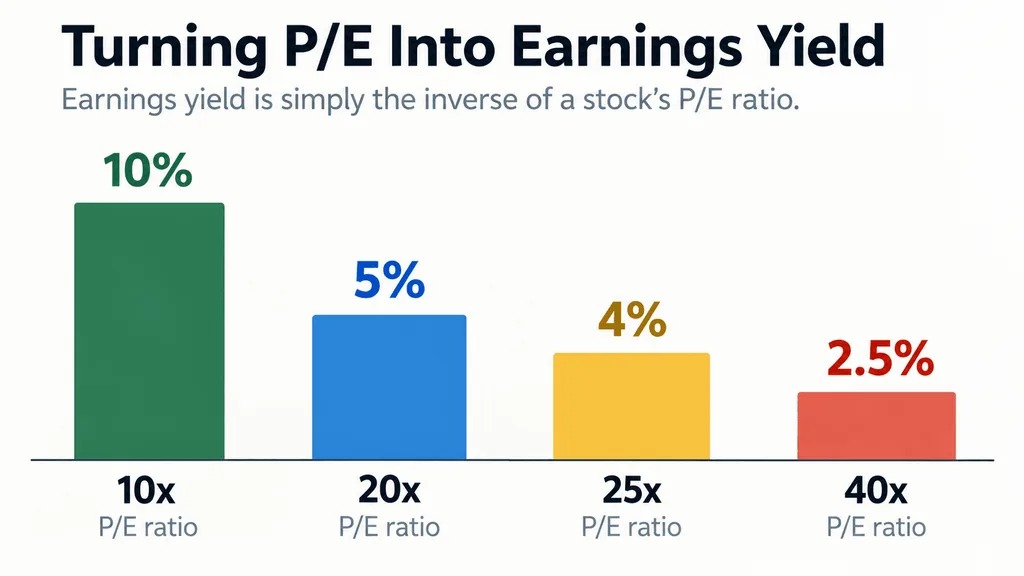
A stock that is traded with a 20x profit target has a profit yield of 5%. When traded with a 25x profit target, the yield is 4%. When traded with a 10x profit target, it is 10%.
This does not mean that investors will actually receive this portion of the profit yield in cash. It is a valuation indicator, not a dividend.
Why compare it with the yield of government bonds?
Government bonds serve as a useful benchmark because they offer returns stipulated in the contract, and they come without the commercial risks associated with stocks.
The U.S. Treasury Department publishes the current interest rates for various maturities on the yield curve through its official interest rate data.
Assuming the forward P/E ratio for the S&P 500 is 20 times, this implies a profit margin of 5%.
If the yield on 10-year government bonds is only 2%, then stocks still offer higher returns despite taking on more risk. However, if the yield on government bonds rises to 5%, this simple advantage in returns disappears.
This is also why an increase in Treasury bond yields can put pressure on stock valuations, especially for technology stocks and growth stocks that have higher valuations.
Higher bond yields have raised the threshold for stocks.
Stocks and government bonds cannot be directly exchanged for each other.
This means that the gap between the profit yield and the bond yield can help investors determine how much compensation they have received for taking on equity risk.
A simple comparison might look like this:
As the interest rate spread narrows, bonds become relatively more competitive.
This helps to explain why changes in the yield on government bonds can affect the entire stock market, even when corporate profits remain unchanged.
Is the profit yield equivalent to the equity risk premium?
Not entirely equivalent.
Subtracting the yield of government bonds from the return on equity can sometimes be used as a rough valuation shortcut, but the true equity risk premium is much more complex.
Professional models may take into account expected earnings growth, dividends, share repurchases, as well as future cash flows. They also consider factors such as the yield on government bonds itself, which includes expected interest rates and term premiums.
Adrian Cole
Adrian Cole has been engaged in financial market reporting for over 6 years, with a focus on cryptocurrencies, stocks, and macroeconomic trends. He tracks Bitcoin, major altcoins, the U.S. stock market, interest rates, commodities, as well as data points that drive market changes. Over the years, he has written hundreds of market updates and analysis articles, with an emphasis on price trends, investor sentiment, and the connections between traditional finance and digital assets.