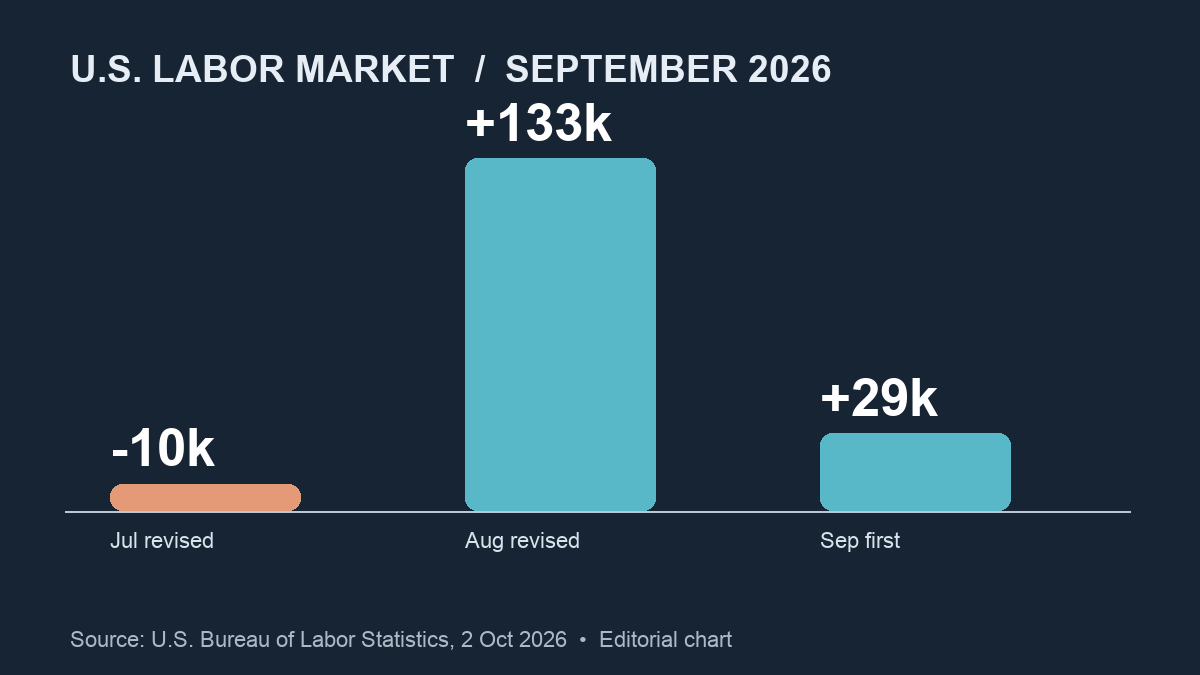


The U.S. labor market does not present figures that indicate a “sudden collapse,” but it also cannot be considered strong. According to the employment report for September released by the U.S. Bureau of Labor Statistics on October 2, non-farm employment increased by 29,000 people, and the unemployment rate was 4.2%. Both indicators showed little change from the previous month in statistical terms. What is more noteworthy is that the total non-farm employment figures for July and August were revised downward by 60,000; in September, the average hourly wage in the private sector only increased by 0.1% on a month-over-month basis. With the unemployment rate still within a narrow range, it is easy to overlook the fact that the pace of job creation by companies has become quite slow.
This report consists of two sets of surveys: one survey of businesses that estimates the number of jobs, industries, working hours, and wages; another survey of households that determines whether a person is employed or unemployed. The increase of 29,000 non-farm jobs and the unemployment rate of 4.2% are not derived directly by dividing one sample by the other, nor should these slight changes be combined to form a precise causal narrative. The Bureau of Labor Statistics will also revise the data as new information becomes available and with seasonal adjustments; the downward revision for the first two months of this period serves as a reminder to readers not to take the initial figures as the final conclusion.
Job growth has slowed down, but healthcare remains one of the few sectors that continue to need additional staff.
In September, the non-farm employment increase was 29,000, which is lower than the average monthly increase of 45,000 over the previous 12 months. The report indicates that there were no significant changes in employment across all major industries that month, and there was no sudden large gap in any particular sector. The healthcare industry continued to add 17,000 jobs, but this was also below the average monthly increase of 33,000 over the previous 12 months; outpatient care added about 13,000 jobs, hospitals added about 12,000 jobs, while nursing and residential care facilities saw a decrease of about 9,000 jobs. The fact that there are both increases and decreases within a single industry suggests that "healthcare is hiring" does not mean that every sub-market within that industry is thriving.
The construction industry added about 11,000 jobs, while the manufacturing industry added around 9,000. However, the statistical bureau still categorizes both as having "little change." The manufacturing sector has a total of 72,000 more jobs than its recent low point in December 2025, but this overall increase over a longer period does not erase the slowdown in September. Financial activities saw a reduction of about 7,000 jobs that month, which is 129,000 less than the recent high point in May 2025, with the insurance and related industries accounting for the majority of this decrease. There is both cyclical demand and internal adjustments within these industries; a single monthly report is not sufficient to determine which jobs have been replaced by technology and which are part of general contraction.
The report also revised the figure for July from an increase of 21,000 to a decrease of 10,000, and for August from an increase of 162,000 to 133,000, resulting in a total reduction of 60,000. The negative figure for July indicates that the situation at that time was worse than initially reported, and although there was still a noticeable increase in August, the magnitude was smaller. After incorporating these revisions, the employment growth in recent months appears to be more gradual and fluctuating, rather than a smooth linear recovery. The Bureau of Statistics explained that the monthly revisions are due to subsequent reports from enterprises and recalculations based on seasonal factors, so the figures for next month, September, may also change again.
Readers should also note that "increasing job positions" and "increasing the number of employed people" are not the same concept. Corporate surveys are counted by job position, so if a person has two jobs at the same time, it may correspond to two job positions; household surveys are counted by person. It is not uncommon for the short-term trends to not be completely consistent due to different sampling methods, estimation techniques, and revision processes used in these surveys. To determine a trend, one should consider job positions, unemployment rates, and participation rates over several months, rather than selecting the data that best supports a particular viewpoint on any single day.
A lack of a significant spike in unemployment rates does not mean that the pressure on those looking for work has not increased.
A household survey shows that in September, the number of unemployed people was approximately 7.1 million, with an unemployment rate of 4.2%; since March, this rate has fluctuated between 4.1% and 4.3%. The labor participation rate is 61.8%, and the proportion of employed population is 59.2%, which also did not change significantly that month. Together, these figures indicate that the overall situation has not deteriorated sharply. However, stability in the overall numbers allows for a reduction in job recruitment, a slowdown in re-employment after leaving jobs, and some people delaying their entry into the labor market. For job seekers, "the unemployment rate not rising" does not mean that there are as many job opportunities as there were a year ago.
The number of long-term unemployed individuals is approximately 1.9 million, accounting for about 27.1% of the total unemployed population; around 4.5 million people are forced to work part-time due to economic reasons, and there are another 5.8 million who are not part of the labor force but express a desire to work. These last two groups cannot be directly added to the official unemployment figures: part-time workers are already counted as employed, and those who wish to work but have not actively sought employment recently do not meet the definition of unemployed. Adding these different groups together to create a more alarming "real unemployment rate" can mislead readers; ignoring them, however, would underestimate the frictions in the labor market.
Wages also present another aspect. In September, the average hourly wage for all employees in the private sector rose to $37.81, an increase of 5 cents from the previous month, representing a 0.1% growth, and a 3.0% increase compared to the same period last year; the average weekly working hours remained at 34.4 hours. Although wages have increased year-on-year, the monthly increase is relatively modest, and there has been no significant expansion in working hours. Wage data are nominal values, and purchasing power also depends on changes in prices; therefore, it is not appropriate to conclude that families' actual incomes have improved merely based on an increase in hourly wages. The experiences of different income groups are likely to vary more significantly.
The market often directly interprets employment reports as the next interest rate decision, but policy judgments also need to take into account inflation, subsequent revisions, and other economic data. The September report supports a more limited set of conclusions: there are fewer new jobs created, figures from the past two months have been revised downward, the unemployment rate remains within a narrow range, and the monthly wage growth is not fast. The next step is to observe whether this slow pace of hiring continues, as well as whether there are consistent changes in the number of unemployed people and working hours. Until then, it would be premature to claim that a full recession has been confirmed with 29,000 new jobs, nor should the stable unemployment rate of 4.2% be used to mask the weakness in new job creation.