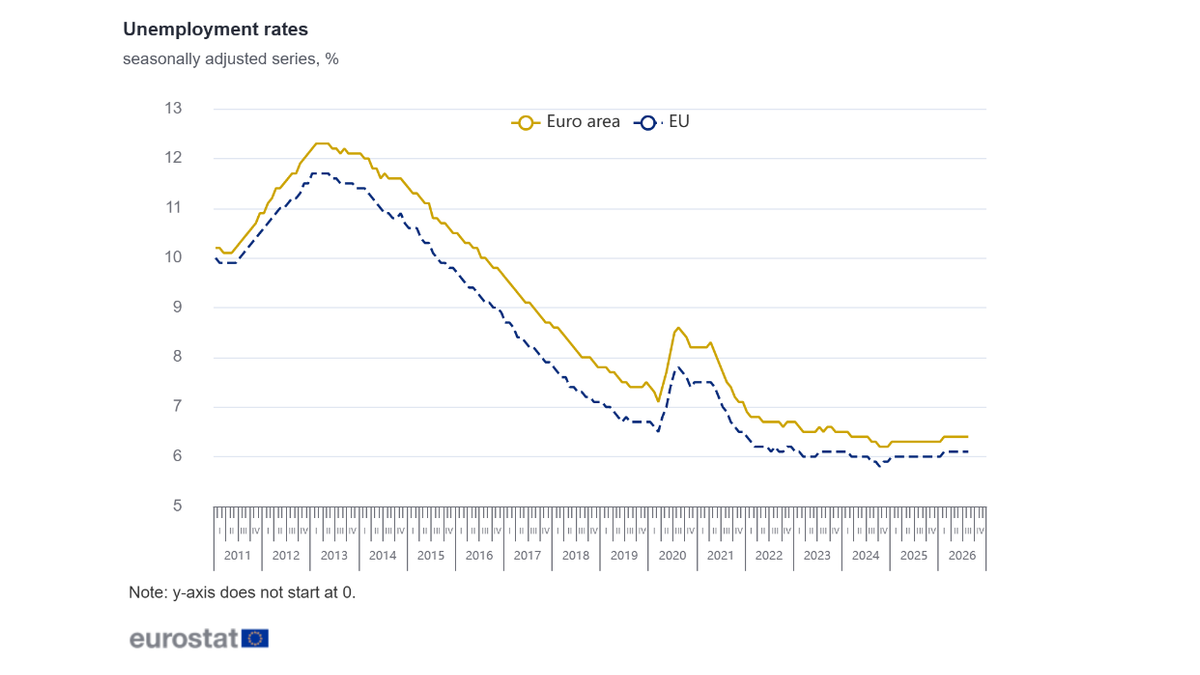















Data released by the European Statistical Office on October 1st showed that the seasonally adjusted unemployment rate in the eurozone in August 2026 was 6.4%, unchanged from July, and slightly higher than 6.3% a year earlier; across the European Union as a whole, it was 6.1%, also unchanged month-on-month, but higher than the 6.0% of the same period last year. On the surface, it seems that the job market has stagnated. However, another set of figures reminds readers that the estimated number of unemployed people in the eurozone is 11.357 million, an increase of 26,000 from July; the number of unemployed people in the EU is 13.6 million, an increase of 12,000 month-on-month. The fact that the rates remain unchanged does not mean that no one has joined or left the ranks of the unemployed.
The unemployment rate is the proportion of the unemployed population to the total labor force. Both the numerator and denominator can change, and since numbers are usually rounded to one decimal place, it is not contradictory for the number of unemployed to increase while the reported rate remains the same. When reporting that "6.4% remains unchanged," it is important to clarify this statistical methodology; otherwise, readers may mistakenly assume that the employment situation has remained static. The data released here is for August and does not represent the recruitment decisions made by companies in October.
The youth unemployment rate is yet another facet of the overall situation.
In August, the number of unemployed youths under the age of 25 in the EU was approximately 2.973 million, and in the Eurozone it was around 2.391 million. The youth unemployment rate in the EU rose from 15.3% in July to 15.4%, while in the Eurozone it decreased from 15.1% to 15.0%. The overall unemployment rates in both regions remained relatively stable, but the figures for youths showed different trends. The youth unemployment rate does not mean that 15% of all young people are unemployed; the denominator refers to young people who have entered the labor market, are currently working, or are seeking employment, and not to the entire population of the same age group, which includes all students. A slight misstatement in the wording can lead to an exaggeration or distortion of the situation.
Young people are more susceptible to the impact of entry-level positions, internship opportunities, and industry cycles. Even if large companies do not carry out mass layoffs, simply reducing the recruitment of new employees can significantly increase the difficulty for graduates to find jobs. Therefore, it is possible for the overall unemployment rate to remain low while the initial employment experience deteriorates. To determine this, it is also necessary to consider job vacancies, employment rates, and labor participation rates, rather than relying solely on the unemployment rate figure.
The overall female unemployment rate in the EU is 6.4%, and that for men is 5.9%, both remaining unchanged from the previous month; in the Eurozone, the rates are 6.7% for women and 6.2% for men. These differences cannot be automatically attributed to a single policy or industry, as the population structure, labor participation, and industry distribution vary from country to country. The news significance of this lies in reminding the market that macro-level ratios mask group disparities, and more detailed data is needed when formulating training and recruitment programs.
Cross-country comparisons should also be approached with caution. The eurozone consists of member states that use the euro, while the European Union includes other member states as well. The unemployment rates in these two regions cannot be directly interpreted as two different methods of measuring the same group of people. Differences in industry structure, seasonal variations in tourism, immigration flows, and labor systems among countries mean that seasonal adjustments can reduce regular fluctuations, but they cannot eliminate all short-term noise. If readers wish to compare a particular country with the regional average, they should examine the country's trend over several consecutive months.
What does stable data mean for policy?
For the European Central Bank, a unemployment rate of 6.4% does not indicate a sudden deterioration in the labor market, but it also does not provide evidence that wage pressures have disappeared. Inflation, wage negotiations, labor productivity, and economic growth will all together determine the next steps in policy. The unemployment rate is a lagging indicator: companies may first reduce overtime and new hiring before considering layoffs. A stable reading does not preclude an economic slowdown in the future.
The statistical bureau adopts the definition provided by the International Labour Organization: Those considered unemployed must be without a job, have actively sought employment in the past four weeks, and be able to start working within the next two weeks. This definition facilitates cross-country comparisons, but it also means that those who have stopped looking for work or those who wish to work more hours but cannot find such opportunities may not be included in the unemployment rate figures. The European Union Statistical Office also provides additional indicators of the labor market; to understand whether it is difficult to find a job, it is necessary to consider both underemployment and labor participation rates together.
The number of unemployed people in the EU increased by 348,000 year-on-year, while in the eurozone it increased by 267,000. Although changes in numbers are more intuitive when presented as percentages with one decimal place, they still need to be considered in conjunction with changes in population and labor force size. For businesses, a stable regional total indicates that there has been no abrupt change in the hiring environment; for job seekers, especially young people and those from specific regions, the average figures may not reflect their individual experiences.
The next monthly release is scheduled for October 30th. By then, readers will need to see whether the increase in new hires continues, whether the youth unemployment rate continues to diverge, and whether subsequent economic data supports recruitment efforts. The most cautious conclusion at present is that the unemployment rates announced by the Eurozone and the European Union in August remained the same as in July, although the number of unemployed persons increased slightly. The employment pressure on young people still deserves special attention. This is one piece of evidence that the labor market still has resilience, but it is not proof that it is easy for everyone to find a job.
The unemployment rate can also be affected by statistical revisions. As more complete survey data becomes available, the estimated numbers and rates for the previous months may be adjusted. Therefore, it is best to use the same set of data over time when analyzing trends, rather than simply subtracting today's figures from the older versions reported by the media last year. Especially when the change is only 0.1 percentage points, consistency in methodology is more important than verbal descriptions of a "rise" or "fall." A stable unemployment rate is worth noting, but to determine whether the labor market is truly weakening, we need to look at continuous evidence over the coming months.