














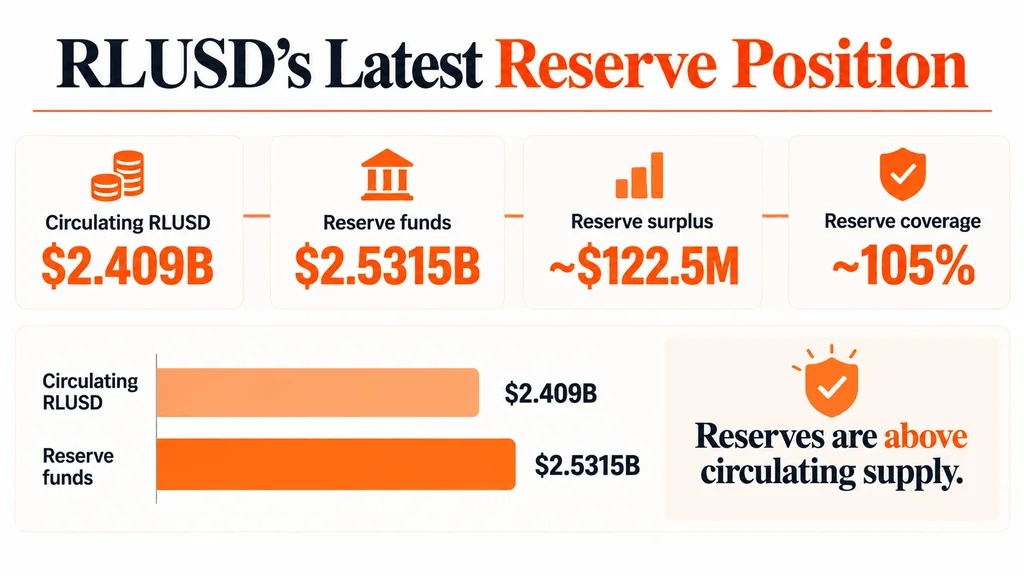
This milestone continues the rapid expansion momentum of RLUSD. Just in August this year, RLUSD surpassed $2 billion, and now this stablecoin is increasingly becoming an important part of the institutional finance strategy of Ripple.
RLUSD Has Increased by Over $400 Million After Breaking Through $2 Billion
RLUSD crossed the $2 billion mark in late August, which means that its circulating supply has increased by over $400 million in just over a month.
Previously, RLUSD surpassed the $2 billion milestone, which has placed it among the faster-growing regulated US dollar tokens.
The issuers of RLUSD, Standard Custody and Trust Company, are regulated by the New York State Department of Financial Services. Ripple also releases an audit report every month, prepared by independent certified public accountants, which covers the circulating supply and reserve assets.
RLUSD is transcending its mere role as a payment tool.
What's more noteworthy is what Ripple is building around these supply volumes.
Today, RLUSD is running in multiple blockchain environments, and its role is also expanding to include payment systems, tokenized assets, and credit markets. Recent progress surrounding RLUSD, FXRP, and lending infrastructure indicates that this stablecoin is becoming part of a broader institutional liquidity system, rather than just a payment token.
Its distribution is also becoming increasingly multi-chain. The Ethereum network currently holds approximately $1.38 billion of RLUSD, while on XRPL it is around $1.03 billion; after the scales of the two networks alternated several times earlier this year, Ethereum has now expanded its lead. The migration of supply between Ethereum and XRPL reflects that Ripple is building liquidity across ecosystems, rather than concentrating issuance on a single network.
Marcus Hale
Marcus Hale is an author who focuses on cryptocurrency and financial markets, with his reporting covering Bitcoin, Ethereum, digital assets, regulation, ETF, as well as institutional adoption. His work focuses on driving market developments, investor trends, and shaping the broader forces of the crypto economy.