


Tesla's global delivery volume in the third quarter exceeded analysts' expectations, providing a stabilizing signal for this electric vehicle manufacturer during a period of market pressure, but it still saw a year-on-year decline.
Tesla announced on Friday that it delivered a total of 486,532 cars globally in the third quarter, exceeding analysts' average forecast of 463,761 cars. There was a noticeable recovery in new car registrations for Tesla in Europe, while sales in the Chinese market fell year-on-year.
The delivery data was released during a difficult period for Tesla, which has experienced declining sales and weak stock prices. Intensifying competition, along with persistent low demand in the United States, continues to put pressure on the company. Meanwhile, CEO Elon Musk is focused on shifting the company's focus towards cutting-edge areas such as artificial intelligence, autonomous driving, and humanoid robots.
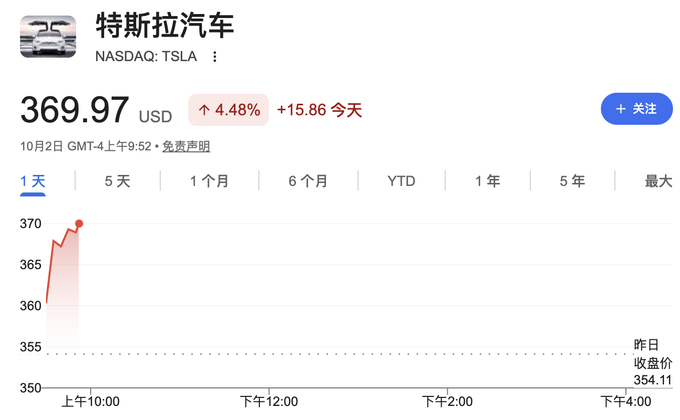
After the announcement, Tesla's stock price initially rose by 4.5%, but it has still been in a downward trend since the beginning of this year. Additionally, there have been recent market rumors that there may be a merger between Musk's SpaceX and Tesla, which has driven a temporary rebound in Tesla's stock price over the past few weeks.
Declined year-on-year, but exceeded expectations
In the third quarter of last year, Tesla delivered 497,099 vehicles, setting a historical record. At that time, federal subsidies in the United States were about to be eliminated, and consumers' rush to buy drove sales to soar. This year, the delivery volume in the third quarter decreased by about 2% from that peak, but it still exceeded market expectations by more than 20,000 vehicles.
Nevertheless, Wall Street generally expects Tesla to achieve modest growth throughout this year, reversing the trend of declining annual sales for the past two consecutive years.
In terms of vehicle model structure, Model Y and Model remain the absolute mainstays of sales. Apart from these two models, the company delivered a total of only 8,295 units of other models, including the controversial Cybertruck.
Previously, Tesla had discontinued the production of the higher-priced Model S and Model X. Currently, the number of models available for sale to consumers has been reduced to three.
Substantial investment supports future layout
To support business expansion, Tesla plans to spend over $25 billion this year on expanding factory capacity and advancing the implementation of Robotaxi business. The company disclosed in a document this week that it has obtained an additional $30 billion in loans and credit lines.
In terms of the energy business, the deployment volume of energy storage products in the third quarter reached 13.7 gigawatt-hours, which is higher than 12.5 gigawatt-hours in the same period last year and also slightly higher than 13.5 gigawatt-hours in the second quarter of this year, continuing a moderate growth trend.
Europe warms up, while China faces pressure
Positive signals worthy of attention have emerged in the European market. According to data from the Association of European Automobile Manufacturers, in August of this year, Tesla's new car registrations in the EU increased by about 53% year-on-year, and the cumulative increase in the first eight months of this year reached 66%.
Last year, affected by consumer boycotts triggered by Elon Musk's personal controversies, Tesla's sales in the European Union plummeted significantly. Currently, soaring oil prices and the influx of electric vehicles from China are stimulating an overall increase in local demand for electric vehicles, and Tesla is benefiting from this.
In contrast, the competitive pressure in the Chinese market remains prominent. Tesla continues to offer end-of-quarter discounts on Model 3 and Model Y to maintain its market share, but the production volume of its Shanghai factory faces challenges.
According to data from the China Passenger Car Market Information Joint Meeting, among the approximately 86,000 cars produced by Tesla in China in August, about 36,000 were exported to overseas markets, resulting in a decline in domestic deliveries compared to the previous month.