What is the difference between stablecoins and bank deposits?
Coinpaper
1h ago
Ai Focus
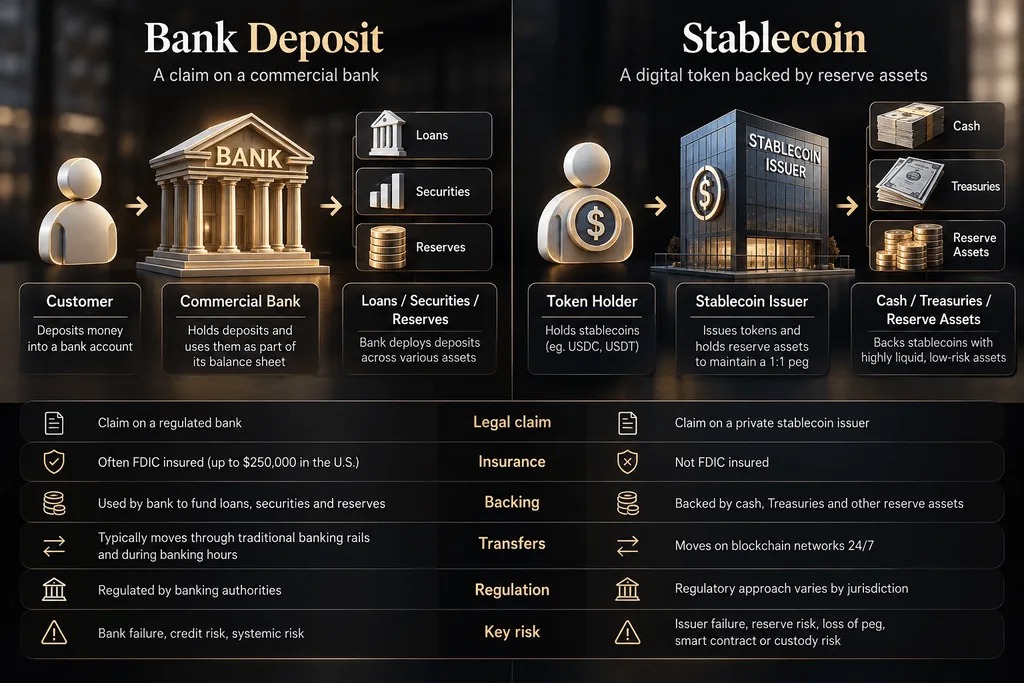
From the user's perspective, both stablecoins and bank deposits can represent $1 and can be used for payments; they may also exist only within applications without being physical cash. However, at the legal and financial levels, the two are distinctly different forms of currency: Bank deposits represent claims against commercial banks, while stablecoins are typically digital tokens issued by independent private entities and backed by reserve assets to maintain their value close to that of legal tender such as the US dollar.
Helpful
No.Help

From the user's perspective, stablecoins and bank deposits can be surprisingly similar. Both can represent $1, can be used for payments, and can also exist solely within applications, rather than in the form of physical cash.

However, from a legal and financial perspective, they are two very different forms of currency.

Bank deposits represent claims against commercial banks. When $1,000 is deposited in a checking account, the bank owes that amount to the customer. Stablecoins, on the other hand, are typically digital tokens issued by independent private entities and backed by reserve assets to ensure their value remains as close as possible to that of currencies such as the US dollar. The International Monetary Fund ( IMF ) describes this distinction as the difference between “account-based money” and “token-based money.”

This difference will affect everything from deposit insurance to the way funds flow.

Bank deposits rely on banks, while stablecoins rely on reserves.

Commercial banks typically do not keep every dollar deposited in their vaults intact. Deposits constitute a part of the funding source for the banking system, while the assets held by banks include loans, securities, and reserves.

Stablecoin issuers adopt different models.

For example, Circle indicates that USDC is backed by reserve assets denominated in US dollars and can be exchanged for US dollars at a 1:1 ratio. Its reserves include cash as well as highly liquid instruments such as short-term US Treasury bonds and overnight US Treasury repurchases.

This reserve structure is also a way for many stablecoin businesses to generate profits. The issuers do not pay most of the earnings to the token holders; instead, they can earn income from the securities that underpin their tokens: this is also a model that we have discussed in our articles on the breakdown of stablecoin reserves.
Deposit insurance is a significant difference.

In the United States, deposits that meet certain criteria and are held in banks insured by the Federal Deposit Insurance Corporation (FDIC) are typically protected, with a limit of up to $250,000 per depositor per insured bank and per type of ownership. It is clearly stated that crypto assets themselves are not covered by deposit insurance.

Therefore, holding stablecoins does not provide the same level of protection as directly depositing funds in a insured bank account.

Stablecoins also carry various risks, including the failure of the issuer, issues with reserve assets, temporary decoupling from the US dollar peg, blockchain malfunctions, and mistakes in managing private keys or wallet addresses.

This is also one of the reasons why bank stablecoins and tokenized deposits should not be considered interchangeable. Tokenized deposits may use blockchain technology, but they are still bank liabilities and do not thereby become tokens supported by independent reserves.

Adrian Cole

Adrian Cole has been engaged in financial market reporting for over 6 years, with a focus on crypto assets, stocks, and macroeconomic trends. He tracks Bitcoin, major altcoins, the U.S. stock market, interest rates, commodities, as well as various types of data that drive market changes. Over the years, he has written hundreds of market updates and analysis articles, with an emphasis on price trends, investor sentiment, and the connections between traditional finance and digital assets.

Tip
$0
Like
0
Save
0
Views 14
CoinMeta reminds readers to view blockchain rationally, stay aware of risks, and beware of virtual token issuance and speculation. All content on this site represents market information or related viewpoints only and does not constitute any form of investment advice. If you find sensitive content, please click“Report”,and we will handle it promptly。
Submit
Comment 0
Hot
Latest
No comments yet. Be the first!
Related
As the mid-term elections in the United States approach, could Bitcoin see another decline similar to that in the fourth quarter?
Bitcoin's trend is weakening before the fourth quarter of 2026, falling back to around $84,000 from its recent high. The article points out that BTC is still above the short-term holder cost base of around $73,000, but if this level is lost, it could indicate further downward pressure. The author also mentions that Bitcoin experienced declines in the fourth quarter during the three mid-term election years in the United States in 2014, 2018, and 2022, so the market is watching to see if this historical pattern will repeat itself.
Coinpedia
·2026-09-29 23:41:56
7
OpenAI's annual recurring revenue approaches $70 billion; company sales accelerate, narrowing the gap with Anthropic
According to Axios, OpenAI's annual recurring revenue is approaching $70 billion, with the revenue growth rate exceeding 70% since the beginning of the third quarter. Corporate sales have more than doubled since July. As corporate customers become the core battleground of competition for AI, OpenAI is narrowing the gap with Anthropic.
Coinpaper
·2026-09-29 23:34:22
12
Gusto Report: Small businesses in the United States created 28,000 new jobs in September, achieving employment growth for the eighth consecutive month
Gusto The latest report on small business employment and salaries shows that American small businesses added approximately 28,000 net new jobs in September after seasonal adjustments, achieving positive growth for the eighth consecutive month. The healthcare and social assistance industries led hiring for the eighth straight month, with average hourly wages rising by 4.0% year-on-year to $37.40, and starting salaries for newly hired employees increasing by 3.1% year-on-year to $25.80 per hour.
PR Newswire
·2026-09-29 23:34:20
12
5 Things to Check Before Participating in Crypto Pre-sales in 2026
The Stage pre-sale of MemeToro has raised over $155,000, with the current price of $MT at 0.00528 USD. The article suggests that buyers evaluate the pre-sale from five aspects: financing progress, launch rules, insider distribution, token allocation, and uses. It also introduces the project's AI token issuance tool, open-source contract, and platform plans.
crypto.news
·2026-09-29 23:21:36
14
China's independently developed 4,500-meter deep-sea operation robot sets sail for scientific research in the South China Sea
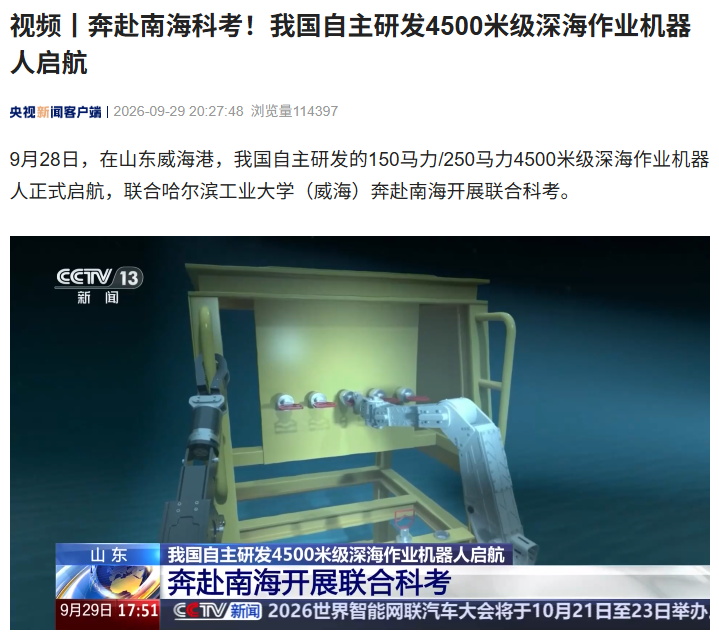
According to CCTV News, on September 28th, at Weihai Port in Shandong, China's independently developed 150 horsepower/250 horsepower 4,500-meter deep-sea operation robot officially set sail, joining forces with Harbin Institute of Technology (Weihai) to carry out joint scientific research in the South China Sea. This robot is equipped with a self-developed seven-axis multi-functional hydraulic robotic arm and has overcome more than thirty key technologies, including deep-sea pressure resistance and sealing, high-power propulsion in deep water, long-distance underwater communication, and multi-modal autonomous navigation. It is capable of performing tasks such as deep-sea oil and gas development, submarine pipeline inspection, mineral resource exploration, underwater scientific sampling, and emergency salvage.
The Block
·2026-09-29 23:13:09
14
View More