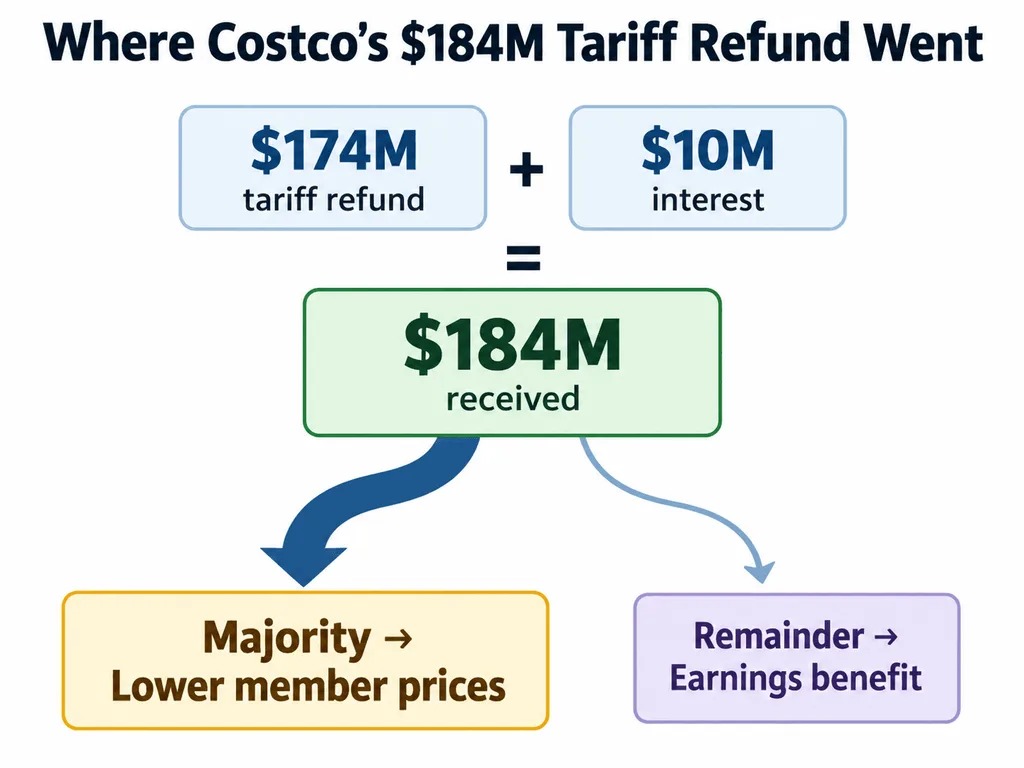
Costco received $184 million in tariff refunds during its fourth fiscal quarter of the 2026 fiscal year, but this warehouse retailer stated that it did not keep most of this unexpected windfall as profit; instead, it used a large portion of it to reduce prices.
Of this amount, approximately $174 million comes from refunded tariffs, with an additional $10 million in interest. The fourth-quarter results of Costco show that after some of the funds were reinvested in member value, this refund led to a one-time boost in earnings, increasing diluted earnings per share by $0.15.
CEO Ron Vachris stated that Costco lowered the prices of categories such as agricultural products, meat, beverages, household items, and hardware in the second half of this quarter.
This means that what may appear to be a refund in accounting terms could ultimately result in consumers actually experiencing a change in prices at the point of sale.
Costco may receive even more funds
$184 million is clearly just a part of the story.
Chief Financial Officer Gary Millerchip stated that this amount is only slightly more than one-third of the total expected tariff refund amount of Costco. The company intends to continue to use most of the future refunds to provide better pricing for members, rather than simply using them as a means to boost profits.
Costco announced net sales of $93.9 billion for the fourth fiscal quarter, a year-on-year increase of 11.2%; net profit increased from $2.61 billion in the same period last year to $3 billion.
Excluding the impact of gasoline prices and exchange rates, comparable sales increased by 6.7%, indicating that even before the revenue generated from refunds, the growth of Costco itself was already quite strong.
Costco and Walmart are turning refunds into a weapon in retail pricing tactics
What is more noteworthy is that Costco is not the only company to do this.
Wal-Mart stated that it plans to use approximately $2.9 billion in tariff refunds to help reduce prices on thousands of products. Coinpaper Previously, it was reported that Wal-Mart was lowering prices despite consumers' spending still being under pressure.
This has created an unusual competitive landscape: what could have been tariff refunds that remain on retailers' profit and loss statements have now become "ammunition" in a price war targeting consumers sensitive to inflation.
The source of these refunds is a ruling made by the U.S. Supreme Court in February, which overturned the wide-ranging tariffs imposed under the International Emergency Economic Powers Act. Coinpaper had previously analyzed the issue of the $175 billion in refunds resulting from this ruling.
For Costco, this strategy also aligns with its business model. Low prices help to maintain the membership renewal rate and enhance consumers' sense of value when paying an annual fee to shop in-store.
Emir Abyazov
Coinpaper serves as the editor-in-chief, responsible for driving data-driven editorial operations in the fields of cryptography, artificial intelligence, and fintech; SEO focuses on content discovery oriented by user intent, as well as audience-first storytelling.