

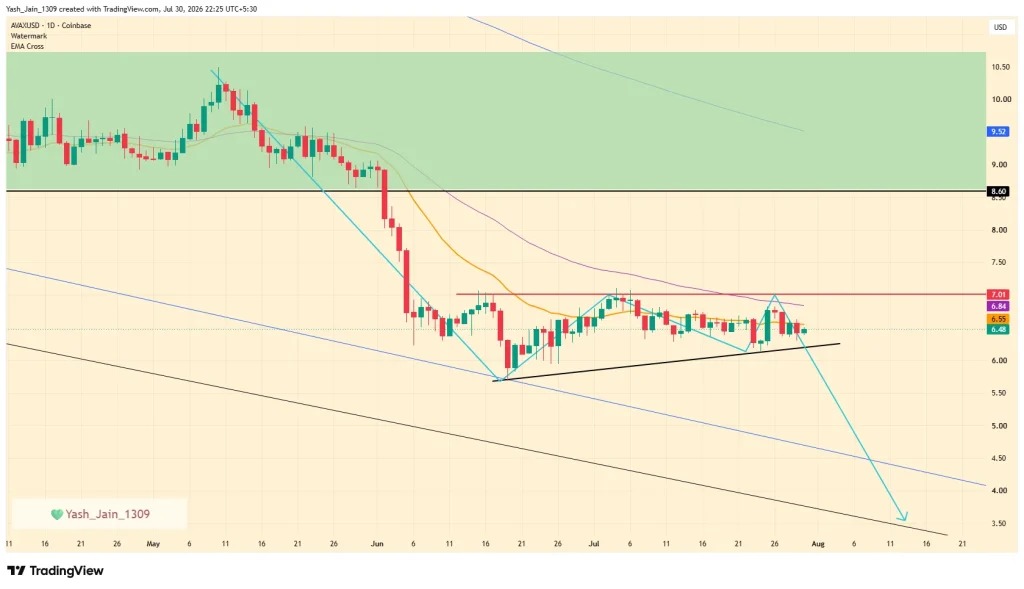
Foreign media reports that AVAX is currently still within a consolidation range, and the market is focused on which direction this pattern will ultimately break out. The article suggests that if the price breaks down, AVAX may continue its weakness; however, if buying interest picks up, the current bearish structure could also be broken.
Prices remain within the convergence range
The report mentions that AVAX is currently trading within a narrowing ascending pennant pattern. This type of pattern is generally considered a continuation signal of a bearish bias, therefore traders should remain cautious in the short term.
According to the article, if selling pressure dominates and the price breaks below the lower edge of the pattern, AVAX could fall to around $3.50. Conversely, if buyers regain control, the price could rebound to around $9.50, where the 200-day exponential moving average is located.
- Support level: $3.50
- Upper reference level: around $9.50
- Key observation point: Whether the pattern has been effectively broken down.
Bitwise disclosed that its collateralization ratio rose to 41.5%.
Despite the weak token price performance, the Avalanche network itself continues to maintain high participation. Bitwise stated on July 28 that approximately 41.5% of all AVAX tokens are currently staked.
This data reflects the continued participation of validators and token holders in the network. The report also mentions that Avalanche's mechanism involves issuing new AVAX to stakers while permanently burning network transaction fees; this design will not cease to function due to short-term price fluctuations.
Network activity and cryptocurrency price are not necessarily synchronized.
The article argues that AVAX is currently exhibiting a divergence between its fundamentals and price performance. On one hand, network staking participation and the token mechanism are still operating; on the other hand, the price remains under short-term technical pressure.
The market's focus now remains on whether buying pressure can rebound before the pattern breaks downwards. If it fails to reverse the current trend, price pressure may continue to mount; if buyers recover the key range, the current bearish assessment may become invalid.