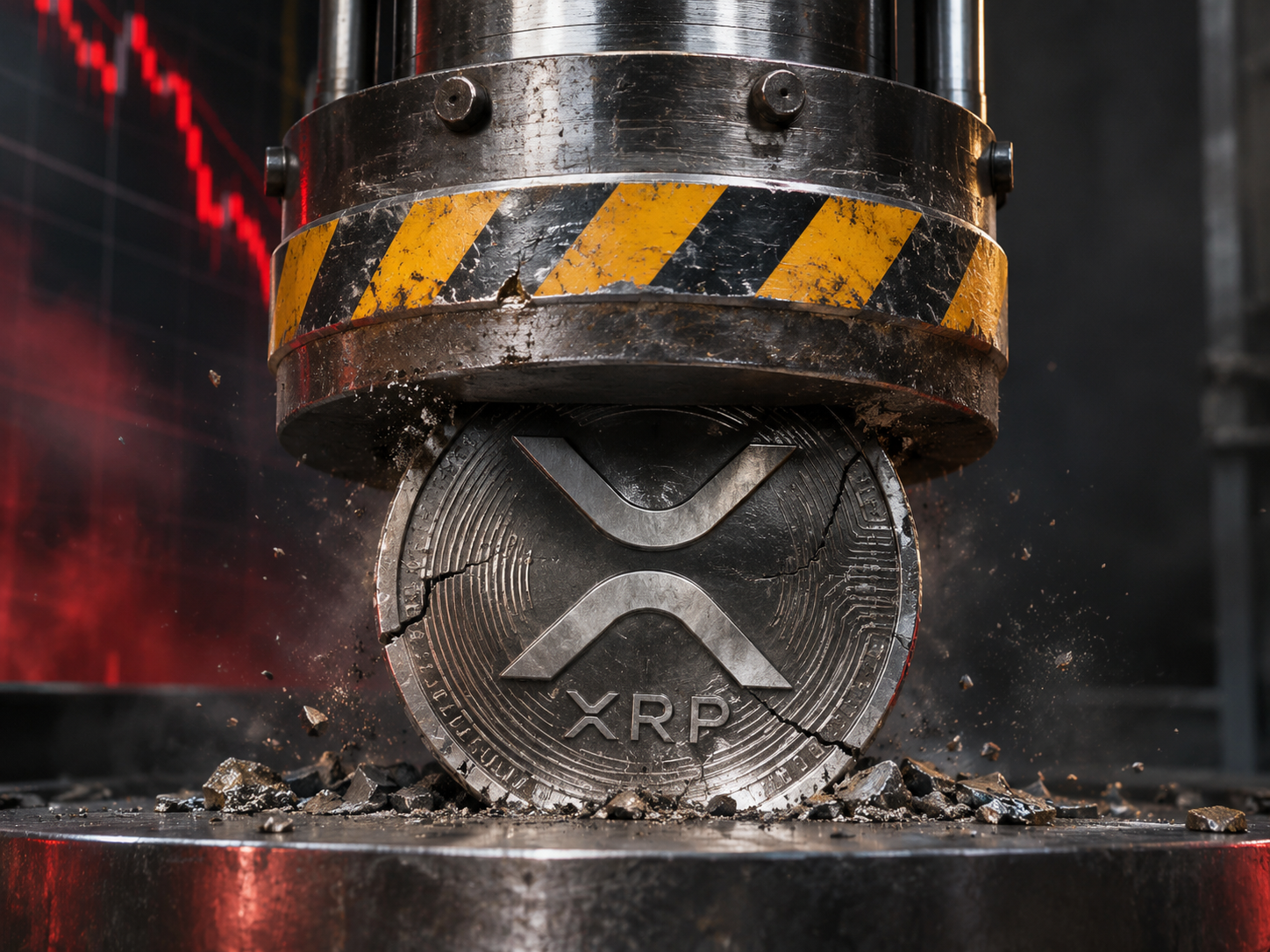
Doubts about whether the artificial intelligence boom can continue are reshaping global asset pricing. Investors are making a mass withdrawal from tech stocks, with funds flowing towards government bonds and the US dollar as safe-havens.
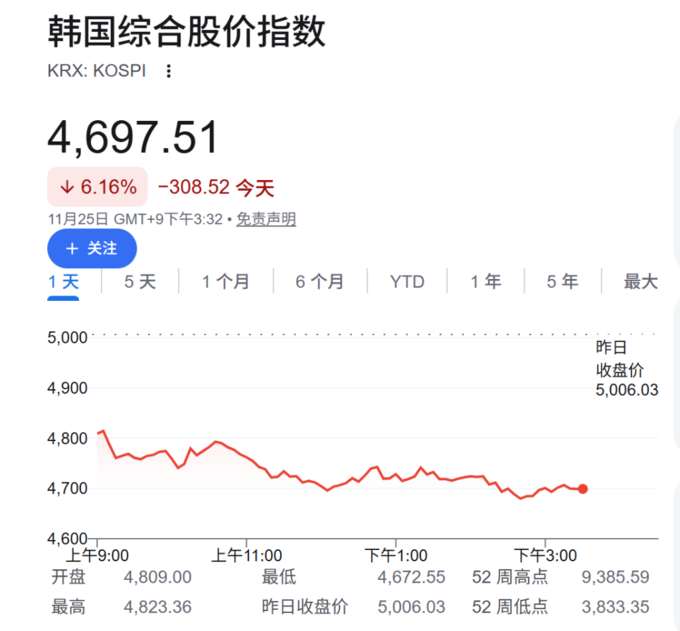
On November 25th, the Asia-Pacific market became a hard-hit area for selling. The Asia-Pacific index fell by 2.1%, with South Korea's index falling by 6.16% to close at 4,697.51 points; China Taiwan's stock index also fell by 4.8%; and the Nikkei 225 index closed down 2.78%. Chip stocks led the decline, with SK Hynix' stock price plummeting by 11% and Samsung Electronics falling by 10%.
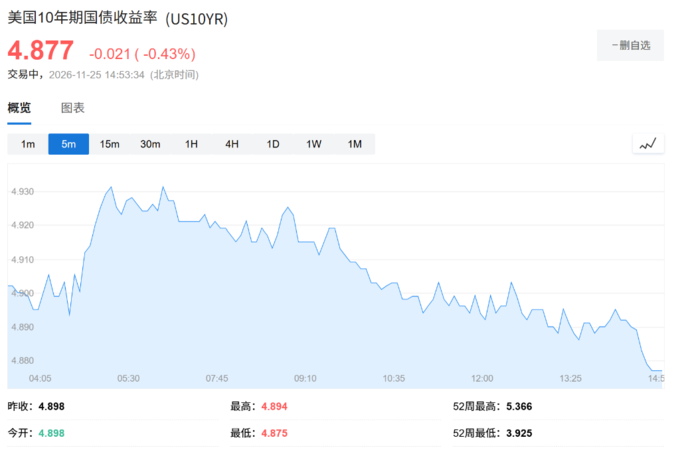
U.S. stock futures indicate that weakness will continue. Nasdaq 100 index futures fell by 1.4%, and S&P 500 index futures fell by 0.8%, suggesting that U.S. tech stocks will decline for the second consecutive trading day. The demand for safe-haven assets drove up U.S. Treasury yields, with the yield on the benchmark 10-year Treasury note dropping by 4 basis points to 4.89%, and Japanese 10-year government bond yields also fell by 7.5 basis points to 2.645%.
Market sentiment has swung wildly over the past three trading days. Last Friday, the collapse of AI trading triggered a sell-off, and on Monday, the return of NVIDIA CEO Jensen Huang to the market drove a rebound in stock indices, but the optimism was short-lived, with investors resuming their withdrawals the following day. The Philadelphia Semiconductor Index tumbled 7.9% on Tuesday, marking a cumulative decline of about 40% from its June highs. The next focus for the market will be the U.S. inflation data to be released on Wednesday, which could influence the Federal Reserve's policy path.
The Nikkei 225 index closed down 2.78% at 57,011.62 points. The Tokyo Stock Exchange index in Japan fell 0.5% to 3,746.20 points. South Korea's KOSPI index declined 6.16% to 4,697.51 points. Nasdaq 100 index futures fell 1.4%, and S&P 500 index futures fell 0.8%. The yield on benchmark 10-year U.S. Treasury bonds dropped 4 basis points to 4.89%. The yield on 10-year Japanese government bonds also fell 7.5 basis points to 2.645%. The U.S. dollar strengthened against all G10 currencies, with the U.S. Dollar Index rising 0.2%. Brent crude oil fell more than 1.5% to $90 per barrel, and gold fell 1.1% to $3,516 per ounce.
Volatility intensifies as the market seeks an anchor for the valuation of AI.
The core contradiction of this round of adjustments lies in the fact that investors have begun to question the sustainability of infrastructure investments in AI.
"The market has been fluctuating around NVIDIA's stock price, as it is clearly the key to the AI boom and bust scenarios," said Nick Twidale, Chief Market Analyst at AT Global Markets. "We are still in a highly volatile market, and adjustments tend to occur; market sentiment seems to swing significantly from day to day."
The trend in the U.S. debt market confirms a tightening of risk appetite. The yield on the benchmark 10-year U.S. Treasury note has declined during the New York session and further weakened during the Asian session, indicating that funds are flowing from stocks to fixed-income assets. The dollar has also strengthened, becoming another beneficiary of this round of risk-aversion trading.
According to Bloomberg, the MSCI global index fell by 0.4%, marking the eighth consecutive decline in 10 trading days. This data indicates that the adjustments are not limited to the AI related sectors but are spreading to a broader market.
Chip stocks were hit the hardest, with their declines reflecting a correction in expectations.
The semiconductor sector was at the center of this sell-off.
The 11% daily decline of Hynix and the 10% decline of Samsung Electronics had a significant negative impact on the Korean market index, which also explains the 6.16% sharp correction in the KOSPI index. A 4.8% decline in the Chinese and Taiwanese markets also indicates that the chip industry chain is under substantial pressure. Together, these factors contributed to the 2.1% decline of the MSCI Asia-Pacific index.
The Philadelphia Semiconductor Index has retreated by about 40% from its June high, a range that technically approaches a bear market territory. According to Bloomberg, the trading price of Anthropic PBC has fallen below the issue price of IPO, further undermining market confidence in assets related to AI.
"The market is telling us that investors do not believe that such investment scales can be pursued in accordance with the previous guidelines, at least not in a sustainable manner," said Dong Chen, Chief Investment Officer for Asia at UBS Bank, on Bloomberg TV.
Dell Technologies and HP saw slight gains in after-hours trading, following the release of optimistic earnings guidance by both companies. This indicates that among the overall weak technology sector, hardware manufacturers with solid profit margins are still favored by some investors.
Commodities under pressure, oil and gold prices weaken simultaneously
The risk-aversion sentiment has not been entirely positive for commodities; both crude oil and gold have seen declines.
Brent crude oil fell by more than 1.5% to $90 per barrel as traders assessed the impact of signs of increased supply and the escalation of attacks on vessels in the vicinity of the Strait of Hormuz. Gold declined by 1.1% to $3,516 per ounce, marking the seventh consecutive trading day of losses, and the aura of traditional safe-haven assets has clearly weakened during this round of volatility.
This combination reflects the contradictory mindset of the market: investors are concerned about the potential pullback in risky assets due to the instability in the AI narrative, yet they have not fully shifted to traditional hedging strategies. Funds are instead flowing more heavily towards U.S. Treasury bonds and the U.S. dollar.
The market focus remains on AI and the Federal Reserve.
Neumann indicates that until the end of the year, investors' attention will still be focused on AI and the Federal Reserve.
According to Bloomberg strategist Mark Cranfield, this will seem like another tense trading period for stock investors, with the market caught in a fierce rotation between increasingly attractive valuations and the theme of AI.
For investors, there are two key variables to watch: on Wednesday, U.S. inflation data will provide clues as to the Federal Reserve's policy direction, while whether the AI sector can stop its decline depends on whether the market is willing to trust the previous guidance on capital spending again. Until then, volatility is likely to remain the main theme of the market.
J.P. Morgan's head of high-rated credit strategy in the U.S., Nathaniel Rosenbaum, expects that AI-related lending will see another busy year, but the growth in issuance may peak in 2027.