U.S. stocks have just experienced a round of sharp fluctuations, yet market sentiment has quickly shifted from panic to optimism. However, in the view of David Rosenberg ( David Rosenberg ), a well-known macroeconomist on Wall Street, this rebound may precisely be the stage during a bear market when investors are most likely to let their guard down.
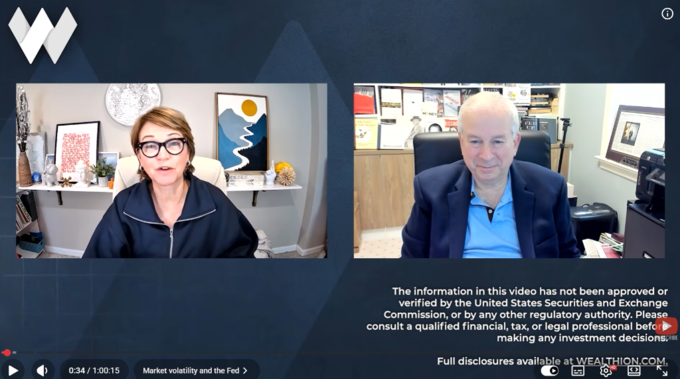
In a conversation with Wealthion host Maggie Lake, he stated that the S&P 500 index may have peaked on October 6th, and the current upward trend is more akin to a reflective rebound in a typical bear market, rather than the beginning of a new bull market.
Rosenberg, citing market cycles over the past 60 years, stated that bear markets typically go through three stages: The first stage is an initial decline that lasts about 4 months and results in a loss of around 14%; the second stage is a rebound that also lasts about 4 months with an average increase of about 11%, during which in about 80% of cases, the market will retest the previous high points; the third stage may be a further decline that lasts about 10 months and results in a loss of 27%. Based on this historical pattern, he believes that the S&P 500 could potentially fall to 5,500 points by the end of 2027 or early 2028.
What truly worries him, he said, is not just the stock market valuation and market sentiment, but rather the financing pressures behind the AI investment frenzy, the increasingly unbalanced growth structure of the U.S. economy, and the wrong policies that the Federal Reserve might adopt.
Rosenberg stated that for the first time, ultra-large-scale cloud computing companies have collectively experienced negative free cash flows. The issues of circular financing and off-balance-sheet debt in the AI industry remain unresolved. Meanwhile, faced with energy supply shocks, the Federal Reserve may further curb demand by raising interest rates. He warned that if policy paths continue to deviate, the unemployment rate in the United States could rise above 6%, and the reversal of the wealth effect in the stock market could also further dampen consumption.
The most dangerous stage of a bear market may actually be during the rebound period.
Rosenberg stated that he firmly believes that October 6th marks the fundamental peak of this cycle for the S&P 500. Based on market experience over the past 60 years, bear markets typically do not start with a straight downward decline from high points but rather go through three stages.
The first phase is an initial decline, which lasts for about 4 months on average, with a decrease of around 14%. As of last Friday, before the interview was recorded, the S&P 500 had already fallen by more than 12%, which is close to this historical pattern in both duration and magnitude.
The second phase is a rebound from a bear market. He pointed out that during a bear market, there is usually a rebound that lasts for about 4 months, with an average increase of around 11%. What is more noteworthy is that in about 80% of cases, the market will once again challenge the previous cycle highs.
He said that this is precisely where a bear market rebound can most easily create illusions. When the market starts to rise again, investors tend to think that the worst has passed and that the previous decline was just a brief adjustment. However, in his view, such a rebound does not necessarily mean that the fundamentals have improved. It can be very strong, even strong enough for investors to re-establish long positions, but it may not change the direction of the overall economy and profit cycle.
He expects that after the rebound ends, the market may experience another decline of about 10 months, with a drop of 27%. If this historical pattern is applied to the current market, the S&P 500 could fall to 5,500 points by the end of 2027 or early 2028.
He also emphasized that bear markets usually last for 12 to 18 months. Historically, during the bear markets of 2001, 2002, and from 2008 to 2009, there were very strong single-day and single-week gains.
The rebound lacks confirmation from the bond market, and investor sentiment is far from cleared.
In addition to historical cycles, Rosenberg also looks for evidence of whether a rebound is reliable by examining cross-asset performance and market sentiment.
Last Friday, before the interview recording, the NASDAQ index fell by about 5%, and there was a clear panic in the market for a time. Subsequently, as news related to NVIDIA helped reverse market sentiment, the stock market quickly rebounded.
But he believes that this is more like a market movement driven by news and changes in positions, rather than a return to risk appetite brought about by improvements in fundamentals.
He specifically mentioned the performance of the bond market. If a rebound in the stock market indicates that investors are once again optimistic about the economy and corporate profits, it usually comes accompanied by an increase in bond yields, as the market will reprice economic growth and future interest rates. However, on the day of the recording, the yield of 10-year U.S. Treasury bonds hardly changed at all.
Rosenberg stated that if this were a round of truly reliable risk appetite trading, the yield on 10-year U.S. Treasury bonds should rise by 5 to 10 basis points.
The performance of gold also came as a surprise to him. Over the past year, gold even behaved in certain periods like a risk-seeking asset, suffering impacts simultaneously with AI trades. However, during this rebound in the stock market, gold prices rose instead, while bond yields did not increase significantly. He said that these signals indicate that the market has not formed a consensus of optimism.
Investor sentiment has not yet reached the level typical of a bear market bottom. Rosenberg pointed out that last Friday, VIX briefly touched 40 during trading, which is usually a noteworthy panic-driven re-entry signal in history. However, the bullish sentiment indicator for Market Vane remains at 71, still a long way from the 40 level that he believes would represent a true clearing of sentiment.
He also mentioned that there has been no obvious shift in the views of Wall Street sellers: the most pessimistic strategists in the market still predict a 19% increase for the S&P 500 next year, while only 3% of analysts have assigned a sell rating to the stocks they cover. In his view, these do not seem to be the kind of sentiment patterns one would expect at the bottom of a typical bear market.
Behind the investment frenzy of AI, cash flow and financing risks are accumulating.
Rosenberg believes that this round of market adjustment is different from the previous short-term pullbacks. In the past, market declines often allowed for waiting for catalysts such as the Federal Reserve, government intervention, or new technologies to reverse the situation. However, this time, the problems are more stemming from the AI industry itself.
Firstly, there is corporate cash flow. He pointed out that this summer, for the first time, large-scale cloud computing companies collectively turned to negative free cash flows. In order to compete for dominance in the AI sector, major tech companies have been continuously increasing their investments in data centers, chips, and infrastructure, leading to a sort of arms race among them.
He said that it is difficult for companies to voluntarily slow down their investment, as any company that does so may worry about being overtaken by competitors. However, as the scale of investment continues to expand, so does the need for financing. Expansion, which was originally supported by operating cash flows, begins to rely more on debt and external capital.
Secondly, there is the issue of revolving financing. Rosenberg believes that there are complex financial and business relationships between NVIDIA and the AI startups it invests in. Corporate investments, procurement, and financing are intertwined, making the actual return on capital of the AI industry chain increasingly worthy of scrutiny. He stated that Jensen Huang's return to power will not solve these structural problems.
The third risk comes from off-balance-sheet debt. He stated that in addition to the bonds that have already been issued, large technology companies and their related projects also have a significant amount of loan guarantees and other financing commitments. These risks may not be directly reflected in traditional balance sheets, but once the investment returns of AI fall short of expectations, the associated financing pressures could become apparent.
He also mentioned that this year's large-scale bond issuance has led to a significant widening of the credit default swap ( CDS ) spread, with some indicators reaching levels approximately three times what they were before.
What is more noteworthy is the supply of stocks. Over the past 15 years, U.S. stock investors have benefited from the reduction in net supply brought about by corporate stock repurchases. Companies have reduced the number of shares outstanding in the market through repurchases, providing continuous support for stock prices.
However, Rosenberg believes that as corporate financing needs rise and stock issuances increase, the market is entering a completely new phase: net stock supply may turn positive for the first time. This means that the repurchase momentum that has long supported U.S. stocks in the past may weaken, and the additional stock supply will become a pressure that the market must digest.
AI Prosperity has overshadowed other problems in the U.S. economy
In Rosenberg's view, the biggest contradiction in the U.S. economy at present is the clear divergence between AI related investments and other economic sectors.
He mentioned that this year, the construction of data centers in the United States has maintained rapid growth, with an increase of nearly 90%, but other types of construction activities have generally declined by about 7%. This means that economic growth is becoming increasingly dependent on a few technology infrastructure projects, while traditional real estate and other construction activities have not improved accordingly.
He compares this situation to the boom of the internet at the end of the 1990s. Back then, internet investment was part of a broader economic wave; technological investments drove the development of numerous industries, and the contribution of productivity and labor input to economic growth was relatively balanced. However, this time, AI investments seem to be drawing funds and resources away from other sectors of the economy.
Real estate is one example. Rosenberg pointed out that the indicator for signed sales of completed homes in the United States has dropped to record lows, even below the levels during the real estate recession from 2008 to 2009. However, compared to AI, the real estate market receives significantly less attention.
There are also hidden concerns in the job market. He believes that the year-on-year growth in employment in the United States is already close to zero. On the surface, the unemployment rate remains around 4%, but changes in immigration policies have affected the labor force participation rate; therefore, one cannot rely solely on the unemployment rate to determine that the job market is still strong.
Meanwhile, the wage growth rate has dropped to its lowest level in nearly five years. On the consumer side, there is another risk: American consumers are becoming increasingly dependent on the wealth effect brought about by rising stock market prices.
Rosenberg mentioned that in the past year, the savings rate in the United States has dropped from over 5% to below 4%, and the wealth effect brought about by the rise in the stock market contributed about 0.25 to 1.5 percentage points to the growth of GDP.
He said that if the bull market in the stock market ends, high-income groups holding large amounts of stock assets may start to reduce their spending, which could lead to a negative feedback loop: a decline in the stock market weakens the wealth effect, consumption weakens, dragging down the economy, corporate profits and employment are further pressured, and ultimately this in turn suppresses the stock market again.
The Federal Reserve may push the U.S. economy into recession in order to curb inflation.
Throughout the entire interview, Rosenberg's criticism of Federal Reserve policy was quite direct.
He believes that the Federal Reserve is facing an energy supply shock, yet it is attempting to curb overall inflation by raising interest rates. This could be a typical policy mistake.
The current rise in energy prices will be transmitted to the prices of a wider range of goods and services through sectors such as diesel, transportation, aviation, fertilizers, and food. However, these price increases do not indicate that there is a general overheating of demand in the U.S. economy.
Rosenberg stated that the interest rate tools in the Fed's hands mainly affect demand, but they cannot directly increase energy supply, nor can they solve the problem of insufficient refining capacity. If the Fed insists on bringing overall inflation down from around 4% to 2%, and energy prices do not fall significantly, then it will have to achieve this goal by reducing demand in other sectors.
He used a model to perform arithmetic calculations: in this case, the federal funds rate may need to be raised by more than another 200 basis points to reach around 6%.
This will come at a severe economic cost. According to his calculations, the actual quarter-four trend growth rate in the United States could drop from 2% positive to negative 2%, and the unemployment rate could rise above 6%.
He believes that the current trend of U.S. economic growth is only about 2.1%, which is significantly lower than the growth levels typically associated with the Federal Reserve's initiation of a tightening cycle in history. The yield curve is also relatively flat, and there is no obvious overheating in the labor market.
Therefore, he is concerned that the Federal Reserve is pushing the economy towards a dangerous policy mix: in order to counter the shock to energy supply, it is deliberately creating even greater demand contraction.
Rosenberg also stated that there is currently not sufficient evidence to prove that the Federal Reserve has lost its credibility in terms of inflation control. If the market truly no longer believes in the Fed's ability to control inflation, then more dramatic changes should occur in the gold, dollar, inflation expectations, and bond markets. However, he believes that these signals have not yet appeared.
He expects that the market has already taken into account the possibility of a 25-basis-point interest rate hike on December 9th, but what is truly worth paying attention to is not the single hike itself, but rather the Fed's statements, press conferences, and the future path of interest rates. In his view, if the Fed goes ahead with further consecutive hikes next year, it may make even more serious mistakes.
Rosenberg did not liquidate his stocks: 40% of his position is bet on healthcare and energy infrastructure
Despite being cautious about market prospects, Rosenberg did not choose to completely withdraw from the stock market.
He revealed that his portfolio still held about 70% in stocks a year ago, but this has now dropped to 40%. The overall allocation of the portfolio is roughly as follows: 40% in stocks, 40% in bonds, 10% in hard assets, and 10% in cash.
He emphasized that he has never held a zero position, nor does he maintain a 100% position at any time. Market risks are not black and white; the key is to adjust one's portfolio as the probabilities of risk and reward change.
In the stock portion, he mainly adopts a defensive strategy. One of his investments is in global healthcare companies. He believes that healthcare has relatively high profitability predictability, making it a strategy that balances defense and growth.
On the other end is energy infrastructure, including pipelines, midstream and upstream energy companies, as well as opportunities related to the transformation of the US power grid.
He stated that the market generally focuses on direct beneficiaries such as AI chips and semiconductors, but if the AI industry continues to expand, energy demand will also increase accordingly. In the long run, energy infrastructure may become an important area of benefit for the prosperity of AI.
In addition, he has also allocated investments in Japanese stocks and assets from some Asian markets, while remaining vigilant regarding semiconductor-related risks in Asia.
In terms of bonds, he is increasing the duration. Rosenberg mentioned that in the past, his bond portfolio was mainly focused on short durations, but currently, the actual yields of long-term U.S. Treasury bonds and the 10-year yield have become quite attractive.
He also allocated funds to Australian bonds and emerging market bonds in local currencies, believing that, apart from Brazil, the fiscal and inflationary conditions of some emerging markets are actually superior to those of developed economies.
In terms of gold, he reduced his position in precious metals from 15% a year ago to the current 5%, without completely ruling out the possibility of increasing it again in the future. He believes that gold is under pressure from real interest rates and a stronger dollar, and that once the Federal Reserve clearly ends its interest rate hikes, gold may regain momentum to rise.
He doesn't accept the label of being "forever bearish".
During the interview, Lake also specifically discussed the label of 'Eternal Void Faction' that Rosenberg has long carried with him.
Rosenberg recalled that when he worked at Merrill Lynch Canada at the end of 1999 to the beginning of 2000, he advocated for removing Nortel Networks ( Nortel ) from the top ten holdings in Canada, but that suggestion was not approved at the time. Later, when Nortel's stock price plummeted, he was labeled as a long-term bearish investor as a result.
However, he does not consider himself a person who is always pessimistic. He admits that he has made mistakes in the past, especially sometimes maintaining a pessimistic outlook for too long without being able to shift his perspective in time.
In the interview, he emphasized that an excellent portfolio manager is not someone who is always right, but rather someone who can reduce their position or exit in a timely manner when they realize they have made a wrong judgment.
He believes that investors need to set risk limits in advance and strictly adhere to them, rather than allowing a wrong position to continue to expand until they are finally forced to take a stop-loss.
At the end of the interview, Wealthion also interviewed Chris Casey. Casey stated that bonds may be one of the riskiest areas in the market, and he generally maintains a light position in bonds with a very short duration. He mentioned that although he would consider varieties with higher yields under certain circumstances, if investors increase their bond exposure, they should consider inflation hedging to guard against potential solvency crises and higher interest rates in the next two to three years.
In her summary, Lake stated that Rosenberg's core point is: a sharp rebound does not equate to recovery; what truly matters is what is in one's investment portfolio, rather than just what proportion of stocks one holds. She mentioned that different investors may follow different approaches, but the key is to complete risk management before the next fluctuation occurs, rather than hastily reacting during the fluctuation itself.