

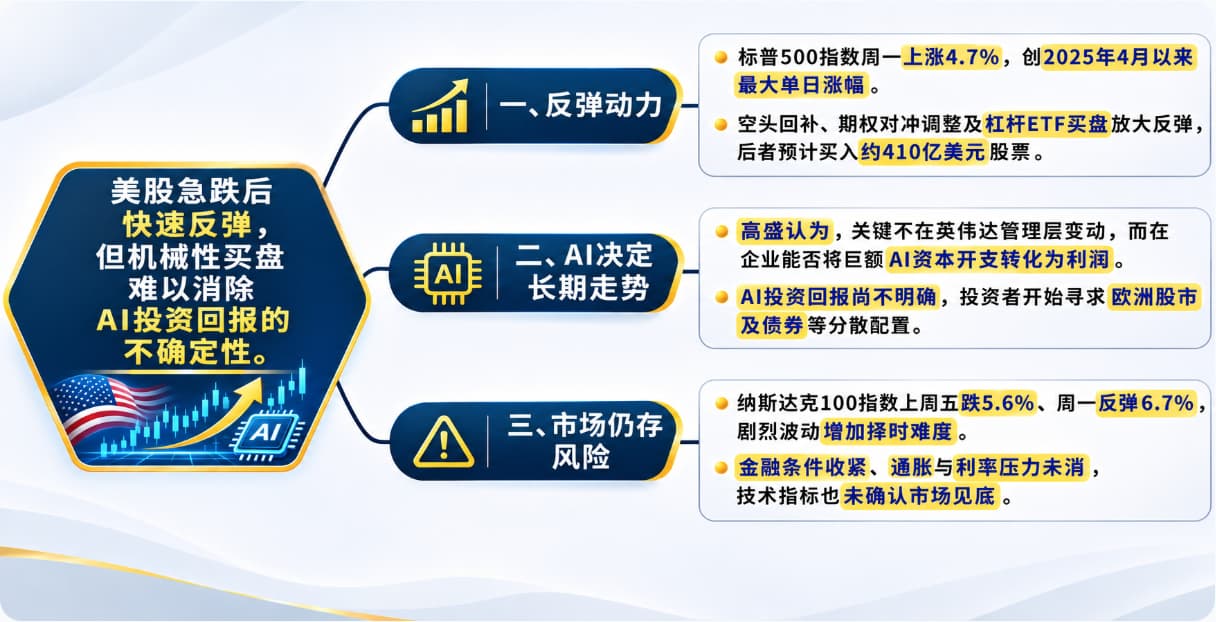
U.S. stocks rebounded rapidly after a sharp sell-off, with market sentiment reversing significantly within just a few trading days. News related to NVIDIA ( NVDA.O ) drove the tech stocks higher, but this round of gains was also fueled by passive buying driven by trading mechanisms. Although the short-term trend has reversed quickly, the long-term direction still depends on whether companies can generate returns from their massive AI investments.
Mechanistic buying orders amplify market rebound
On Monday, the S&P 500 index ( SPX ) rose by 4.7%, recording the largest single-day increase since April 2025. Analysts at Nomura Securities believe that this rebound is driven not only by improved market sentiment but also by mechanical buying triggered by various trading strategies.
During previous market downturns, traders had hedged against the risk of put options by selling stock index futures. As stock prices rebounded and volatility decreased, some put options became deeply out-of-the-money, and traders' hedging needs changed accordingly, necessitating the repurchase of futures. Short covering and other investors' chasing of gains further pushed up stock indices.
The Volatility Index VIX tumbled by more than 9 points on Monday, which also prompted some strategy funds to adjust their positions. Nomura analyst Charlie McEligott Charlie McElligott estimated that leveraged exchange-traded funds may have bought stocks worth approximately $41 billion on that day in order to maintain their target leverage, making it the second-largest single-day purchase on record for Nomura. In contrast, volatility-controlled funds are expected to sell between $11 and $16 billion.
Trend-following funds may also experience a change in direction. The Nomura model shows that strategy signals for various time periods over the past few weeks have turned bearish; however, if the S&P 500 index closes above 7,043 points, its 12-month model will turn bullish, expected to generate approximately $16 billion in buying orders for S&P 500 index futures and $2.5 billion in buying orders for NASDAQ 100 index futures. The S&P 500 index closed at 7,237.17 points on Monday.
However, McEligott reminds that a single-day rebound cannot eliminate structural pressures such as tightening financial conditions, adjustments to AI capital expenditure expectations, high inflation, rising real interest rates, and widening credit spreads.
AI Investment returns determine the long-term direction of the market
Sharon Bell, a European equity strategist at Goldman Sachs ( Sharon Bell ), also believes that the key to determining whether the AI transaction can continue does not lie in changes to NVIDIA's management, but rather in whether the company can obtain sufficient returns from its massive capital expenditures.
In an interview with Bloomberg TV, Bell stated that if companies can demonstrate that investments in AI can be converted into profits, the long-term performance of the tech sector will be supported; otherwise, market performance will be hindered. She believes that changes in NVIDIA's management will not fundamentally change this assessment.
Currently, the U.S. stock market is highly concentrated among a few large companies, and news about a single enterprise can also trigger significant market fluctuations. This level of concentration has prompted global investors to reconsider their asset allocation in search of diversification opportunities beyond AI trading. Bell pointed out that the correlation between European stock markets and AI trading is relatively low.
Discussions among enterprises about AI are gradually shifting from technical applications to profitability, but there is still limited data on investment returns at the project level. The market has not fully convinced itself that such substantial AI capital expenditures will lead to corresponding profit growth.
Bell's team has recently increased its bond allocation, while continuing to overweight stocks, and recommends using a combination of stocks and bonds to cope with volatility. She also reminded that in an environment with high inflation and potential interest rate hikes, market fluctuations tend to be more pronounced.
Sharp rises and falls make it more difficult for the market to time its entries and exits.
The sharp fluctuations in the market also make it more difficult for investors to determine the right timing for entering and exiting positions. The Nasdaq 100 index ( NDX ) fell by 5.6% last Friday and then rose by 6.7% on Monday. If investors chose to exit their positions during the decline, they would likely miss out on the subsequent days of significant gains.
Bloomberg data shows that if investors miss the 10 trading days with the best performance for the S&P 500 index this century, their annualized return would be reduced by half. Chris Galipo, head of market strategy at Franklin Templeton Investments, stated: "It is more important to continue investing in the market than to try to time the market." Investors not only need to decide when to exit but also when to re-enter the market.
A calculation based on Hightower Signature Wealth shows that if $10,000 was invested at the end of 1999 and held continuously, the asset value has exceeded $75,000 by this year; however, if the investor sold during a market downturn and thus missed out on some of the maximum gains, the asset size would only have increased to about $33,000.
Michael Wilson, Morgan Stanley's chief U.S. equity strategist and chief investment officer ( Michael Wilson ), pointed out that over the past five to ten years, it has become increasingly difficult for markets to provide exiting investors with opportunities to re-enter. However, he does not believe that investors should enter the market all at once on the first day of a rebound. Wilson described Monday's rise as a typical reflexive rebound following a period of selling and reminded investors to carefully choose the timing of their entry and the specific stocks to invest in.
Market technical indicators have also not provided clear signals of a reversal. Jonathan Klingsky, the chief market technical analyst at BTIG, pointed out that when the S&P 500 index is below its 200-day moving average, if the index rises more than 4% in a single day, it will still fall by an average of 2.1% in the following five trading days. He believes that the market may not have truly bottomed out yet.