

The positive market sentiment brought about by Jensen Huang's return to the CEO position at NVIDIA (NVDA.O) is beginning to fade, and investors are once again turning their attention to the massive financing needs of the artificial intelligence industry, as well as the potential impacts if the construction of data centers slows down.
NVIDIA still faces a core issue that has not been resolved: to what extent should it leverage its strong balance sheet to provide financial support for the artificial intelligence ecosystem and the demand for its chips?
In recent years, NVIDIA has supported customers purchasing its chips through equity investments and financing guarantees. This business model has been referred to by the market as the "NVIDIA Bank" ( Bank of Nvidia ). As investors' doubts about the return on investment in AI deepen, this model is facing increasing scrutiny.
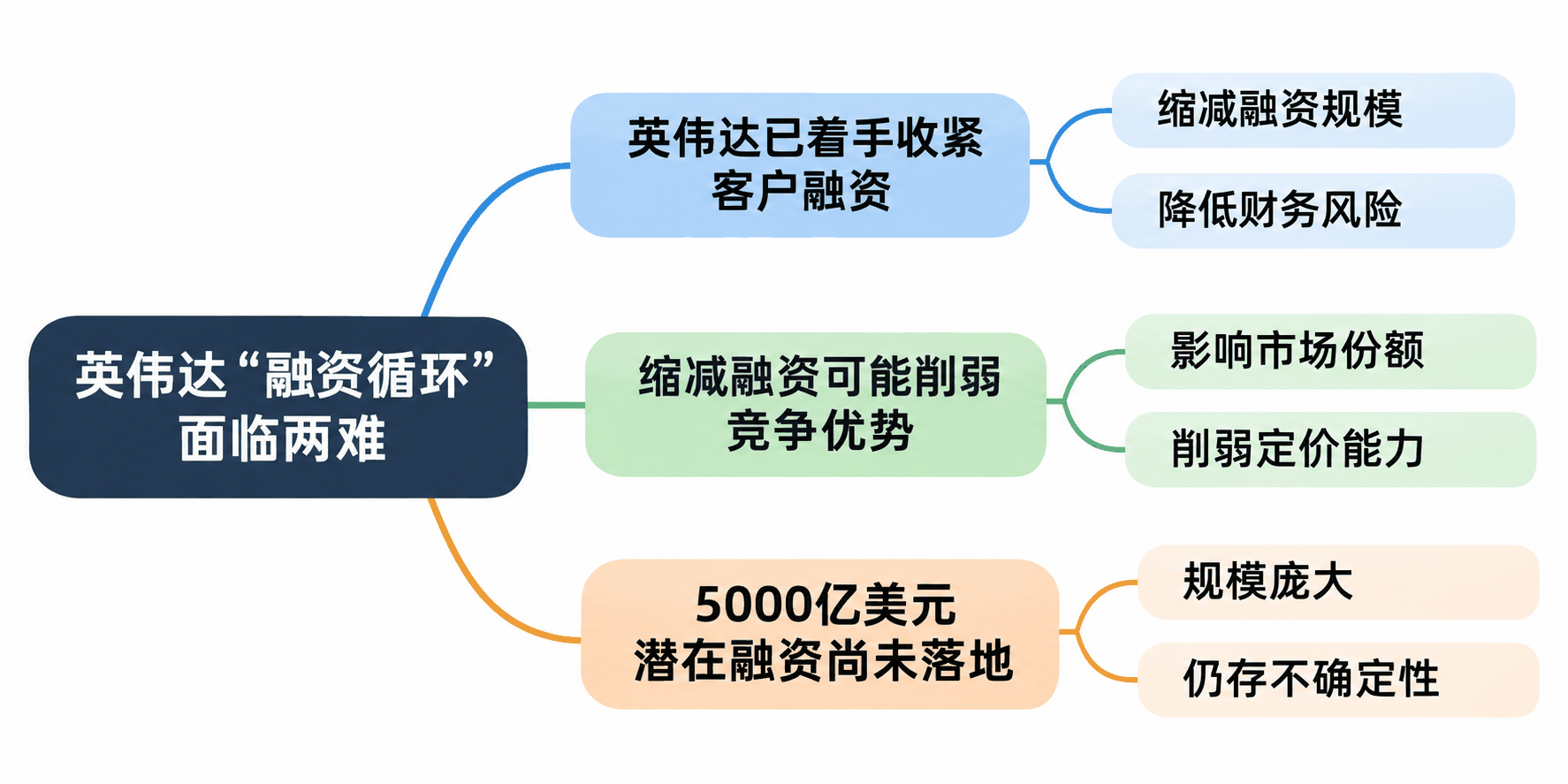
NVIDIA has begun to tighten customer financing requirements.
Before Jensen Huang's brief departure, NVIDIA had already begun to provide financing support for the artificial intelligence industry more cautiously. The price of credit default swaps (CDS) used to measure the company's credit risk had previously started to rise and is still at a high level currently.
Jensen Huang has previously requested that emerging cloud computing service providers ( Neocloud ) solicit more advance payments from their own customers in order to reduce their dependence on NVIDIA's financial support.
It is reported that NVIDIA had previously planned to reduce the guarantee scale provided for the leasing obligations of a data center park in OpenAI, but the potential liability exposure remains as high as $105 billion.
NVIDIA's Chief Financial Officer Colette Kress ( Colette Kress ) stated last week during a financial report conference call that the company will maintain prudence and discipline, and will rigorously evaluate future transactions. According to The Wall Street Journal, she also told some investors that NVIDIA will continue to support emerging cloud computing service providers, but will not provide financing to all companies.
Analyst Ruben Roy ( Ruben Roy ) believes that Jensen Huang's return to his position is unlikely to prompt NVIDIA to quickly resume its broader customer financing business.
From the perspective of shareholder returns, NVIDIA also has other options for the use of funds. As of the end of October, the company still had a remaining stock repurchase authorization of up to $227 billion, and the market expects its revenue to grow by 75% next year.
Nevertheless, NVIDIA's current market value of approximately $3.6 trillion is still far below its historical peak, which is about 10 times the earnings expected by analysts for the fiscal year ending January 2028.
Reducing financing may weaken NVIDIA's competitive advantage.
Although customer financing increased NVIDIA's financial risks, it also helped the company expand its customer base and reduce its dependence on traditional large cloud computing service providers.
Currently, over 40% of NVIDIA's data center business revenue comes from customers who are not hyperscale cloud service providers, including enterprise customers and emerging cloud computing service providers.
If NVIDIA reduces its financial support, and the debt financing costs of emerging cloud computing service providers continue to rise, the demand for chip purchases may further concentrate among large technology companies, which are also accelerating the development of their own chips in an attempt to reduce their dependence on NVIDIA.
Major artificial intelligence laboratories such as OpenAI and Anthropic are expected to account for approximately 15% of NVIDIA's data center revenue, but both companies are working to diversify their chip supply.
OpenAI CEO Sam Altman ( Sam Altman ) is seeking to reduce the costs of building computing power. Currently, the cost required to build one gigawatt of AI computing power is about 70 billion US dollars. In contrast, NVIDIA's gross margin still exceeds 70%.
Anthropic has also established a multi-chip strategy, covering Google's TPU, Amazon's Trainium, as well as GPU of AMD.
Bernstein analysts expect that the market share of custom AI accelerated chips will rise from 10% this year to 20% by 2027.
$500 billion in potential financing has not yet been secured.
NVIDIA's competitors are also using their own balance sheets to compete for customers. Broadcom has previously provided financial support for the computing power procurement commitments of Anthropic.
In contrast, the $500 billion potential Wall Street financing plan announced by Jensen Huang in August this year, aimed at helping companies with weaker financial strength to purchase NVIDIA chips, has not yet been actually utilized. Although negotiations with banks are still ongoing, NVIDIA is facing increased pressure to bear the risk of customer defaults.
Some customers with stronger financial capabilities are able to resolve financing issues independently. SpaceX has ample funds after a large-scale public offering and financing, and has obtained an investment-grade credit rating due to its profitable broadband business. As a result, it has secured tens of billions of dollars in off-balance-sheet financing without the need for NVIDIA's involvement.
However, not all AI enterprises possess such financing capabilities. Even though Anthropic has expanded its capital base to over $200 billion through IPO and private placements, the substantial capital expenditures and fluctuations in cash flow may still make it difficult for them to immediately obtain an investment-grade credit rating.
Analyst Jay Goldberg ( Jay Goldberg ) stated that NVIDIA hopes to reduce the credit support provided to customers, but there is a limit to the extent of reduction that can be made. If the vast financing system that encourages customers to use NVIDIA chips begins to weaken, its dominant position in the AI computing power market may also be affected.