

Despite the latest inflation data from the United States reinforcing market expectations for further interest rate hikes by the Federal Reserve, silver has rebounded after experiencing significant selling pressure earlier on. However, silver has not yet formed a solid bottom and still faces the risk of further declines in the short term.
Data shows that since the beginning of the fourth quarter, the non-commercial net long positions in silver futures have decreased by approximately 36 million ounces, mainly driven by an increase in short positions, while during the same period, silver ETF recorded a net inflow of nearly 14 million ounces.
UBS believes that the weakening investment demand reflected in the futures market outweighs the positive impact of capital inflows from ETF. However, it is expected that silver ETF positions will still maintain a certain level of resilience, and the Federal Reserve's further tightening of monetary policy will become an important test.
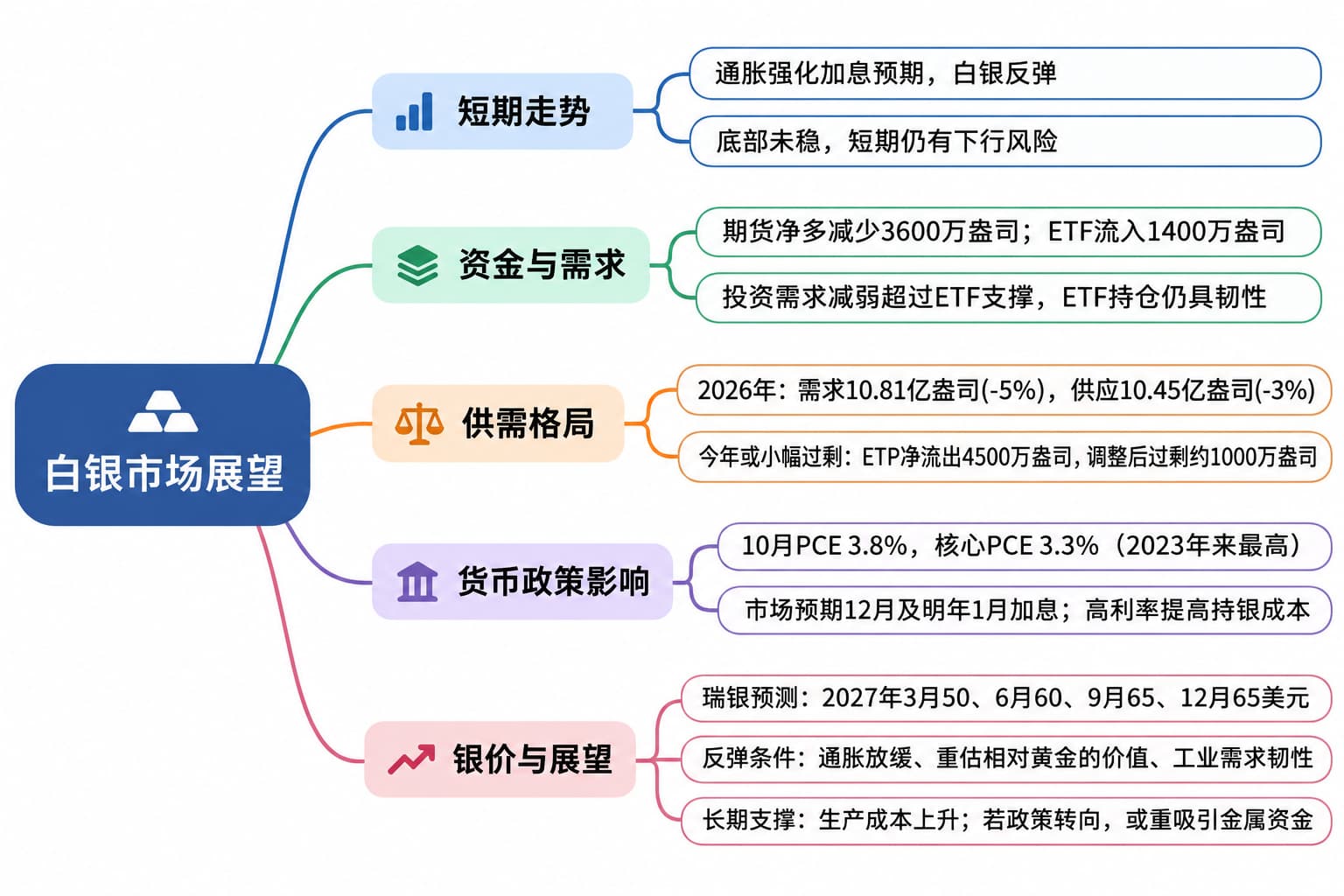
Data released by the U.S. Department of Commerce on Wednesday this week showed that in October, the PCE price index rose 3.8% year-on-year, and the core PCE price index rose 3.3% year-on-year, with the latter recording the highest growth rate since 2023. Financial markets have already factored in the expectation of the Federal Reserve raising interest rates by 25 basis points in December and anticipate another rate hike in January next year. Maintaining high interest rates will increase the opportunity cost of holding interest-free assets such as silver.
This year, there may be a slight surplus in the silver market.
The latest annual supply and demand estimate compiled by research institution Metals Focus for the World Silver Association shows that global silver demand is expected to decline by 5% in 2026 to 1.081 billion ounces, with total supply expected to fall by 3% to 1.045 billion ounces, resulting in a market supply gap of about 35 million ounces.
Among them, industrial demand is expected to decline by 3% to 640 million ounces, silver jewelry demand to fall by 22% to 148 million ounces, and demand for silver bars and coins to decrease by 2% to 215 million ounces.
However, UBS holds a different view on the supply shortage. The bank believes that the forecast of a 35 million ounce supply gap depends on the demand for silver bars and coins remaining strong, but this demand has been under pressure in recent months. Therefore, it is expected that the silver market will approach supply-demand equilibrium this year, with a slight bias towards oversupply.
The World Silver Association also expects that this year, there will be a net outflow of 45 million ounces of silver exchange-traded products ( ETP ), compared to a net inflow of 278 million ounces last year. Taking this change into account, the adjusted supply-demand balance in the silver market this year is expected to show a surplus of 10 million ounces.
Will silver prices rebound to $65 next year?
UBS pointed out that silver has fallen by nearly 70% from this year's peak, with the speed and magnitude of the decline being rare since the global financial crisis and the early 1980s. However, when considering the actual price adjusted for inflation, silver is still higher than during most of the past 25 years, and there is still a potential for a 25% to 50% decline before reaching what UBS considers a more reasonable valuation level.
An increase in production costs may gradually raise the long-term actual price center of silver. Some high-cost producers experienced a comprehensive maintenance cost ( AISC ) this first half of the year that was $10 to $20 per ounce more than in the same period last year, or even more.
UBS believes that US monetary policy will become a key driving factor for the silver market trend in 2027. As US economic activity slows down and inflationary pressures ease, the Federal Reserve is expected to end its interest rate hike cycle in the first quarter of next year, with inflation possibly falling further or reigniting market expectations for interest rate cuts starting from the second quarter.
Even if the actual interest rate cut is postponed until 2028, the anticipated shift in monetary policy could still attract investors back into the precious metals market.
The latest research report provides the following silver price forecasts:
- End of March 2027: $50 per ounce
- End of June 2027: $60 per ounce
- End of September 2027: $65 per ounce
- By the end of December 2027: $65 per ounce
UBS believes that silver has significant potential for a rebound in the next 12 months, but this judgment depends on the continued slowdown of inflation in the United States, investors' renewed focus on the valuation advantages of silver relative to gold, and whether industrial demand can remain resilient.