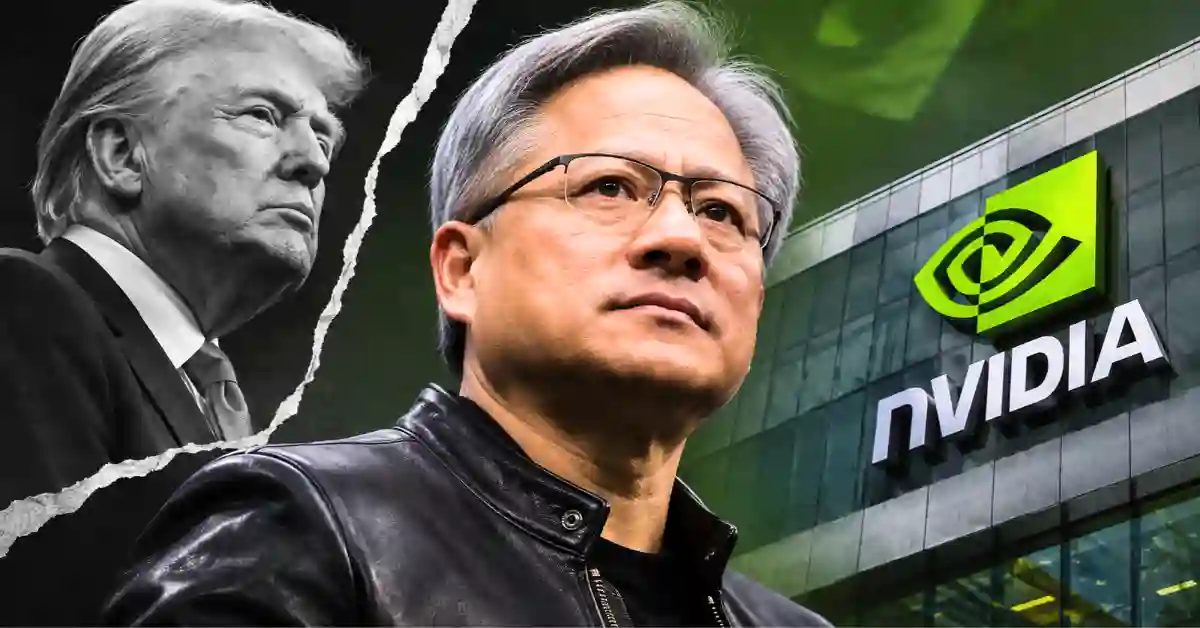
The Nasdaq 100 index recorded its largest one-day gain in nearly 19 months, with NVIDIA's market value increasing by over $950 billion in a single day, setting a new historical record. However, this seemingly strong rebound did not dispel market concerns. Peter Callahan, the chief expert in the technology sector at Goldman Sachs, stated that on the day of the rebound, clients repeatedly asked only one question: "Is this really true?"
NVIDIA closed the day with a gain of about 31%, increasing its market value by approximately $952 billion, setting a new record for the largest single-day increase in market value among global listed companies. However, the Nasdaq 100 index still saw a cumulative decline of about 140 basis points over the previous three trading days, and the overall decline for the week exceeded 10%. Goldman Sachs noted during mid-day review that even after the rebound, both the S&P 500 index and the Nasdaq 100 index only returned to their levels from last Thursday.
There is a clear divergence in the market regarding whether the rebound can be sustained. The bulls believe that the bearish positions have been largely cleared, and this round of adjustment is more driven by sentiment rather than a deterioration in fundamentals; on the other hand, the bears warn that long-term uncertainties such as regulatory reviews, the return on investment of AI, and industry growth prospects have not yet been resolved. For the index to regain the ground lost earlier and once again stand above the 200-day moving average, it still faces significant resistance.
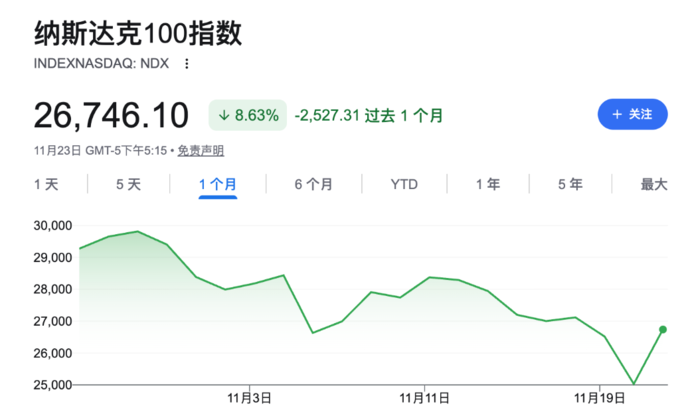
One rise cannot offset three falls; can the rebound continue?
In its report to clients, Callahan pointed out that despite the astonishing gains on that day, the debate about the sustainability of the rebound remained intense in the market. After the Nasdaq 100 index rose by more than 5% in a single day, the cumulative decline over the previous three trading days was still about 140 basis points, and the cumulative gain over two days was only about 70 basis points. Measured by the previous daily decline of about 6%, this rebound merely recovered the losses from one trading day, while the index's cumulative decline for the week still exceeded 10%.
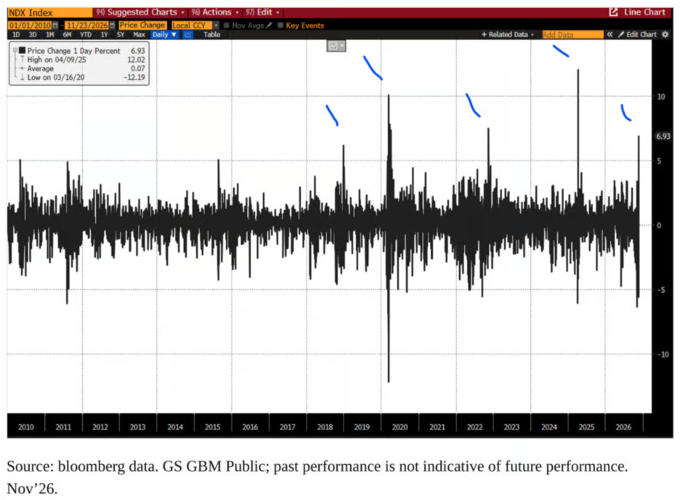
From a historical perspective, Callahan points out that in the past 15 years or so, it has been extremely rare for the Nasdaq to experience a single-day increase of more than 5%. Each time this occurred, it corresponded to or was close to a temporary market low point, including in April 2025 when the United States temporarily postponed the implementation of some tariff measures, in November 2022 when CPI in the U.S. cooled down, in March 2020 during the impact of the pandemic, and in December 2018 when concerns about the Federal Reserve's interest rate hikes eased.
However, significant rebounds in history do not necessarily mean that the market has hit bottom. According to Bloomberg, Goldman Sachs derivatives trader Brian Garrett previously cited a similar case from December 2018: back then, the Nasdaq soared by 5% following a massive sell-off in the market on Christmas Eve. Based on this historical scenario, the corresponding level for the S&P 500 index would be around 6,294 points.
Surge in trading volume, where do the buying orders come from?
On that day, the trading volume of the constituent stocks of the NSE index was about 60% higher than the average level from the beginning of the year to date. However, Callahan indicates that the order flow actually received by Goldman Sachs' trading desk fell far short of expectations. Another notable signal is that in the early hours of that day, the trading volume of ETF once exceeded 30%, approaching the high point of the year. This suggests that market transactions were more focused on overall position adjustments at the index level, rather than actively selecting individual stocks.
According to Bloomberg, Nomura Securities previously analyzed that the buying pressure on that day mainly came from market makers, trend-following strategies, and leverage. These transactions were more driven by position adjustment mechanisms rather than active bullish sentiment. At the same time, despite a significant increase in trading volume, market liquidity remained weak, with a depth of about 2.5 million US dollars. Trading accounted for approximately 33% of the total market, which is significantly higher than the average level of 28% since the beginning of the year.
Goldman Sachs' proprietary trading data also shows that hedge funds continued to increase their short positions last week, with the long-to-short ratio dropping to a historical low. Therefore, the rebound on that day reflected to a considerable extent the covering of short positions by traders, rather than a large influx of new long positions. In other words, increased trading volume does not necessarily mean that funds are re-establishing bullish positions.
Long-short divergence: Has the risk been cleared?
To be honest, on the day of the rebound, what was received was more questions rather than clear market opinions. Most investors are still in a state of 'not knowing'. Callahan
The core judgment for the bulls is that they have continuously adjusted their positions, significantly digesting the bearish positions in the market. The recent decline in AI and the semiconductor sector is more driven by sentiment, indicating a bear market rather than a fundamental turnaround. In this situation, the market may be approaching a state where "no one has anything to sell," which creates the conditions for a technical rebound.
However, the sector's performance remains weak. Since November, only 3 of the components in the Philadelphia Semiconductor Index have recorded positive returns, while the index as a whole has fallen by 10.8%. Even though NVIDIA saw a significant increase of 31% on that day, its monthly decline was still around 19.5%; Marvell experienced a decline of 27% during the same period.
Short sellers believe that the structural risks faced by the market have not disappeared, including issues such as the approval of infrastructure site selection for AI and whether the return on investment can be sustained, as well as the growth trajectory of Token. Uncertainty at the regulatory level also constitutes pressure: NVIDIA is still facing investigations from the US Department of Justice and the Securities and Exchange Commission.
Goldman Sachs analyst James Schneider believes that until the relevant investigations are concluded, NVIDIA's valuation multiples will continue to be under pressure. Based on the normalized earnings per share calculation used by Schneider, NVIDIA's current stock price is around $166, with a price-earnings ratio of less than 17 times.
In addition, according to Bloomberg, data from Goldman Sachs Lee Coppersmith over the weekend shows that retail investors and long-term funds still hold a large number of long positions; JPMorgan Chase also pointed out that true long-term funds have not significantly reduced their positions. This means that the so-called "no one to sell to" situation in the market may not be the case, and there is still room for further selling in the future.
The 200-day moving average remains a key threshold.
Callahan pointed out that the NASDAQ 100 index is currently still about 5% below the 200-day moving average, which is at 28,082 points; compared to the historical high set on October 6th, the index still has about a 15% gap to cover. He is focusing on two technical signals: whether the index can break through the downward trend line and whether it can once again stand above the 200-day moving average.
Historical experience shows that when an index remains consistently below its 200-day moving average, it is usually difficult for the market to form a stable trend, and such a significant decline is also unlikely to be reversed within a month.
The intraday performance during this rebound is also worthy of caution. Callahan noted that almost all of the gains on that day for the Nasdaq index were concentrated within about 20 minutes from 8:55 am to 9:15 am; thereafter, for over six hours of trading time, the index remained relatively flat and consolidating.
The key verification indicators previously proposed by Goldman Sachs Rich Privorotsky still apply: if NVIDIA's stock price continues to rise, but the credit spreads related to emerging cloud computing companies remain high, then this rise is more likely to be a short covering rather than a confirmation of a trend reversal. In other words, whether the stock price rebound is also recognized by the credit market remains an important basis for judging whether the AI market is truly stabilizing.
Callahan It is expected that due to the Thanksgiving holiday, the opening performance on the next trading day will have a significant impact on market sentiment over the following two and a half trading days. In addition, policy developments related to NVIDIA, as well as the public hearing in the Senate on December 3rd, may also become potential factors affecting market trends.