Key points:
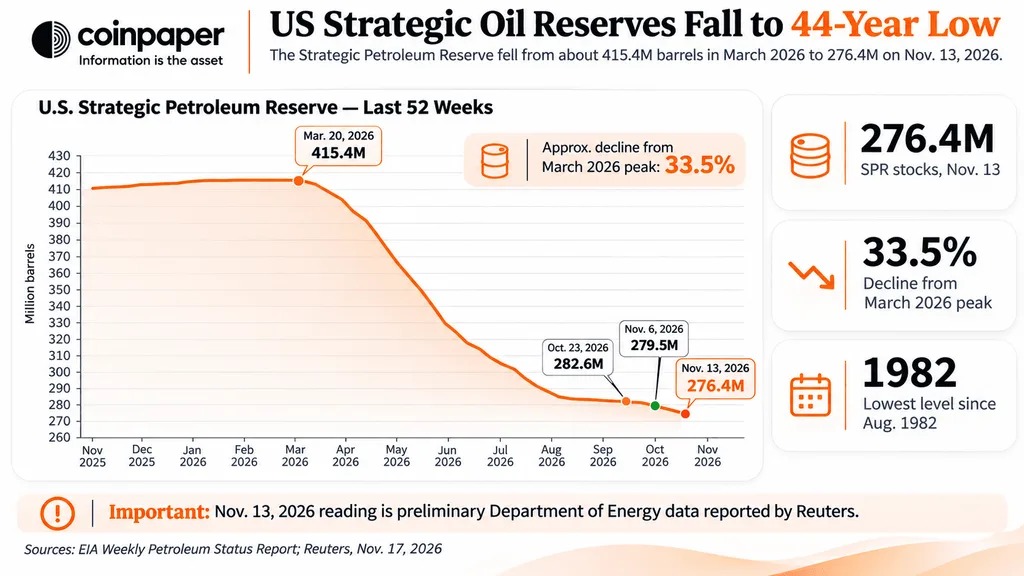
- U.S. emergency oil reserves drop to 276.4 million barrels
- Strategic inventory levels drop to their lowest since 1982
- Despite a reduction in emergency supplies from the United States, Brent crude is still approaching $90.
The United States' Strategic Petroleum Reserves ( SPR ) have dropped to around 276.4 million barrels, the lowest level since 1982; meanwhile, after a sharp reversal in global oil prices, Brent crude oil remains hovering near $93 per barrel.
According to Reuters, citing data from the U.S. Department of Energy, as of the week of November 13, emergency reserves continued to decline, bringing Washington's strategic oil buffer to its smallest level in over 40 years.
This decline occurred after reaching a 44-year low in October. At that time, inventories were 282.6 million barrels, while the price of Brent was above $115 per barrel.
U.S. Strategic Petroleum Reserves Continue to Decline Amid Crashing Oil Prices
Since March, this reserve has been reduced by about one-third, following emergency releases previously made to alleviate supply disruptions related to conflicts in the Middle East.
However, crude oil prices moved significantly in the opposite direction.
Brent crude oil has recently plummeted by 32% from its October high, falling from around $136, due to improved production and expectations of global supply surplus that have weakened the geopolitical risk premium.
On November 17th, the trading price of Brent futures approached $92.76 per barrel, while West Texas Intermediate crude oil ( WTI ) remained around $86 per barrel.
This opposite trend indicates that the market is increasingly taking into account the recovery of supply, while the United States' ability to cope with another major shock is declining.
OPEC + Production recovery drives Brent towards $90
One reason for the reversal in oil prices is that production in the Middle East has gradually resumed after several months of interruption.
According to the OPEC November report, this alliance of oil-producing countries increased its production to about 41.23 million barrels per day in October, returning to approximately 97% of pre-war production levels.
At the same time, the International Energy Agency expects that global oil supply will exceed demand in the fourth quarter, which further strengthens the expectation of weaker oil prices.
This prospect has also drawn market attention to the OPEC+ meeting to be held on November 29th, when major oil-producing countries will re-evaluate their production strategies for 2027.
However, the US Energy Information Administration's oil forecast for November still predicts that the average price of Brent crude in December will be around $99, which also indicates that there may be a significant discrepancy between official forecasts and current market expectations.
Could low U.S. oil reserves trigger another oil price shock?
A reduction in strategic oil reserves does not necessarily mean that oil prices will rise. Commercial inventories, global idle production capacity, and the direction of international trade also determine the market's ability to absorb supply disruptions.
However, the reduction in emergency reserves has indeed weakened Washington's flexibility in the event of another major supply disruption.
This risk is particularly noteworthy near the Strait of Hormuz. Previously, attacks on oil tankers caused Brent crude to rise above $116, with markets concerned about disruptions in energy transportation.
Emir Abyazov
Editor-in-Chief Coinpaper, responsible for data-driven editorial operations; SEO focuses on content discovery, as well as storytelling tailored to the audience. The reporting areas cover cryptocurrencies, artificial intelligence, and fintech.