Key Points
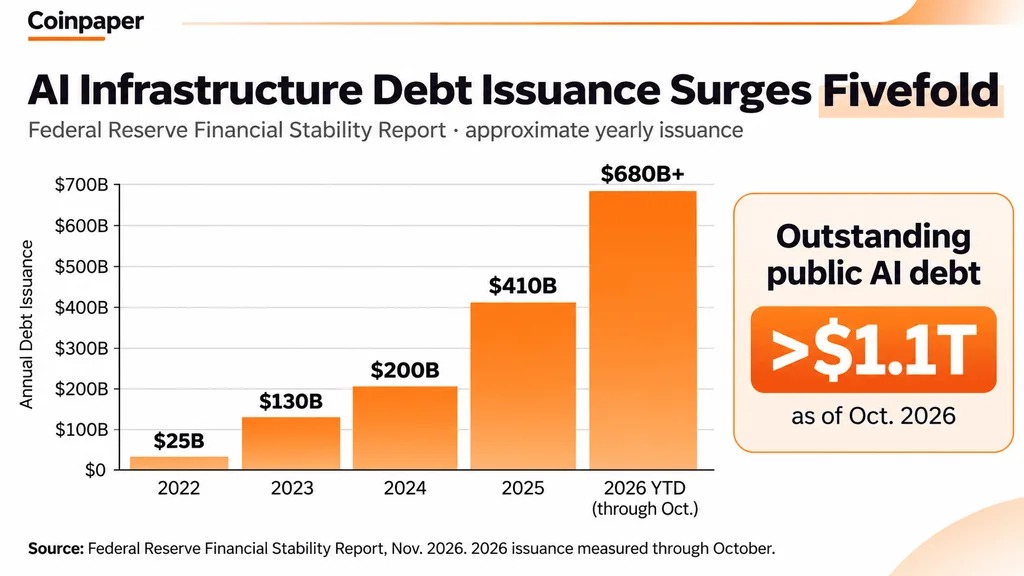
- AI The issuance amount of infrastructure debt has exceeded $680 billion.
- The Federal Reserve estimates that the outstanding public AI debt exceeds $1.1 trillion.
- Complex data center financing raises concerns about financial stability
The Federal Reserve warns that as the financing for artificial intelligence infrastructure expands rapidly, it may create vulnerabilities within the U.S. financial system. As of October 2026, debt issuance related to advanced computing has exceeded $680 billion.
In the "Financial Stability Report" released on November 13, this central bank stated that the borrowing scale related to the AI infrastructure has increased by approximately five times compared to the $130 billion issued throughout 2023.
AI Debt quintupled, the Fed notes a $1.1 trillion exposure
The Federal Reserve estimates that as of October, the outstanding public debt related to advanced computing has exceeded $1.1 trillion, and private credit transactions make it more difficult to determine the total exposure.
These data continue the trends identified in the previous AI infrastructure debt analysis. That analysis examined $466 billion in financing that had been disclosed as of September.
However, these figures come from different estimation and statistical periods, and therefore should not be added directly.
The Federal Reserve pointed out that large technology companies are increasingly relying on the bond market, private lending institutions, and project financing tools to support their expanding computing power capacities.
These arrangements are similar to the financing structures that we analyzed in the financing disassembly of the AI data center.
Nvidia and large technology companies face rising financial risks
The report also points out another concern: tech companies are assuming a large amount of obligations that go beyond the debt levels of traditional companies.
Future data center leasing commitments exceed $1 trillion, while the undiscounted value of guarantees and contractual commitments exceeds $2 trillion.
The Federal Reserve warns that GPU manufacturers and hyperscale cloud service providers sometimes provide guarantees or equity investments to help smaller companies obtain financing, which can create interrelated financial exposures.
If the demand for AI falls short of expectations, or if the anticipated revenue is not realized, these structures could expose investors to losses.
Recent financial reports also highlight the financing pressures faced by this industry. While CoreWeave has achieved considerable revenue growth, its debt burden has remained at a high level.
At the same time, Nebius has raised its expenditure outlook, indicating that scaling up computing power often requires a significant investment before revenue can keep up.
AI Can foam trigger a financial crisis?
Respondents viewed overly high valuations, complex financing arrangements, and cyber security threats as potential sources of instability.
These findings have intensified discussions regarding the impact of AI on the financial market, especially in a context where companies are reducing their investments or creditors are tightening financing conditions.
The Federal Reserve also compares the current expansion of infrastructure with the telecom investment boom at the end of the 1990s, when excessive spending, while bringing about real technological progress, also created vulnerabilities.
Ethan Mercer
Ethan Mercer is a financial journalist who covers cryptocurrency, stocks, and the global economy. He studied economics and finance before turning to market reporting, with a particular focus on Bitcoin, stocks, monetary policy, and investor sentiment. His work focuses on explaining daily market fluctuations and the broader trends behind them.