


The price of Bitcoin has fallen by nearly 15% from its recent high, breaking through the crucial support level of $75,000.
Short-term holders transferred approximately 48,500 BTC to the exchange within 24 hours, of which about 47,300 were reportedly transferred while in a loss-making state.
As more short-term holders exit their positions at a loss, the pullback in Bitcoin prices reveals deeper investor stress. After failing to hold above the $85,000 level, BTC continued to fall to around $74,000 and broke below an important technical support area. What's more concerning is that the latest on-chain data indicates that this may be one of the strongest short-term holder sell-offs in recent months.
Against the backdrop of increasing selling pressure and weakened institutional demand, the key question for the market is whether Bitcoin will be able to stabilize around $70,000 or whether it will continue to fall further.
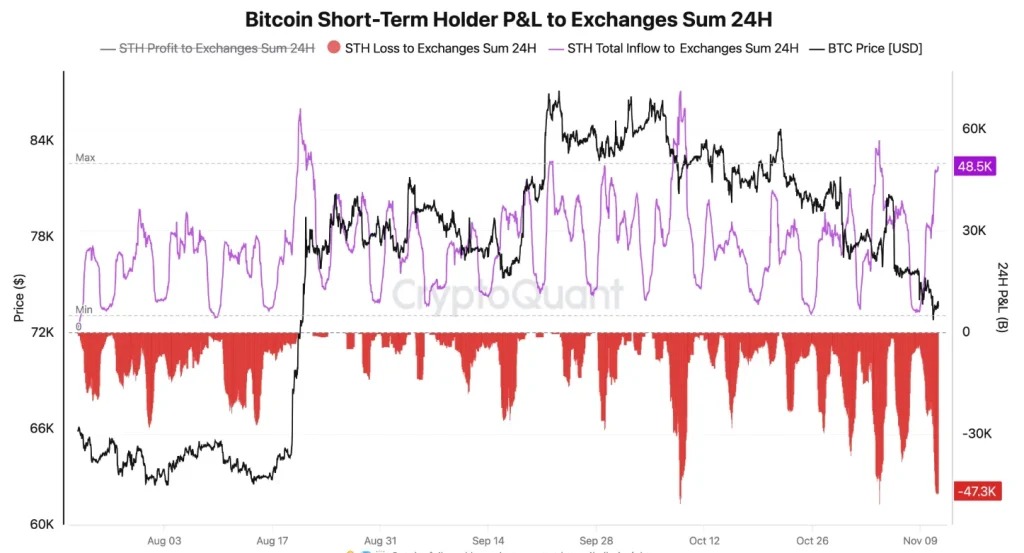
47,300 BTC tokens flowed into the exchange, indicating that short-term holders have given up.
According to on-chain data, short-term holders transferred approximately 48,500 BTC to the exchange within 24 hours, of which nearly 47,300 were transferred while in a loss-making state. This indicates that about 97.5% of these transfers were related to floating losses.
This change indicates that there is a shift in the behavior of the Bitcoin market. At the beginning of October, profit-taking drove a price correction; however, recent activity suggests that more investors are selling in order to reduce losses, rather than to lock in gains.
Why has Bitcoin fallen today?
The decline in Bitcoin prices reflects the combined effects of macroeconomic uncertainty, weakening institutional demand, and a deteriorating market structure. The latest U.S. inflation data has reignited concerns about interest rates remaining high, dragging down the preference for risk-sensitive assets. At the same time, the cryptocurrency market also faces additional pressures from regulatory uncertainties and a more cautious sentiment among investors.
Institutional capital flows are also weakening. The US spot Bitcoin ETF recorded a net outflow of approximately $430.2 million on November 5th, reversing the positive capital flow from the previous trading day. The withdrawal of funds further increased selling pressure, as it became difficult for Bitcoin to maintain a rebound. Overall, these factors make it increasingly challenging for BTC to attract sustained buying interest.
BTC can it rebound, or will $70,000 remain ahead?
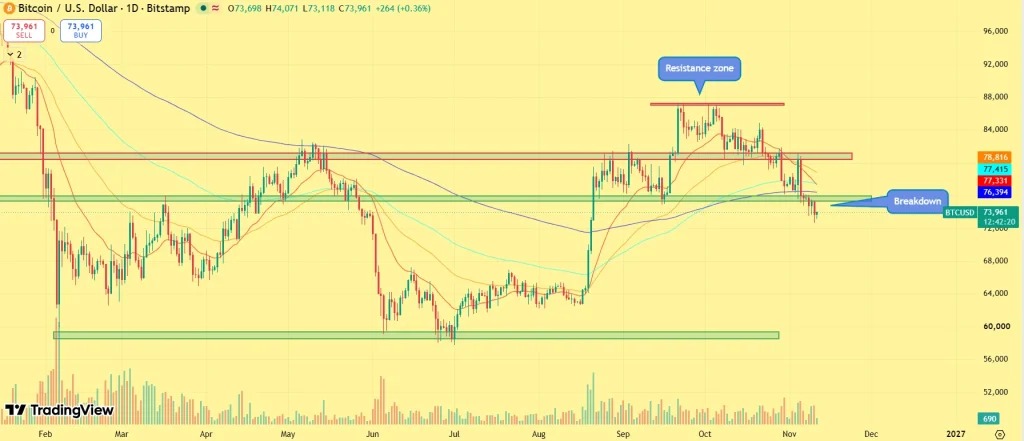
The Bitcoin price chart shows that after multiple attempts to break through the resistance range of $87,000 to $88,000 failed, the short-term structure has deteriorated. Subsequently, lower highs were formed, and the price fell below the support range of $76,000 to $77,000, a region that had previously attracted buying interest. BTC
Bitcoin is currently trading around $73,900, below its key moving average. The previous support level has now turned into a resistance level. Therefore, to improve the short-term outlook, it is crucial to regain levels above $76,000 to $77,000. On the downside, the range of $72,000 to $73,000 is an immediate support area that needs attention. If this level is continuously lost, BTC could fall to the psychological barrier of $70,000, followed by $68,000.
If selling pressure further accelerates, a broader demand range of $60,000 to $62,000 could become the next major downward area. On the contrary, if the price can recover to $77,000, it may help stabilize Bitcoin prices and create room for a further rebound to $81,000 to $83,000.