Fort Collins, Colorado, November 11, 2026 / PRNewswire / — Ampt announces the launch of a new battery converter that claims to enable more computing power to be operated per megawatt of grid capacity during the transition from 800 VDC architectures in the AI data center.
The company stated that this converter is capable of outputting a regulated 800 VDC from a DC bus shared by battery energy storage and the power grid or on-site power sources, and it provides active power regulation, responding to GPU load changes in less than 1 millisecond. By utilizing batteries to handle short-term peak loads, GPU does not require power limitation, and the grid connection capacity can be configured based on the average load rather than the peak load.
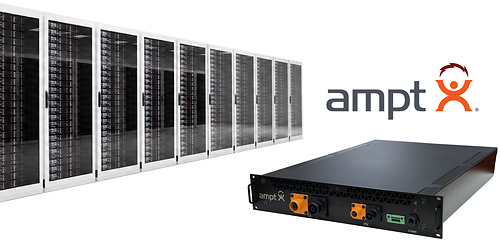
Each 2U rack-mounted device can provide 80 kilowatts (100 amperes) of power, and multiple devices can be connected in parallel for expansion, from a single rack to an entire row of cabinets, or to cover the entire GPU cluster. Ampt indicates that this battery converter is currently undergoing pilot tests in data centers with partners, and is expected to be fully launched in the third quarter of 2027.
Why is a millisecond-level response so important?
According to NVIDIA, data centers are transitioning to an 800 VDC power supply architecture for rack-level AI systems. This architecture is expected to support 1 megawatt of IT racks and can improve end-to-end power efficiency by up to 5% compared to 54-volt systems.
The article states that the workload of AI can cause the power consumption of a single rack to fluctuate between 30% and 100% within a few milliseconds. The power grid requires a stable and predictable load, whereas GPU needs a highly dynamic power supply. According to NVIDIA's white paper, energy storage "needs to fill the gap between these two conflicting requirements."
How does a battery converter work?
According to the design of Ampt, batteries, the power grid, and any on-site power generation equipment are all connected to a common DC bus. A battery converter reduces the voltage of this bus to a stabilized 800 VDC to supply power to the GPU racks.
Ampt indicates that when the load of GPU changes, its converter can respond in less than 1 millisecond, allowing the battery to provide or absorb the difference. As a result, the demand perceived by the power grid or on-site generation equipment becomes more stable. By smoothing these peaks, operators can configure upstream power equipment to better match the average demand, thereby reducing equipment costs and operating with a more stable load. This may also help the site obtain grid connection more promptly.
The power grid is connected to the DC bus through medium-voltage transformers and power conversion systems, and it supplies power to batteries that can operate at a maximum capacity of 1500 VDC. The company states that if a grid-forming power conversion system is equipped, the batteries, which are used to absorb GPU load fluctuations, can also actively support the voltage and frequency of the power grid.
Ampt indicates that these transformers, power conversion systems, and batteries are of the same type as those used in current utility-scale energy storage. Therefore, data center operators can rely on a mature supply chain and also take advantage of Ampt's nearly two decades of experience in the deployment of DC power conversion for utility-scale solar and energy storage systems.
How does this design improve efficiency?
The article states that in the AI factories with limited power supply, every kilowatt of power lost during the conversion and distribution process reduces the capacity available for the operation of GPU. Moreover, operators have to bear double costs as a result: once in the form of electricity fees, and again as cooling costs.
Ampt indicates that in order to reserve more power for computing power, the design reduces losses in converters, energy storage, and power distribution. The peak efficiency of this battery converter can reach up to 99.2%. The stored energy is always maintained in direct current (DC) form, thus avoiding the costly process of converting DC to AC and then back to DC in AC-coupled energy storage.
In addition, the DC bus voltage that powers the converter can vary between 1100 VDC and 1500 VDC depending on the battery state of charge, while the converter outputs a stable 800 VDC to the GPU rack. Higher voltages allow the transmission of the same power at lower currents, thereby reducing conductor losses or enabling the use of conductors of smaller specifications.
According to Ampt, this battery converter is designed for the first-generation 800 VDC racks, and it also offers the benefits of higher distribution voltages, which are currently only planned for future roadmaps.
How can converters be extended?
Ampt indicates that its battery converter can be paralleled and expanded to any power level. Therefore, the same 2U, 80-kilowatt (100-ampere) module can serve either a single GPU rack or an entire row of cabinets or the whole data center.
Adding just one more device can provide N+1 redundancy, ensuring that the full power output can still be maintained even when one device goes offline. The company also stated that sites that already have or plan to deploy solar energy can connect their photovoltaic systems to the same battery DC bus through Ampt String Optimizers, without the need for additional inverters or transformers.
Ampt CEO Aaron Gomolak stated: "In the AI factory, the load fluctuates in milliseconds, so energy storage must be operational at all times. With the help of Ampt battery converters, the same set of batteries can provide a stable load for the power grid as well as the fast-response power required by GPU. For operators, this means more reliable computing power and a faster path to bringing new AI capacity online. For the surrounding communities, it means a data center that is more friendly to the power grid."
Ampt indicates that for information on specifications or to arrange for a pilot project, you can visit the company's website or contact [ email protected ].
About Ampt
Ampt indicates that the company provides power conversion and communication technologies, which are used to reduce the cost of new photovoltaic systems, improve the performance of existing systems, support lower-cost DC-coupled energy storage, and provide 800 VDC of power for the AI data center. The company claims that, with its installation and service experience in the global market, Ampt is the number one DC optimizer company in the field of large-scale systems.
The company is headquartered in Fort Collins, Colorado, USA, and has sales and support offices in North America, Europe, Japan, and Australia. It also has representative offices in Asia and the Middle East. For more information, please visit www.ampt.com, or follow Ampt on LinkedIn.
Ampt also indicates that NVIDIA is a trademark and/or registered trademark of NVIDIA Corporation in the United States and other countries.