IT News from the scene on November 6th: The 9th China International Import Expo (hereinafter referred to as "CIIE") was held at the Shanghai National Exhibition and Convention Center from November 5th to 10th.
Wang Zhicong, Chairman of Intel China, introduced to media such as IT Home that this year Intel has also brought some very interesting products, such as the Green Computing Power Cabin (Intel's integrated solution for green energy storage and computing power). In the future, these computing power cabins will be introduced to western China, where they will be combined with new energy sources like solar and wind power to convert computing power into useful elements.
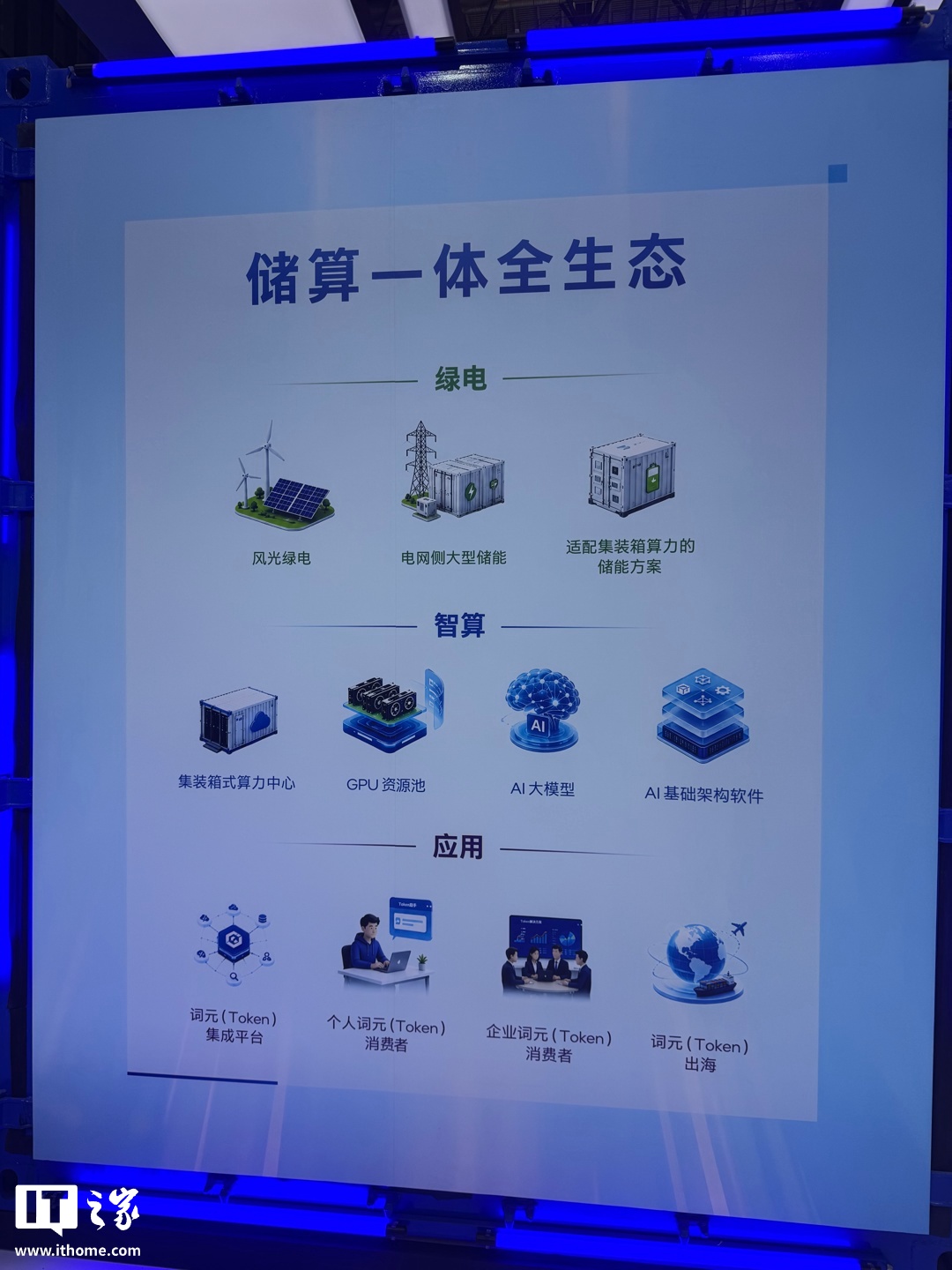
Speaking about Intel's future plans for its "integrated storage and computing" solution, Wang Zhicong mentioned that this is a brand-new approach proposed by Intel since last year in response to the country's "15th Five-Year Plan." The "15th Five-Year Plan" highlights two key directions: one is the "morpheme economy," and the other is "computing and power collaboration." "We observed that there is an abundance of new energy resources in western China, but the actual utilization rate of these resources is not very high. Therefore, we wondered if it would be possible to create a highly mobile standard container solution. Container deployment is relatively easy; there is no need to build traditional physical data centers. They can be directly placed next to photovoltaic power stations, enabling 'green power supply' directly."

He stated that the losses associated with long-distance power transmission are very significant. For example, transmitting electricity over thousands of kilometers from the remote western regions to Shanghai results in substantial transmission losses; moreover, green energy is subject to weather conditions and its generation is not very stable. The fundamental intention behind Intel's development of this solution is to bring this containerized approach to the western regions, to directly convert green electricity into usable form without any loss, efficiently, on-site. Then, through a computing power network, these converted units (or "elements") are scheduled and, after software optimization, distributed for use by businesses or individuals.
In addition, the future form of green computing power pods will evolve in various ways: they can serve as local computing facilities for enterprise-level single/partial pods, or they can support a city in establishing a "meta-element factory." Since computing power pods support interconnection between multiple pods and modular expansion, it is possible to connect 100 computing power pods to directly build a large-scale computing center that outputs meta-elements.
At the same time, its construction period is extremely short. Intel currently estimates that it takes only about 8 to 12 weeks from the start of design and manufacturing to being put into use; whereas for traditional computing power centers, just the civil construction alone takes two years before they can begin to be installed and powered on. AI Technology is changing very rapidly, and the containerized modular format can help customers quickly keep up with the technological trends.
In addition, due to the extremely high computing power density and limited space within containers, if the traditional 48V power supply architecture is continued to be used, very thick copper cables would be required, which would consume too much physical space. Therefore, Intel is also actively advocating for the adoption of 800V high-voltage direct current power supply, in order to further reduce the volume occupied by power distribution units and leave more space for computing devices.