On November 5th, according to Bloomberg, which cited informed sources, Microsoft is strengthening its supervision over some data center projects involving Nebius, IREN, and Nscale. It is withdrawing from projects it considers to be higher-risk and is internally discussing whether to continue signing new cloud deals.
This shift was already evident in Microsoft's recent financial report conference call. Chief Financial Officer Amy Hood mentioned three times that delays in the delivery of third-party computing power were disrupting the company's spending plans.
Previously, Microsoft's overall commitments in the new cloud sector were quite substantial: the commitment amount for Nscale reached up to $43.8 billion, for Nebius up to $19.4 billion, for CoreWeave over $10 billion, and for IREN approximately $9.7 billion.
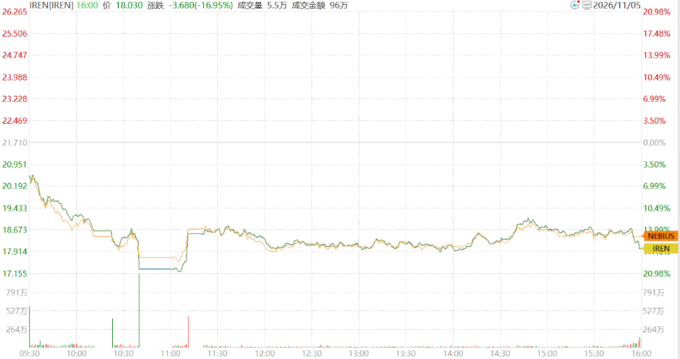
The aforementioned developments pose a significant impact on the new cloud industry. After the announcement, the stock prices of IREN and Nebius both fell by 20% for a time. Industry research firm Gartner previously estimated that by the end of 2030, 80% of new cloud service providers may face integration or closure.
Problems with the project are frequent, and IREN has become a focal point of potential hazards.
It is reported that one of the issues that have recently come to light involves wiring faults in a project developed by IREN in Texas. Data center servers rely on complex fiber optic networks for interconnection, and wiring problems can directly affect the overall delivery schedule.
In April of this year, a generator fire accident occurred in the park, and IREN disclosed in August that there were delays in hardware delivery locally, with problems having been accumulating over time.
It is reported that, according to informed sources, IREN held talks with Microsoft management last week to negotiate a revised schedule, which may result in a delay of several weeks or even months in the project completion time.
IREN refuses to comment on this. Microsoft, on the other hand, stated that the company manages its relationships with infrastructure partners based on 'its own and customer needs', including monitoring delivery progress and adjusting plans when circumstances change, and characterized the aforementioned measures as 'normal and responsible practices in managing large, complex infrastructure projects'.
Microsoft strengthens on-site supervision and project exit processes
Faced with the uncertainty of delivery, Microsoft adopted two parallel approaches.
On one hand, companies are increasingly sending personnel to work directly at project sites. It has been reported that in recent months, Microsoft has dispatched employees to its projects located in Nebius in New Jersey, as well as the projects in Texas conducted by Nscale and IREN, to ensure that the facilities are constructed in accordance with Microsoft's specifications and meet regulatory requirements.
On the other hand, Microsoft has begun to actively withdraw from projects that it deems no longer feasible. According to Wall Street Journal reports, Microsoft has withdrawn from several Nscale projects and refused to expand their collaboration in Texas; the relevant computing power was later taken over by Figure AI. In addition, Microsoft has retracted a letter of intent and no longer plans to rent 1.35 gigawatts of computing power located in West Virginia from Nscale.
Nscale has therefore suffered a double blow. According to reports by the British Financial Times, citing informed sources, Microsoft canceled a lease worth approximately $3 billion with Nscale's data center in Essex, UK, at the beginning of the year. The company incurred a net loss of $1 billion in the first half of the year, with revenue amounting to only $141 million, despite having a total contract backlog of $103 billion.
Nscale was originally preparing to launch a project valued at up to $35 billion, known as IPO. Its board of directors included former Meta executive Sheryl Sandberg and the former British Deputy Prime Minister Sir Nick Clegg. However, these consecutive setbacks have put the company's listing plans under new pressure.
Increasing industry pressure and rising regulatory risks
For the new cloud industry, the current external environment is also becoming increasingly challenging.
This week, several Democratic governors-elect were successful in their campaigns, and all of them listed strengthening data center regulation as an important issue during their campaigns. Among them, the incoming governor of Texas, Gina Hinojosa, called for an immediate suspension of data center development before a more comprehensive regulatory system is established, directly threatening the core operations of several new cloud companies.
Elon Musk has previously made pessimistic predictions about this industry, stating that many new cloud companies may be eliminated like "small fish" due to difficulties in raising sufficient operating funds. The prediction by Gartner is even more direct: by the end of 2030, 80% of the participants in this industry may be integrated or shut down.
Within Microsoft, doubts about the new cloud strategy have been around for a long time. Senior management has been concerned that outsourcing some of their operations may not only foster the growth of potential competitors but also pose higher cost pressures and execution risks to Microsoft due to the relatively limited experience of the new cloud companies in building and operating data centers.