

As everyone knows, to challenge Netflix, the key is to scale up.
After all, for many years, media companies that have not been involved in the Netflix business have always used this argument to justify mergers and acquisitions: Disney's acquisition of most of Fox's assets was based on this reason, as was Paramount Global (Discovery)'s acquisition of what was formerly known as Time Warner, and the same logic applies to Ellison and his son's initial acquisition of Paramount and later the acquisition of Warner Bros. Exploration.
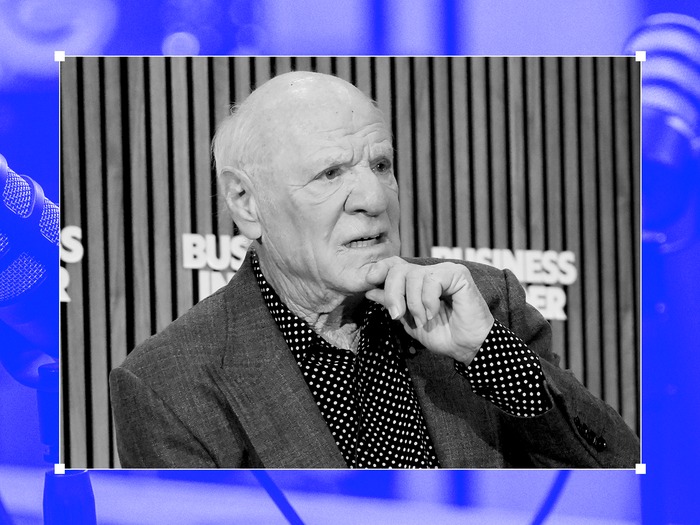
But Barry Diller says that these ideas are all off the mark.
Diller once headed Paramount and Fox Film Studios, and later co-founded the Fox Broadcasting Network with Rupert Murdoch. He said that fighting against Netflix on a large scale is meaningless for a simple reason: Netflix has dominated paid streaming for many years. You can't go to war in a battle that has already been won.
Diller has been an important figure in the internet industry for decades since leaving Hollywood, founding companies such as Expedia, Match Group, and Ticketmaster. As a result, he is very aware of the power that scale can bring in the digital world, as well as how new technologies can make even the largest companies vulnerable.
Last week, I interviewed Diller at the The Long Play event in Business Insider. You can also listen to the full conversation on my Channels podcast – we talked about his recent bidding war for MGM Resorts, why he believes his investment portfolio can withstand the AI revolution, and why he still has no plans to retire at the age of 84. Here is an edited excerpt from our conversation:
Peter Kafka:You used to work at Paramount, which was a big company back then. Now it’s much smaller. Larry and David Ellison think it can grow again, this time as part of Skydance. Would you bet on that?
Barry Diller:Well, I'm not really in favor of centralization for the sake of scale. Scale is not the solution to many problems, nor is it a decisive factor. Therefore, I don't believe in mergers and acquisitions for integration.
Kafka:Your statement is truly going against the trend. Everyone says, "No, no, we must do even more to compete with the Netflixs in the world."
Diller:Netflix won.
This doesn’t mean you can’t have a pretty good, profitable, and continuously growing business. It’s just that you’ll never be able to beat Netflix; never, unless they do something strange themselves.
So, if you're willing to call it a game, then that game is over now.
This doesn’t mean you can’t have a great, profitable business. To be honest, the more the better.
This makes me very sad: I worked at 20th Century Fox for over eight years. I loved that company, and I loved everything we did in the fields of film and television.
And now it no longer exists. 20th Century Fox is gone. Perhaps there are still some small remnants left. As for Paramount, I doubt—I’m not making any predictions—but over time, I suspect that Paramount will also disappear.
If the brand Paramount, this company, were to disappear, but they still continued to produce content from that entity, would that be important?
It doesn't matter. No matter how high the commitment to maintain a certain level of production is, over time, they will produce the same amount of content as market demand dictates. However, back when there were six major studios, that environment was very conducive to producing high-quality works. As the number of studios decreased...
I'm not saying that the quality is getting worse now, or that it will get worse in the future.ButI really think it has gotten worse. I don’t know if you all feel the same way, but for a while after the pandemic, all sorts of content was overwhelming and spread throughout the world. Even before that—over the past five, ten, fifteen years, the quality of content produced in just the television industry alone was already very outstanding.
I think that the quality of the content produced over the past few years, for various reasons, has not been very good overall.
The bubble has burst.
What I'm talking about is quality. When was the last time you saw a truly iconic, great series? Or multiple such works appearing in succession? We used to have that in the past.
I think this is also part of this trend of integration, and I don't think it's healthy. What surprises me even more is that in this era, with just one click of a button, you can publish anything to the whole world. You can make your own movies, your own magazines, you can do whatever you want. Basically, you can publish it to the whole world for free.
So, if we're talking about who will be the “biggest winner” next, then that's definitely YouTube.
Because there are thousands and thousands of people there – TikTok is no exception – creating, publishing, and pushing content out there.
Traditional large companies are contracting, while these platforms are expanding. Nevertheless, I still hope that these high-quality content production engines can thrive and develop.