IT News on November 3rd: According to the latest data from Counterpoint Research market monitoring service, global smartphone shipments in the third quarter of 2026 declined significantly by 19% year-on-year. However, supported by higher average selling prices, global smartphone revenue increased by 3% year-on-year, reaching 114 billion US dollars (Note from IT: The current exchange rate is approximately 759.855 billion RMB). The trend towards higher prices completely offset the sharp decline in shipments.
Driven by the contribution of high-end models and the increase in storage costs across the industry, the average selling price of smartphones globally ($ASP) soared by 27% year-on-year, reaching $442 (approximately 2,946 yuan at current exchange rates), setting a new record for a single quarter.
Counterpoint Senior Analyst Shilpi Jain indicates that the smartphone market is increasingly facing a trade-off between shipment volume and value. Although higher average selling prices have mitigated the impact of declining shipments on revenue, this does not necessarily equate to improved profitability. As storage costs continue to squeeze profit margins, phone manufacturers are raising prices and scaling back on less profitable SKU models, focusing instead on their main hit products and core markets; the entry-level segment is particularly vulnerable, with little room to absorb rising costs without harming profits. For manufacturers, the greater challenge in the future is not only to maintain shipment volumes but also to protect profits while keeping devices affordable.
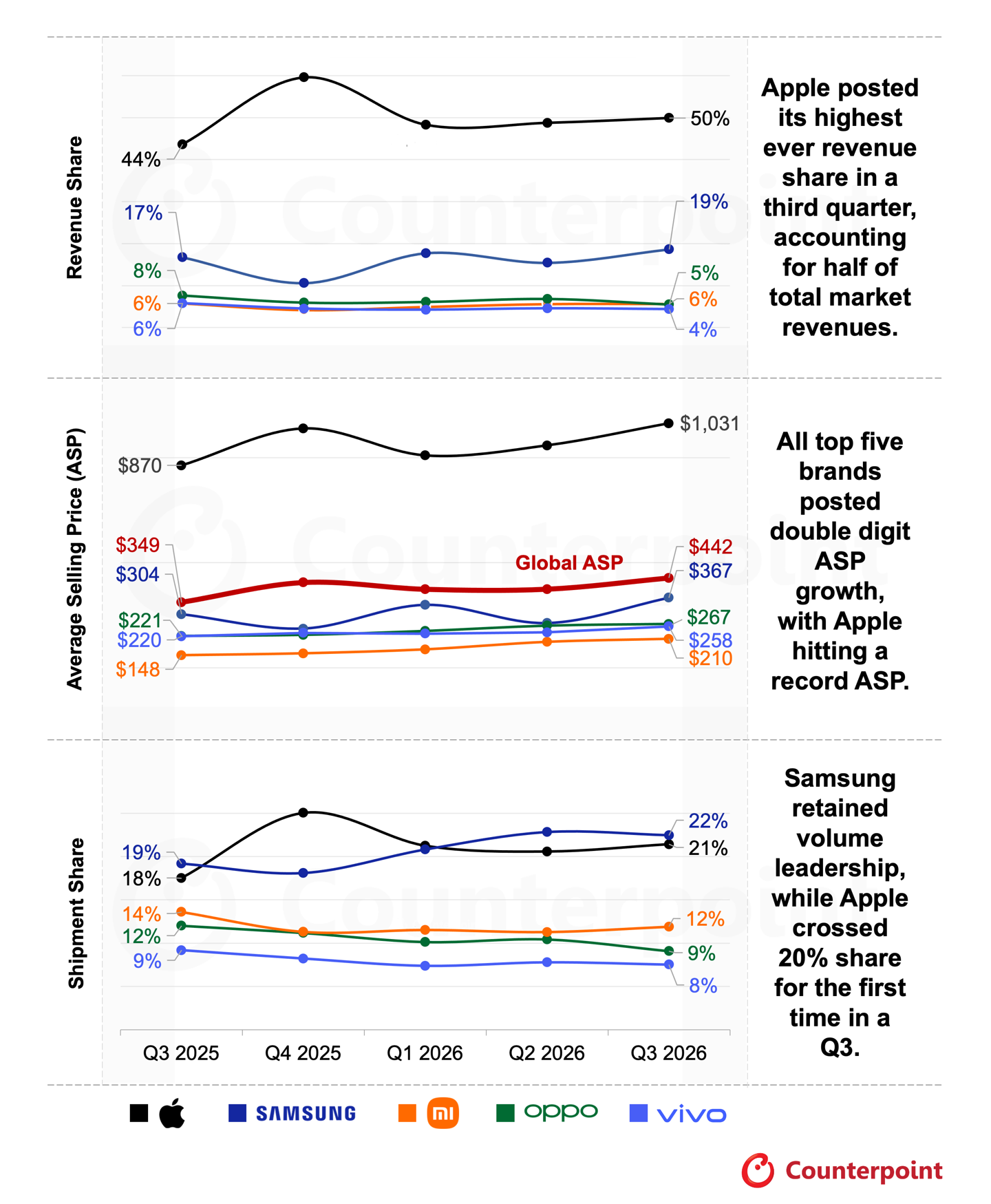
In the third quarter of 2026, Apple recorded its highest quarterly revenue ever for a calendar year, with a year-over-year increase of 17%. At the same time, it set a new historical record by holding 50% of the global smartphone market share. The average selling price of its products also increased by 19% year-over-year. This success was driven by the continued strong sales of the iPhone series, as well as the initial market enthusiasm for the iPhone and Pro series upon their launch.
Counterpoint Research Director Tarun Pathak pointed out that Apple is the mainstream brand with the strongest resilience this quarter, with shipments remaining relatively unchanged year-on-year. Apple has sufficient pricing power to absorb the rising costs of storage and pass on these costs to consumers without significantly impacting demand. iPhone The higher initial pricing of the Pro series, along with the iPhone model's absence from this quarter's launch and the price increases for all older models in September, collectively contributed to Apple's strong revenue growth in a generally challenging market.
Samsung ranked second with a 19% revenue share, experiencing a year-on-year revenue growth of 14%. At the same time, it maintained its position as the global leader in shipments with a 22% shipment share. Samsung's revenue growth mainly came from a year-on-year increase in average selling price to $367 (approximately 2,446 yuan at current exchange rates), driven by price hikes across its popular A-series products, as well as greater contributions from Galaxy S26 Ultra and Z Fold8. The strong demand in the early stages of the launch of Z Fold8 further optimized its high-end product mix, and Samsung's integrated supply chain also helped it mitigate the impact of rising storage costs.
Xiaomi's revenue this quarter remained flat year-on-year, but the average selling price saw double-digit growth, which completely offset the impact of declining shipments. The driving force for this growth came from the transmission of component costs to downstream suppliers, as well as a clear shift in the product portfolio towards mid-range and high-end models; the REDMI Note 15 series and Xiaomi 17T were the main models contributing to revenue in its core markets.
OPPO and vivo experienced year-on-year revenue declines of 26% and 22% respectively this quarter, with the decline in shipments exceeding the growth rate of average selling prices. Both brands have prioritized profits over shipment volumes, scaling back operations in non-core markets to focus on flagship and key models in order to strengthen their brand positioning and drive revenue. OPPO has benefited from the OPPO A6 series, resulting in a wider increase in the average selling price of mid-range models, and the product mix continues to improve; vivo's average selling price growth is concentrated in the mid-to-high-end and high-end markets. The vivo, S60, V70, and X300 series are its core sources of growth.
Counterpoint It is judged that the current resilience in revenue is unlikely to continue into the next quarter: In the fourth quarter of 2026, the decline in shipments is expected to exceed the increase in average selling prices, pushing global smartphone revenue into a contractionary range. However, the high average selling prices in the first three quarters will still result in annual revenue for 2026 being higher than that of the previous year.
In 2027, high storage costs will continue to squeeze manufacturers' profits and drive further price increases. Shipments are expected to decline, but the decrease will be less than in 2026. Higher average selling prices will drive revenue growth to exceed the level of 2026. A relief in costs is not anticipated until 2028, by which time manufacturers are more likely to reinvest the savings in equipment upgrades rather than lowering prices.