Key Points
- S&P 500 rebounds due to accelerated manufacturing activity
- U.S. factory PMI rises to 55.5, exceeding expectations
- Declining oil prices support the rebound of tech stocks
On November 2nd, the U.S. stock market rose, with stronger-than-expected manufacturing data and falling oil prices helping Wall Street to recover from the sell-off dominated by tech stocks in October.
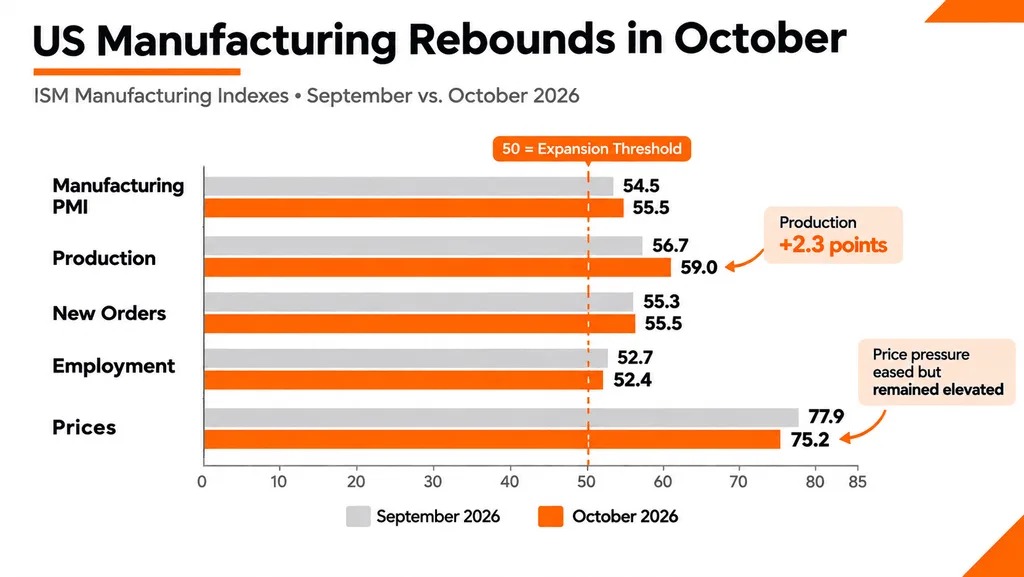
According to the October report from the Institute for Supply Management (ISM) of the United States ( Institute for Supply Management ), the U.S. manufacturing index PMI rose from 54.5 in September to 55.5, exceeding economists' expectations.
This reading indicates that the industry has been expanding for the tenth consecutive month, demonstrating that despite high borrowing costs and ongoing geopolitical uncertainties, U.S. industrial activity remains resilient.
U.S. manufacturing PMI rises to 55.5, factory output accelerates
The October manufacturing report shows stronger output, with new orders continuing to grow.
The production index rose from 56.7 to 59.0, reaching the highest level since November 2021. New orders increased to 55.5, and the employment index remains in an expansionary range at 52.4.
However, the report also indicates that cost pressures still exist, which may complicate the Fed's inflation outlook.
The price index has dropped from 77.9 to 75.2, indicating that manufacturers are still facing significant increases in input costs, although the rate of increase has slowed down.
At the same time, 66% of the comments from the surveyed companies expressed negative sentiment, mentioning tariffs, disruptions in the supply chain, and geopolitical uncertainties.
This mixed prospect also explains the unusual divergence in the market in October: despite the decline in the benchmark index, 72% of the components of the S&P 500 still rose.
Oil prices plummet, while the Nasdaq and S&P 500 rebound
The energy market provided another boost for the rebound on Monday.
Affected by reports of renewed diplomatic efforts regarding Iran, Brent crude oil prices fell by about 6.5%, approaching $106 per barrel, alleviating market concerns about a prolonged supply disruption.
Lower energy costs could be beneficial for manufacturers, airlines, and consumer companies, while also alleviating some inflationary pressures.
When Intel's stock price fell by nearly 29% in a single day, these concerns were further exacerbated, indicating that even strong demand from data centers may not always be able to offset disappointing performance forecasts.
At the same time, the broader sell-off in technology stocks increasingly reflects market concerns about whether costly infrastructure investments will yield sufficient returns in the future.
Wall Street faces another test with financial report and employment data
Investors are now facing several important catalysts that could determine whether the rebound in November can continue.
After Amazon's investment in artificial intelligence led to a $42 billion gap in free cash flow, corporate financial reports have become particularly important, highlighting the financial costs of expanding computing infrastructure.
Semiconductor stocks are also under scrutiny, as Intel's disappointing fourth-quarter revenue forecasts have raised doubts about manufacturing capacity and broader technological demand in the market.
Ethan Mercer
Ethan Mercer is a financial journalist who covers cryptocurrency, stocks, and the global economy. He studied economics and finance before turning to market reporting, with a particular focus on Bitcoin, stocks, monetary policy, and investor sentiment. His work primarily explains daily market fluctuations and the broader trends behind them.