

Key Points
- Oil prices reflect expectations, not just current supply.
- Cuts or freezes in production, as indicated by OPEC, cannot eliminate price fluctuations caused by geopolitics.
- Iranian negotiations indicate that the risk premium can disappear quickly
On November 2nd, oil prices plummeted by more than 4%, pushing Brent crude below $109 per barrel, and US West Texas Intermediate (WTI) crude below $100 per barrel. At the same time, the world's most influential oil-producing countries have just agreed not to raise their production targets.
A day ago, 7 OPEC member countries announced that they would maintain their current production targets in December. Logically, this decision should support oil prices by restricting new supply.
However, due to diplomatic discussions involving Iran that boosted expectations of a potential alleviation in disruptions to Middle Eastern shipping, oil prices instead tumbled significantly.
Why do oil prices fall even when there is no new supply?
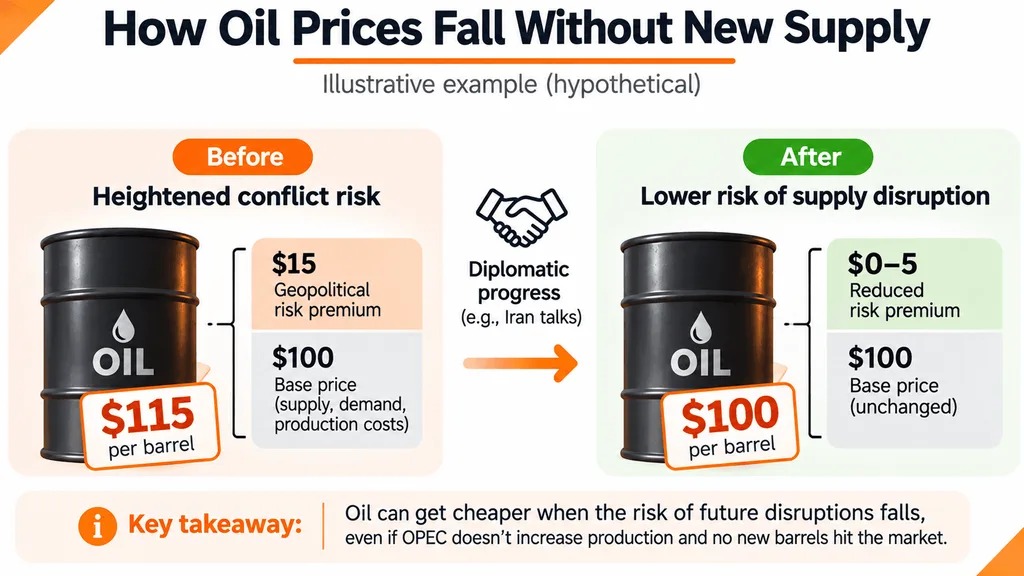
Imagine, for instance, that the price of crude oil is $115 per barrel, as investors are concerned that a single attack could disrupt transportation through the Strait of Hormuz.
This price reflects the current production, transportation, expected demand, as well as a risk premium for the possibility of future shortages.
If the possibility of negotiations suddenly escalating the situation seems to decrease, traders may reduce this part of the risk premium, even if there is no additional barrel of crude oil added to the market.
This is exactly what happened on November 2nd.
A similar trend occurred in July as well, when oil prices fell by 6% after a brief pause in military operations.
However, a decline in futures prices does not necessarily mean that the physical supply has been restored.
As we previously reported, despite the continued tight supply, the price of Brent crude oil has still fallen, indicating a discrepancy between improved market expectations and the actual changes in shipping.
Why can't OPEC fully control oil prices?
OPEC mainly influences prices by coordinating the production targets of major oil-exporting countries.
Cuts in production will tighten supply, while increases in production will help to meet demand. However, these decisions cannot determine how much crude oil will actually end up in the hands of buyers.
During the conflict in Iran, due to damaged infrastructure and disruptions in shipping that restricted exports, some oil-producing countries found it difficult to meet their quotas.
A previous OPEC production analysis also highlighted this difference between authorized production and the actual supply that can be provided.
The oil market will also respond to expectations of demand. If traders anticipate a weakening of industrial activity or a slowdown in economic growth, they may expect a decrease in future crude oil consumption.
Even if OPEC refuses to release more crude oil, this could still push down oil prices.
At the same time, declining inventories will make the market more sensitive to sudden disruptions. Saudi Aramco previously warned that global oil reserves are abnormally low, limiting the buffer available in emergency situations.
How futures traders drive oil price fluctuations before real-world changes occur
The most commonly cited oil prices come from the futures market, where participants trade contracts for delivery on a future date.
Airlines, refiners, and producers use these contracts to manage price risks, while investment funds and other traders establish positions based on expected market trends.
When geopolitical expectations change, futures traders can quickly adjust their positions.
This also explains why, even though there is basically no change in the physical supply, crude oil prices can sometimes reverse within a few hours after the release of diplomatic statements.
JPMorgan Chase recently estimated that the fundamental value of crude oil is close to $94 per barrel, while the trading price of Brent crude oil at that time was higher than $115 per barrel. This gap indicates that geopolitical and transportation risks can affect market valuations, although this estimate relies on a model.
There is another complex factor: a decline in benchmark oil prices does not necessarily mean that the cost of fuel at the port will decrease accordingly.
Damaged shipping routes, expensive insurance, and shortages at refineries will all contribute to keeping energy prices high. Coinpaper has previously discussed the situation where even as crude oil prices decline, diesel prices remain high.
Adrian Cole
Adrian Cole has been engaged in financial market reporting for over 6 years, with a focus on cryptocurrencies, stocks, and macroeconomic trends. He tracks Bitcoin, major altcoins, the U.S. stock market, interest rates, commodities, as well as data that drives market changes. Over the years, he has written hundreds of market updates and analysis articles, with an emphasis on price trends, investor sentiment, and the connections between traditional finance and digital assets.