Ryanair is considering temporarily freezing employees' salaries, reducing staff numbers, and making greater use of artificial intelligence in order to control costs and cope with a potential increase in fuel expenses of 2 billion euros.
This Irish low-cost airline announced the aforementioned potential cost-cutting measures on November 2nd, and the financial report released at the same time showed that its profits for the first half of the year had decreased by 15%.
Chief Executive Officer Michael O'Leary stated that due to the ongoing impact of the Middle East conflict, the rise in jet fuel prices may force the company to make significant operational adjustments beyond its expectations for fare increases in 2027.
Ryanair considers freezing employees' salaries in 2027
Ryanair is reviewing the labor agreements that are about to be renewed, and temporarily freezing salaries is one of the cost-control measures under consideration. The company is also exploring ways to reduce the ratio of crew to passengers, renegotiate airport agreements, and expand the use of artificial intelligence in administrative and operational departments.
However, the company has not yet officially implemented a company-wide salary freeze, and the potential scale of any layoffs remains unclear.
At the time these proposed measures were introduced, Ryanair estimated that operating costs would rise significantly once the existing fuel hedging agreements expired.
Ryanair faces a fuel cost increase of 2 billion euros
Currently, 80% of Ryanair's fuel demand has been hedged at a price of around $67 per barrel, with the contract valid until March 2027. However, for the next fiscal year, only 25% of the fuel demand has been hedged, at a price of approximately $95 per barrel.
O'Leary warns that unless the conflict in the Middle East is resolved, fuel prices may remain high until 2027.
He also stated that next year, air ticket prices in Europe could see a double-digit percentage increase, but Ryanair may need a rise of nearly 20% to fully offset the additional fuel costs.
With the growth in passenger traffic, Ryanair's profits have declined.
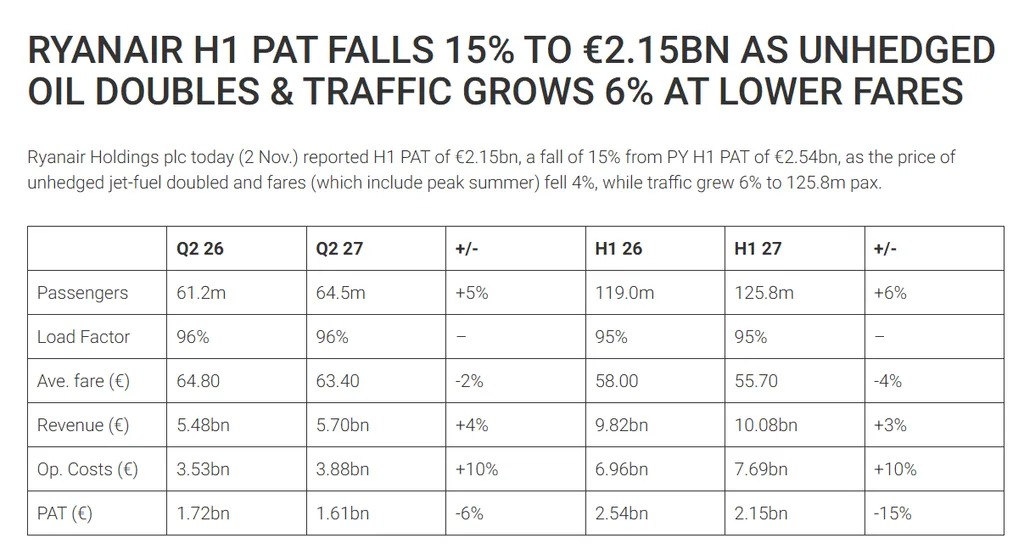
Ryanair announced that its net profit for the six months ending September 30 was 2.15 billion euros, a 15% decrease from 2.54 billion euros in the same period last year. Revenues grew by 3% to 10.08 billion euros, and the number of passengers increased by 6% to 125.8 million. However, operating costs rose by 10% to 7.69 billion euros, and average ticket prices decreased by 4%.
The airline has also lowered its annual passenger volume forecast from 216 million to 214 million, due to the reduction in its winter flight schedule.