According to Amazon's third-quarter financial report, during the comparable 12-month period, free cash flow deteriorated from $14.8 billion positive to $42.4 billion negative, representing a reversal of up to $57.2 billion.
$220 billion in AI expenditures results in a huge cash shortfall
In the 12 months up to September 30, Amazon's operating cash flow reached $168.3 billion, an increase of 29% compared to the previous year.
However, during the same period, expenditures on property and equipment purchases that did not include disposal gains or incentive measures amounted to 210.7 billion US dollars, exceeding the cash generated from operating activities.
The company stated that this growth is largely attributed to AI infrastructure investments, including data centers, servers, and dedicated computing equipment.
Amazon has also maintained its forecast for cash capital expenditures of approximately $220 billion in 2026, and CEO Andy Jassy ( Andy Jassy ) has hinted that investments in 2027 could be even higher.
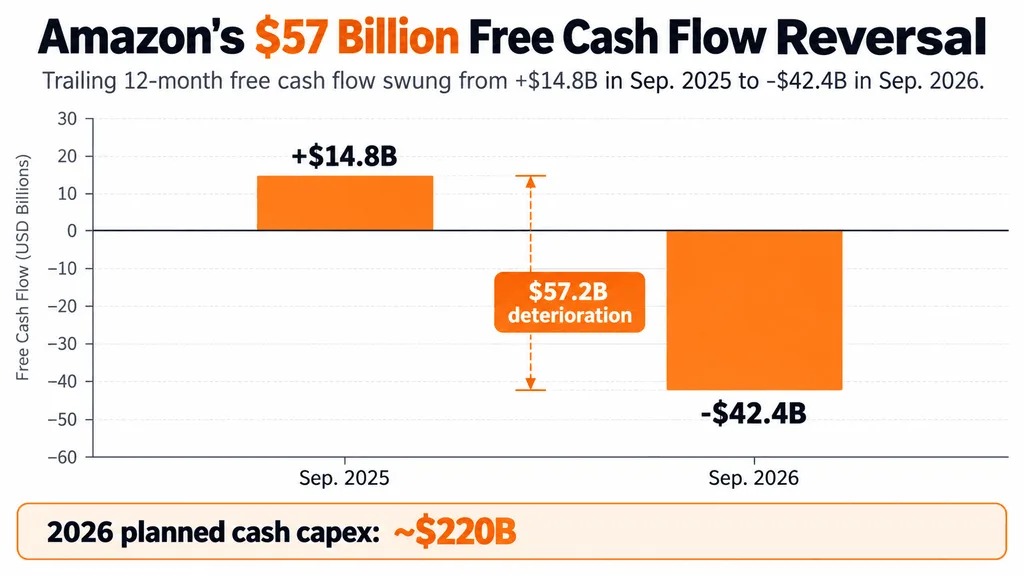
The pace of deteriorating cash flow has clearly accelerated. Coinpaper previously reported that after the second quarter, the annualized deficit amounted to $7.6 billion, at which point Amazon was already experiencing negative cash flow.
Today, this figure has grown to $42.4 billion, and as a result, the market has begun to question when AI's investments will finally translate into sustainable cash-generating capabilities.
AWS Posts 39% Revenue Growth and Sets a Record for Operating Profit
However, the financial reports are not all negative news.
Amazon Web Services ( AWS ) reported revenue of $46 billion in the third quarter, a year-on-year increase of 39.3%, marking the fastest growth rate in nearly five years.
AWS Operating profit rose from $11.4 billion in the same period last year to $17.8 billion, while Amazon's consolidated operating profit reached a record $28.1 billion.
The company also announced quarterly net profits of $20.7 billion, which indicates that a negative free cash flow does not mean that its business itself is unprofitable.
Nevertheless, Wall Street seems to be more concerned about the timing of future returns than the strength of current profits.
Amazon Cloud's backlogged orders are reported to amount to $578 billion, reflecting a large number of contracted demands. However, these commitments still need to be converted into confirmed revenue and profitable operations.
This reaction is similar to the recent cash flow impact of Alphabet. At that time, despite a surge in Google Cloud's revenue, quarterly capital expenditures still exceeded $51 billion.
Both companies have made substantial investments before it has become clear at what speed the computing power they have acquired will yield returns after expansion.
Wall Street questions the returns of AI as tech spending accelerates
Amazon has added another concern to its revenue outlook for the fourth quarter.
The company expects sales to range between $240 billion and $247 billion, with a median of $243.5 billion, which is slightly lower than analysts' forecast of around $244.5 billion.
Microsoft plans to issue $25 billion in bonds, which also reflects another aspect of the financing needs in this industry.
At the same time, recent sell-offs in technology stocks indicate that investor sentiment has shifted from enthusiasm for the demand for AI to a focus on expenditure efficiency.
—— Maya Bennett
Maya Bennett is a financial journalist whose reporting covers cryptocurrency, stocks, and broader market trends. Her writing focuses on Bitcoin, major digital assets, the stock market, monetary policy, as well as economic developments that influence investor sentiment. She is adept at transforming rapidly changing market news into clear and concise reports.