On October 30th, at the financial report conference for the first fiscal quarter of 2027 (from July 4, 2026, to October 2, 2026), executives from SanDisk (SanDisk) stated that AI's advancements are reshaping the supply and demand dynamics of the NAND flash memory market, and customers have "underestimated the demand for NAND flash memory capacity."
Sandisk management stated that customers have generally 'underestimated the NAND capacity required to operate the AI infrastructure,' and as a result, they are placing a large number of additional long-term orders; the company's new business model (NBM) has an order pipeline that extends until 2030 and beyond.
IT Note: NBM is a long-term cooperation model based on committed purchase volumes, contractual constraints, and pricing mechanisms. Sandisk revealed that in the fiscal year 2027, approximately 50% of bit shipments (measured by storage capacity) were locked in under the NBM agreement, and this proportion is expected to rise to about two-thirds in the fiscal year 2028; by the end of this decade, the demand for NBM may exceed the company's available supply.
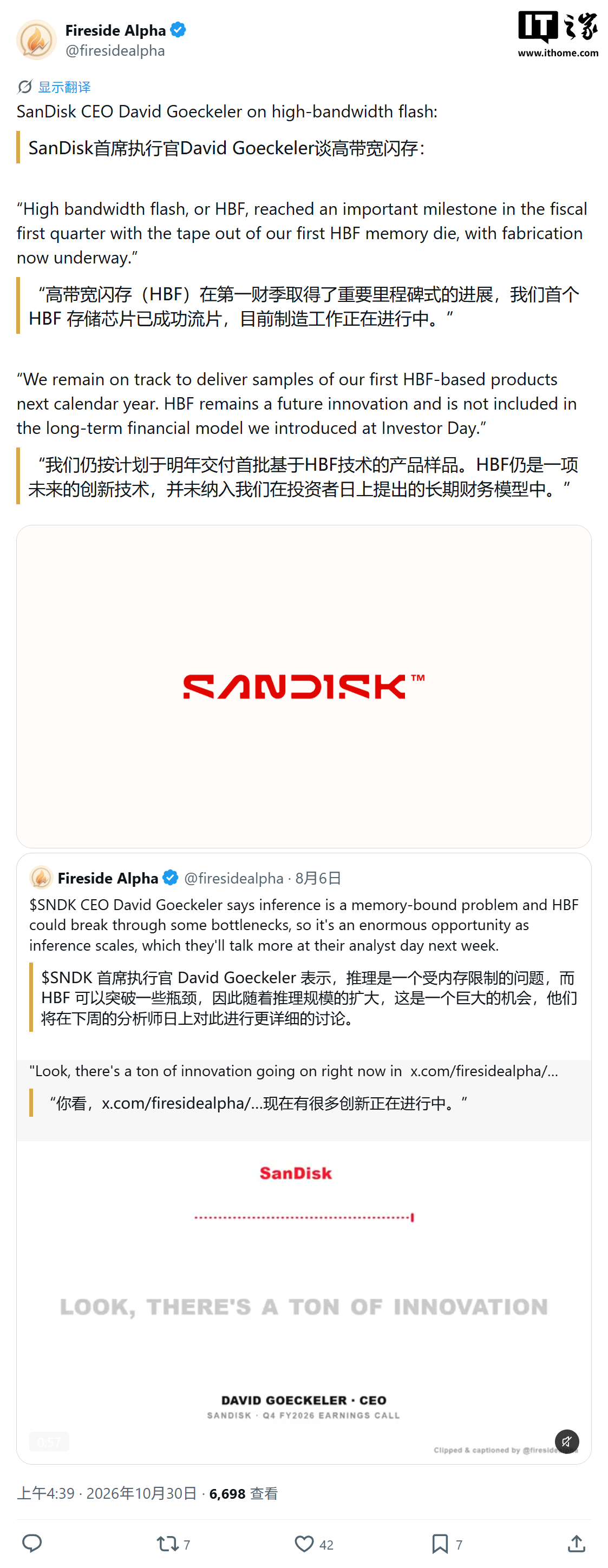
Technically, Sandisk announced that its first high-bandwidth flash memory (HBF) storage chip has completed tape-out and entered the manufacturing phase. HBF is aimed at AI inference scenarios, with the goal of providing read bandwidth close to HBM, while also possessing NAND level large capacity. It can be used to support larger models, longer contexts, and the continuously growing KV cache; the first batch of product samples is scheduled to be delivered in the next calendar year.
Sandisk also pointed out that the market is exploring the use of SLC NAND to replace some high-cost DRAM. In the reasoning of AI, flash memory can play a role in capacity layering, helping systems to retain a broader context and reduce expensive redundant calculations.
After the financial report was released, the stock price of SanDisk ( SNDK ) showed a clear trend of "positive results realized, first rising then falling": although both the Q1 performance and the guidance for the next quarter exceeded expectations, the stock price still declined after the market closed.
During the regular trading session on October 29th, Sandisk closed at $1,330.05, a decrease of $74.72 or 5.32% from the previous day's closing price of $1,404.77.
The financial report was released after the close of U.S. stock trading. The company's revenue for the quarter was $11.03 billion, and the earnings per share (excluding GAAP) were $49.51, both of which exceeded market expectations; at the same time, the company announced a 1-for-8 stock split, which will take effect on November 19th.
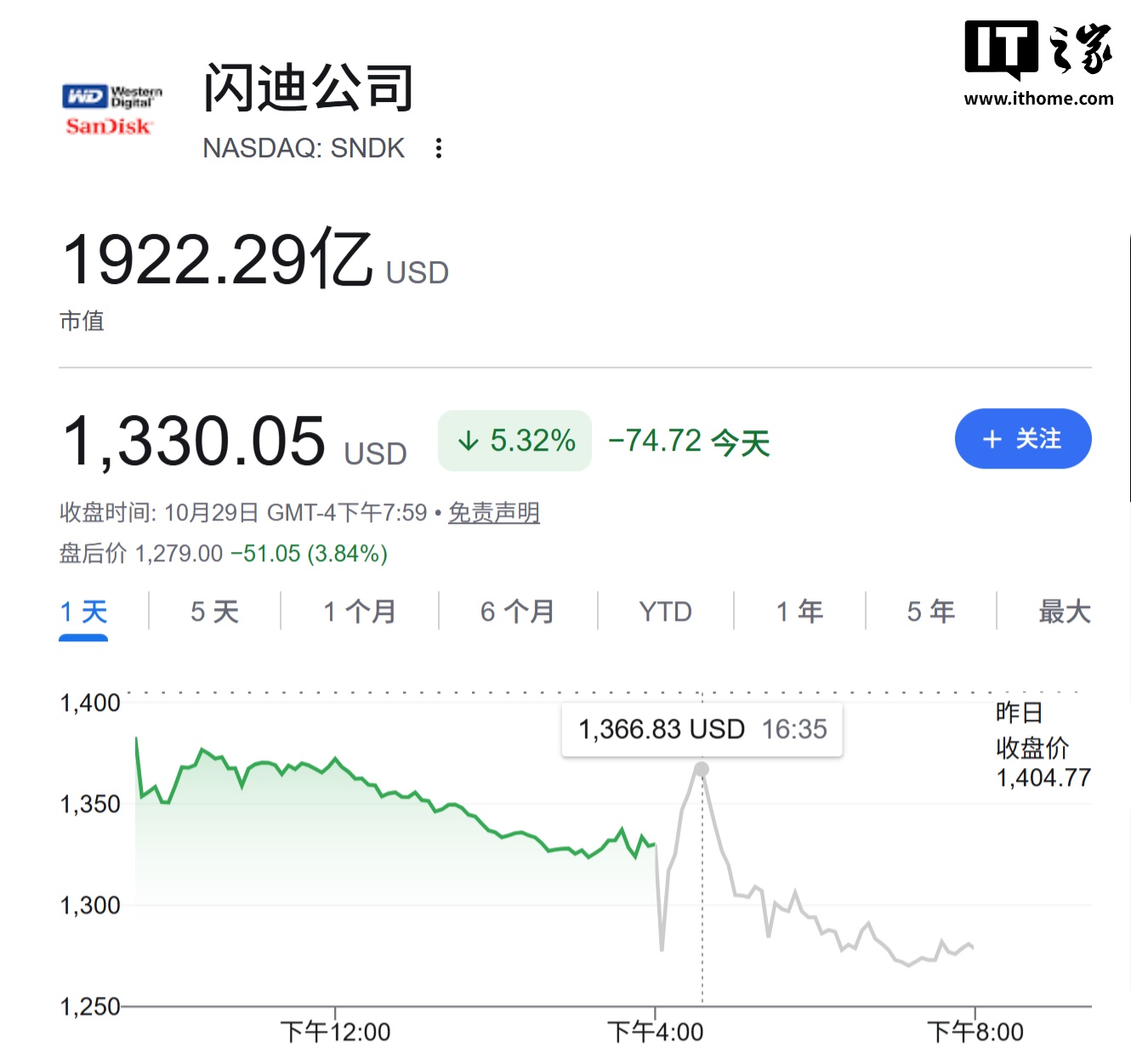
After the financial report was released, SanDisk's stock price rose for a while, but then it fell back. As of the evening of October 29th, Eastern Time, the after-hours price was around $1,282.50 to $1,295.05, a further decline of about 2.6% to 3.6% from the day's closing price; if calculated based on the previous closing price of $1,404.77, the cumulative decline is about 7.8%.