Key Points
- Galaxy applies for authorization from the Federal Trust Bank amidst ongoing legal disputes
- Community banks question the authority of OCC over crypto banking licenses
- The proposed institution will combine encrypted hosting, trading, and staking services.
Galaxy Digital has applied to establish a federally regulated trust bank in the United States, entering a heated debate over crypto banking licenses. Just 27 days ago, traditional lending institutions had just sued the regulatory authorities responsible for issuing such licenses.
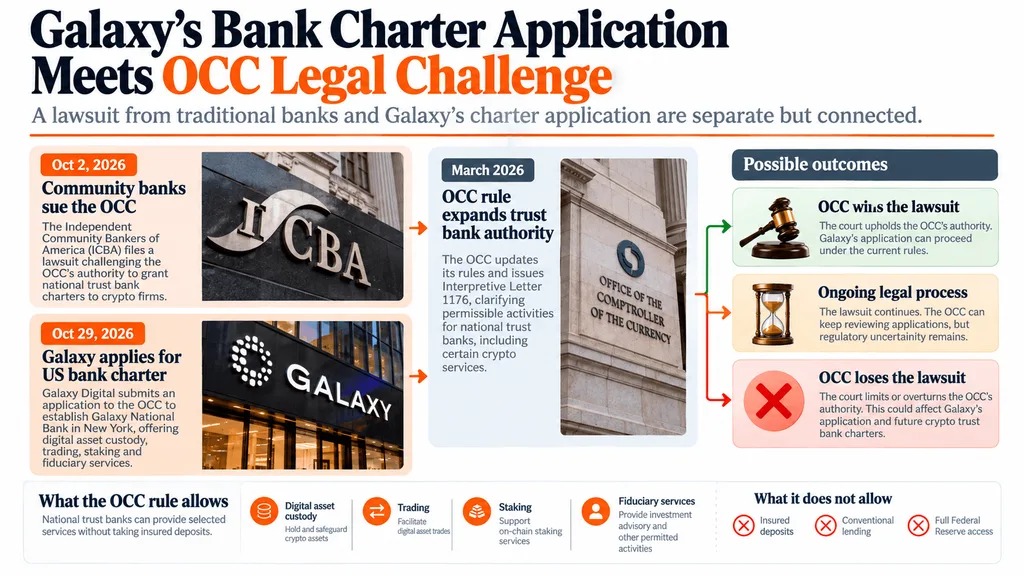
On October 29, the company announced that its subsidiary Galaxy Digital LP had submitted an application to the Federal Reserve Bank of New York (OCC), intending to establish Galaxy National Bank in New York. If approved, this institution will provide digital asset custody, trading, staking, and fiduciary investment advisory services under federal regulation.
This time point is particularly noteworthy. On October 2nd, the Independent Community Bankers of America ( ICBA ) sued the Federal Reserve Board, claiming that its regulations regarding national trust bank licenses allow cryptocurrency companies to obtain federal bank status without having to meet the requirements applicable to traditional banks.
Galaxy Involved in Legal Dispute over Cryptocurrency Banking Licenses
The lawsuit filed under ICBA targets the licensing regulations and explanatory letter 1176 issued by OCC in March 2026. The association believes that these actions exceed the statutory authority of the regulatory authorities.
Traditional lending institutions believe that allowing crypto companies to conduct a large amount of non-trusted business through national trust banks would create an unfair regulatory environment and may mislead consumers' understanding of the protection provided by these institutions.
Unlike traditional commercial banks, national trust banks generally do not accept insured deposits nor issue ordinary consumer loans. Their services are mainly focused on custody, fiduciary activities, and other permitted financial services.
As companies such as Ripple, Circle, Fidelity, and BitGo seek to engage in digital asset businesses under federal regulation, this distinction becomes increasingly important.
This controversy has also drawn attention at the political level. Senator Elizabeth Warren has previously questioned whether encryption trust licenses would grant digital asset companies banking privileges without equivalent safeguards.
Why does Galaxy still want to apply for a bank license when they already have more than 50 licenses?
Galaxy currently holds over 50 licenses in the United States, Europe, and Asia, including registration qualifications for securities, derivatives, and other financial services.
The company has also recently obtained a BitLicense license from the state of New York, as well as a remittance license, allowing its subsidiaries to expand regulated digital asset trading and custody services in that state.
However, these authorizations do not provide the same national framework as that of federal charter agencies.
National Trust Banks can integrate multiple institutional services under the supervision of OCC, which may simplify regulatory relationships and enhance the attractiveness of Galaxy to financial institutions seeking regulated encrypted infrastructure.
This strategy is similar to Ripple's earlier expansion into the banking industry, which aimed to bring custody and other digital asset services under federal regulatory frameworks.
Galaxy The proposed institution will not automatically obtain access to the Federal Reserve’s payment system due to a national trust license, nor will it be entitled to FDIC deposit insurance.
Will bank litigation affect the application for Galaxy?
The lawsuit involving ICBA does not directly target Galaxy, and filing a complaint will not automatically suspend the authority to review applications under OCC.
However, if the legal challenge is ultimately successful, it could affect the regulatory framework that supports certain crypto trust bank licenses.
Galaxy itself also listed the legal challenges faced by the OCC license rights as one of the risks in its announcement.
The company has entered a field that is becoming increasingly competitive, where federal approval has become a strategic necessity for institutional custody, stablecoins, and digital asset settlement.
Ethan Mercer
Ethan Mercer is a financial journalist who covers cryptocurrency, stocks, and the global economy. He studied economics and finance before turning to market reporting, with a particular focus on Bitcoin, stocks, monetary policy, and investor sentiment. His work focuses on explaining daily market fluctuations and the broader trends behind them.