Key Points
- U.S. natural gas production forecast to reach a record 11.22 billion cubic feet per day
- U.S. LNG exports are expected to grow by 17% in 2026
- European prices are close to 100 euros, and winter inventory is weakening.
U.S. natural gas production is on its way to setting another annual record. The U.S. Energy Information Administration (EIA) expects that in 2026, U.S. natural gas production will reach 11.22 billion cubic feet per day, while European natural gas prices are rising again due to concerns about the energy crisis, approaching 100 euros per megawatt-hour.
This comparison highlights the growing divergence between the world's largest natural gas producer and European buyers. European buyers are facing import disruptions and abnormally low winter inventories.
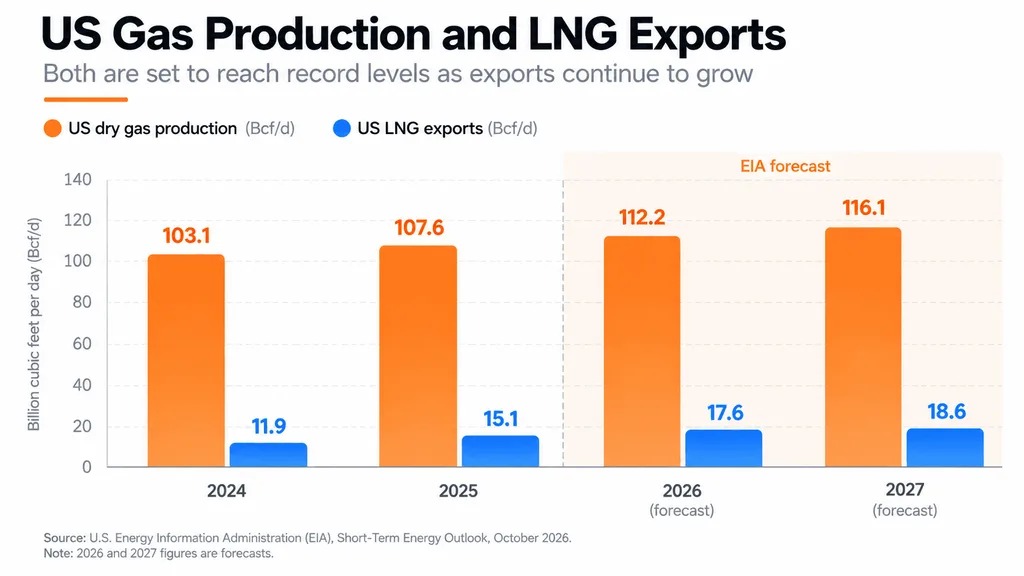
According to data from the U.S. Energy Information Administration, U.S. natural gas production is expected to increase from 10.76 billion cubic feet per day in 2025 to 11.22 billion cubic feet per day in 2026, and further to 11.61 billion cubic feet per day in 2027.
Meanwhile, data from Trading Economics shows that on October 28th, the benchmark natural gas price in Europe was approximately 98.99 euros per megawatt-hour, an increase of 42.5% from the previous month and a year-on-year rise of over 200%.
EIA It is expected that U.S. liquefied natural gas ( LNG ) exports this year will average 17.6 billion cubic feet per day, higher than the 15.1 billion cubic feet per day in 2025.
This represents a growth of approximately 16.6%, due to the expansion of export facilities and stronger demand from international customers. The institution also expects that exports will further increase to 18.6 billion cubic feet per day by 2027.
The increase in production is mainly concentrated in the Permian Basin and the Haynesville shale area, where relevant companies are expanding output while controlling expenses.
Expand Energy It is expected that by 2026, its production will reach 7.4 to 7.6 billion cubic feet per day, with capital expenditures of about 2.75 to 2.95 billion US dollars.
EQT also agreed to acquire Range Resources in a all-stock deal worth $13 billion, which could create the largest natural gas producer in the United States. The combined production will exceed 9 billion cubic feet per day.
This expansion is built upon previous U.S. natural gas records. Previously, U.S. natural gas production reached approximately 11.15 billion cubic feet per day in August, at a time when prices in Europe had already begun to rise.
European natural gas prices approaching 100 euros, winter inventories lagging behind
The supply situation in Europe seems to be significantly weaker.
The European Union's energy regulatory agency ACER reported that as of October 21, gas storage facilities were about 75% full, which is lower than the historical seasonal average.
More recent inventory data shows that as of October 26th, the inventory level was 74.9%, which is lower than 82.9% from a year ago and also below the five-year average of around 89.6%.
Germany's reserves are particularly low, at around 61.6%, which makes Europe's largest economy more vulnerable to the impact of increased demand during winter.
Transport disruptions in the Middle East LNG have further tightened international supply.
ACER It is estimated that regional conflicts have increased the cost of natural gas imports for Europe by 18 to 33 billion euros, while the United States LNG currently accounts for about 30% of the total natural gas supply to the EU.
Why record U.S. production cannot immediately alleviate the European crisis
Despite a significant increase in prices in Europe, the price of Henry Hub natural gas in the United States remains close to $3 per million British thermal units, which is significantly lower than the equivalent prices in Europe, such as LNG.
These differences reflect the costs of transportation, liquefaction, and regasification, limited export capacity, as well as the disparities between domestic and international natural gas markets.
For US exporters, higher prices in Europe may bring stronger business opportunities, however, long-term contracts determine how much of that price difference will ultimately be converted into profit.
Domestic consumption is also increasing, and because the AI data center requires more electricity, there may be a demand for several billion cubic feet of natural gas in the future.
The broader power shortage has also prompted technology companies to seek new power generation capabilities, including gas-fired power generation projects.
Higher energy costs in Europe could also bring back inflationary pressures, complicating central banks' decisions as winter approaches.
At the same time, rising energy costs in the United States indicate that an abundant supply of natural gas does not necessarily mean that gasoline, diesel, or other petroleum products will become cheaper.
Ethan Mercer
Ethan Mercer is a financial journalist who covers cryptocurrency, stocks, and the global economy. He studied economics and finance before turning to market reporting, with a particular focus on Bitcoin, stocks, monetary policy, and investor sentiment. His work focuses on explaining daily market fluctuations as well as the broader trends behind them.