Key Points
- The Brazilian Ibovespa index tumbled by over 17% after the election shock.
- The Brazilian real tumbled nearly 12% against the US dollar.
- B3 Trading Suspended, Government Cancells Treasury Bond Auction
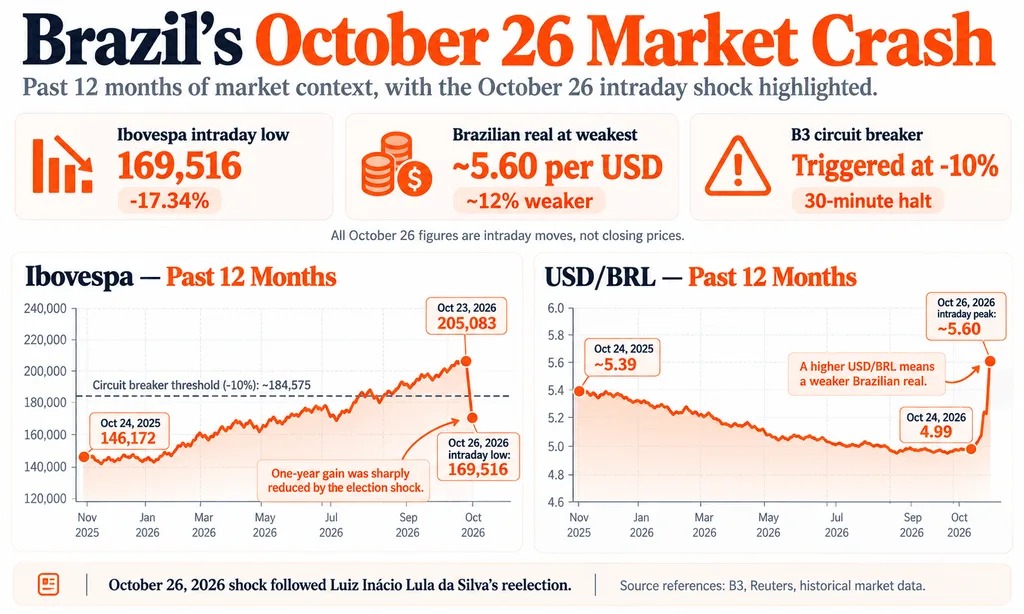
On Monday, October 26th, following President Luiz Inácio Lula da Silva's unexpected re-election, the Brazilian stock market plummeted by 17.34%, and the Brazilian real weakened by nearly 12% against the US dollar, triggering a 30-minute trading halt.
According to local market reports, the benchmark Ibovespa index fell to a low of 169,516 points during trading. The Brazilian exchange operator B3 confirmed that after the index dropped by 10% from its closing level last Friday, the circuit breaker mechanism was activated.
This round of selling continues the previous reversal trend in the Brazilian market. Previously, investors had taken positions based on the possibility that Lula's opponent, Jair Bolsonaro, would win, and now they are beginning to liquidate their positions in large numbers.
Why Did the Brazilian Stock Market Plunge After Lula's Victory?
In the presidential runoff held on Sunday, Lula received 51.79% of the votes, defeating Bolsonaro who got 48.21%. This result reversed the market's previous expectations, as Bolsonaro was in the lead after the first round of voting earlier in October.
Before the vote, the Brazilian stock market continued to rise, with the Ibovespa index closing above 205,000 points last Friday. Due to investors' expectations of changes in fiscal policy and government spending, the real had also strengthened previously.
The results on Monday led to a complete reversal of these trades.
At its deepest point during the session, Ibovespa fell by more than 35,000 points from last Friday's closing price. Meanwhile, the US dollar surpassed 5.60 against the real, compared to around 4.99 reais before the election.
This sell-off is similar to the collapse of other emerging markets, where unexpected events force investors to rapidly reduce their risk exposure.
Brazilian financial institutions and enterprises that mainly focus on domestic demand led the decline, reflecting market concerns about future borrowing costs and economic policies.
As the real currency plummeted, Brazil's Ministry of Finance canceled a government bond auction.
Market turmoil is not limited to stocks alone.
As interest rate futures soared, Brazil's Ministry of Finance canceled the scheduled auction of fixed-rate government bonds linked to inflation. Reuters reported that sovereign bonds with longer maturities also saw declines, with the price of bonds maturing in 2056 falling by about 2.5 cents.
These trends indicate that investors are demanding higher compensation in order to be willing to hold Brazilian government debt, especially against the backdrop of uncertainties regarding public spending and debt sustainability.
This reaction echoes the recent pressure on Europe's sovereign debt market, when concerns about fiscal deficits drove up borrowing costs.
Weaker currencies pose additional challenges. Imported goods, priced in the local currency, will become more expensive, which may exacerbate inflationary pressures and limit the central bank's ability to cut interest rates.
This round of selling in the foreign exchange market also highlights how quickly the foreign exchange market can respond to changes in fiscal and political risk assessments.
What will happen after Brazil suspends trading?
The circuit breaker mechanism of B3 will temporarily suspend trading when Ibovespa falls by 10%. According to the exchange rules, if the decline further expands to 15% after trading resumes, another one-hour suspension may be triggered; if it falls to 20%, further intervention measures can be taken.
This mechanism does not set a price floor, nor can it prevent further declines. Its function is to provide time for market participants to re-evaluate their orders during periods of abnormal volatility.
Currently, Brazilian investors are facing two unresolved issues: whether the Lula government will propose a credible fiscal plan, and whether the bond and exchange rate markets will stabilize.
The cancellation of the auction by the Ministry of Finance makes fiscal issues particularly important. Rising government borrowing costs may ultimately affect corporate financing, household credit, and economic growth.
The similar pressures faced by the global bond market recently have shown that financing conditions can tighten rapidly when investors demand higher yields.
Author: Emir Abyazov