On October 25th, according to a report by Bloomberg journalist Mark Gurman, Apple's first touchscreen MacBook Pro is set to be officially unveiled at 1 a.m. Beijing time on October 29th. This product will not only introduce touch operations to the Mac product line but also feature a OLED screen and a brand-new user interface, marking another example of Apple's strategic shift in recent years.
In the past, Apple executives have repeatedly denied any intention to enter certain markets before the official launch of related products. Whether it was smartphones, tablets, or more recent low-cost laptops, foldable screen phones, and smart home display devices, Apple has eventually launched corresponding products one after another. However, unlike these categories, touchscreen laptops have long been a direction that Apple has explicitly stated it is not optimistic about.
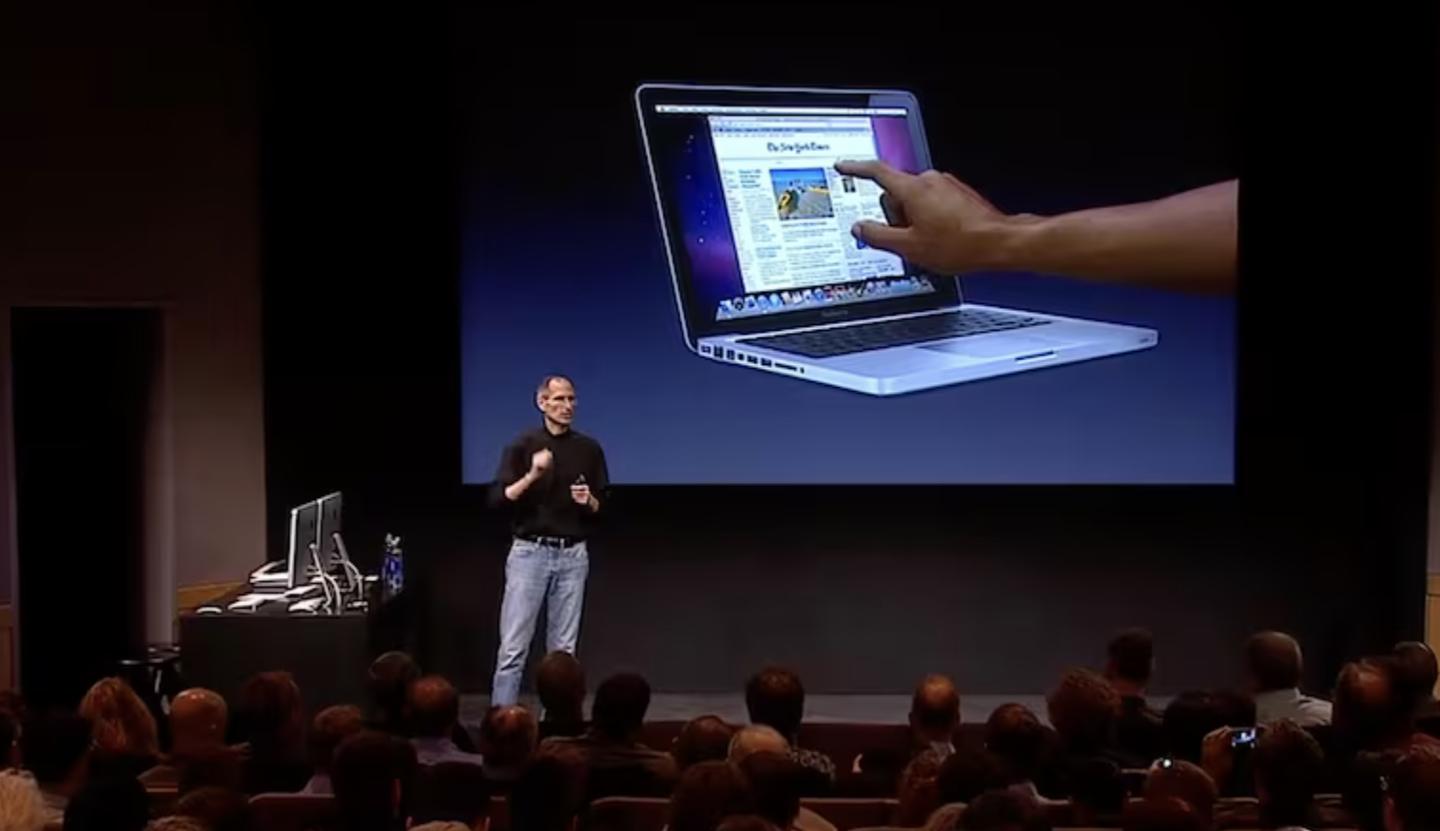
In fact, Steve Jobs once described touchscreen laptops as having an “extremely poor” ergonomic design. After Tim Cook took over as CEO, he also compared the combination of tablets and PC to “merging a toaster and a refrigerator into one.” Former marketing director Phil Schiller and software director Craig Federighi also held negative views towards touchscreen Mac. Now, with John Ternus taking on the role of CEO, Apple is finally ready to launch its first touchscreen Mac.
IT Home has learned that the corresponding product offers two sizes to choose from: 14 inches and 16 inches. The overall appearance is similar to the existing models, but the body weight is lighter. For the first time, the OLED screen and the user-familiar Dynamic Island design are introduced into the Mac product line. Its price is expected to be significantly higher than the current starting price of $2,499 (Note from IT Home: The current exchange rate is approximately 16,716 yuan).
Apple has previously insisted for a long time on distinguishing between Mac and iPad, emphasizing the differences between the two in terms of ergonomics and operating system design, and also using this to encourage users to purchase each type of device separately. However, as iPad gradually develops more advanced multitasking capabilities, and iPadOS introduces more features that are closer to desktop systems, this product differentiation is beginning to face challenges.
Today, it seems that Apple believes that the adoption of touch screens Mac does not necessarily harm the sales of iPad; on the contrary, it may attract new users and encourage consumers to purchase both Mac and iPad at the same time. The two product lines can still differ in terms of software, performance, battery life, and usage: iPad is thinner and lighter, suitable for touch operations and mobile use; Mac comes with a built-in keyboard, larger screen space, and a more complete desktop operating system, making it more suitable for complex tasks.
It is reported that both Tim Cook and John Ternus of Apple believe that consumers have begun to expect devices to support touch operations, but the industrial design team still has concerns about this approach. The final compromise was to make touch an optional input method, rather than transforming the device into one that focuses solely on touch controls.
From a practical usage perspective, touchscreen laptops still have certain ergonomic issues. Users need to lift their hands to operate the screen, which is placed vertically, and prolonged use can lead to arm fatigue. Therefore, this change in product strategy is more driven by market demand and commercial considerations than by Apple having resolved all the usage problems associated with touchscreen laptops.
In Apple's view, adding touch functionality to Mac is a way to continue the growth momentum, and making some of the interaction methods between Mac and iPad more similar also helps to reduce the cost for users when switching between these two types of devices.
Apple is expected to emphasize during this week's launch event that "touchscreen MacBook Pro is not a fusion product of Mac and iPad," nor will it become a computer that primarily uses touch for operation. The keyboard and trackpad will still be the core input devices, while touch will be used for scrolling, zooming, panning, and sliding, which are more suitable for direct screen operations.
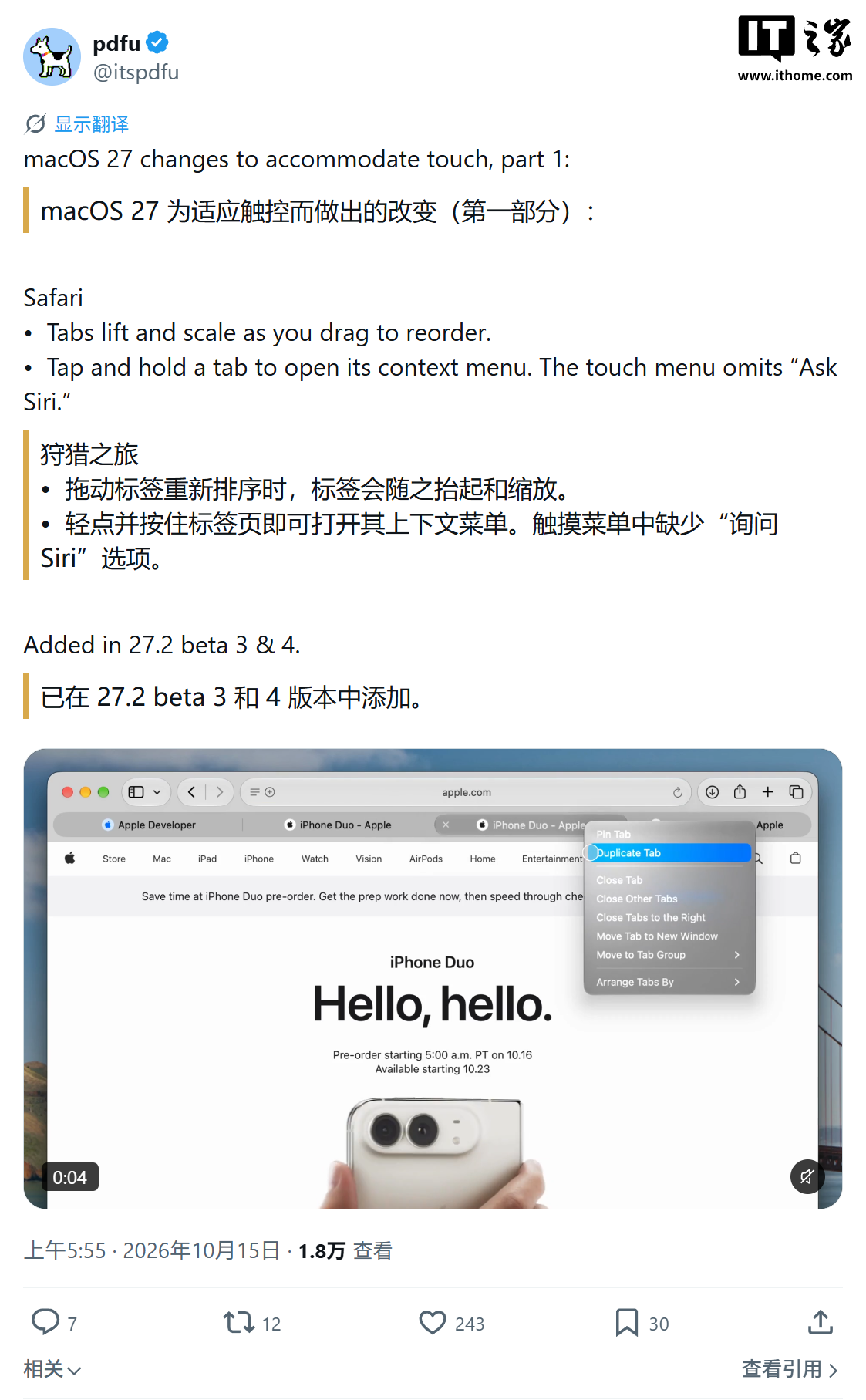
However, in order to accommodate the new interaction methods, Apple has actually adjusted the interface design of macOS 27 Golden Gate. The system is capable of dynamically displaying corresponding controls based on the user's previous usage habits; for example, it adjusts the presentation of interface elements depending on whether the user is using a touchscreen or a trackpad. After clicking a button, related menus can unfold around the position of the finger, and the Dock bar as well as the menu bar are also optimized for touch operations, allowing users to switch more naturally between touch and traditional pointer-based controls.
In addition, Gorman also revealed that the OLED screen is another important factor in the increased price of the new model. Compared to the mini-LED screen used in the current MacBook, the OLED screen offers deeper blacks and higher contrast, but it also comes at a higher manufacturing cost. Apple can use this to establish a higher-end product positioning and increase the average selling price of the Mac. This strategy is similar to when Apple launched the Retina MacBook Pro in 2012; at that time, the new model also differentiated itself from other models with a more premium screen and product positioning.
However, touchscreen laptops still represent a minority in the entire PC market. Manufacturers such as Lenovo, Dell, and HP have been offering touchscreen laptops for over a decade, but these products currently account for only about 20% to 25% of the global laptop shipments. For most users, the keyboard and touchpad remain the most natural ways to operate a computer. Touch functionality is mainly used for scrolling, zooming, and direct control of content, and it is not a necessary feature for completing daily work tasks.
From this perspective, the new touch screen added by MacBook Pro also reminds people of Touch Bar which Apple once launched. The latter was initially seen as an important selling point, but due to replacing some of the physical buttons that users were familiar with, it ultimately failed to be retained in the long term. However, the touch screen is different; it adds another mode of operation in addition to the existing keyboard and trackpad, rather than reducing the original functions. Therefore, even if it cannot significantly boost sales, it is more likely to remain in the Mac product line in the long run.
At the same time, touchscreen technology MacBook Pro is also the latest example of Apple gradually filling in gaps in its product line in recent years. Earlier this year, Apple launched the MacBook Neo with a starting price of $699 (approximately 4,676 yuan at current exchange rates), entering the previously relatively cautious low-priced laptop market; this month, the company also released its first smart home display device HomeView and began selling its first foldable screen phones iPhone and Duo. All of these products represent a shift by Apple to re-examine its past conservative approach towards certain product categories.
It is worth noting that HomeView, iPhone, Duo, and the touchscreen feature MacBook Pro all appeared within the first few weeks after Tim Cook took on the role of CEO. Although these products were clearly planned long before Cook's tenure, this series of moves reflects that Apple is becoming more flexible. No longer adhering strictly to past product strategies, Apple is now more willing to adjust its product lineup according to market demand.