

Reality Bites has turned the "lying flat" image of Generation X into a movie poster, and 32 years later, this generation's retirement calculations also begin to echo the title of the film.
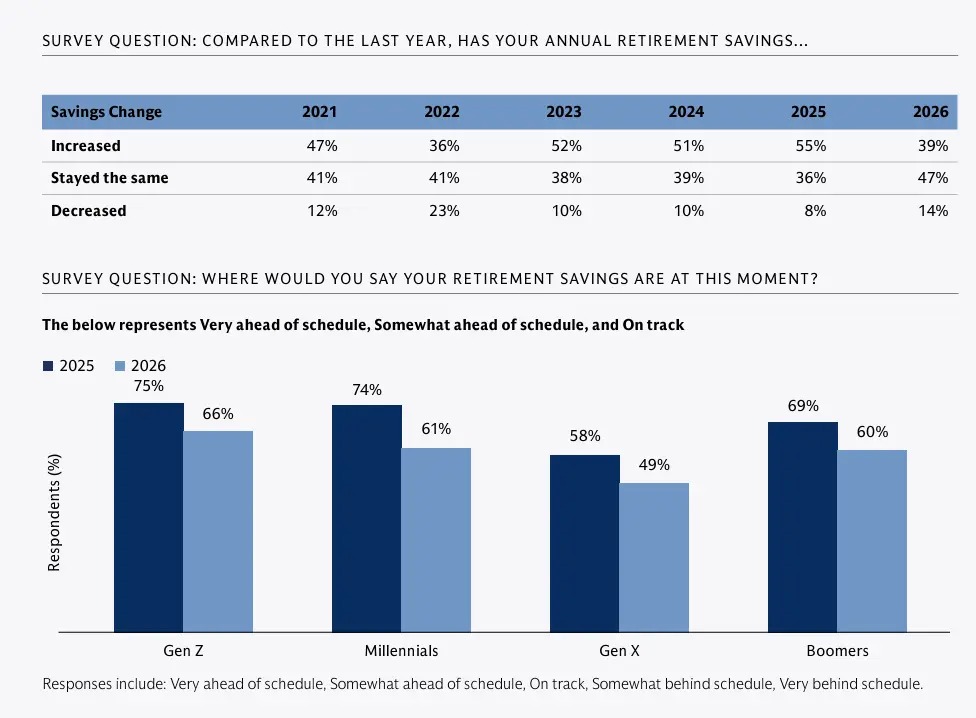
According to the "2026 Goldman Sachs Asset Management Retirement Survey and Insights Report" released on September 30, only 49% of Gen X savers indicated that they were on track or ahead in their retirement savings, which is lower than the 58% from a year ago. This makes Gen X the only generation in the survey where less than half of them feel they are making progress. Gen Z has a rate of 66%, Millennials at 61%, and the Baby Boomer generation at 60%.
Other generations also saw declines this year, but they started from a higher baseline. The Millennial generation experienced the largest drop, falling by 13 percentage points to 74%. However, Generation X started from an even lower baseline to begin with and fell even more significantly.
This survey was conducted in July and involved interviews with 5,106 people, depicting a generation that has more jobs but feels less secure about their financial situation. Only 57% of Generation X respondents felt that their primary job was financially stable, which is the lowest rate among the four generations. For Millennials, this proportion is 71%. In addition, 57% of Generation X also hold jobs outside of their main occupation, and 72% of them stated that they needed this additional income.
In a statement issued in conjunction with the investigation, Greg Wilson, head of retirement services and co-head of third-party wealth management in the Americas at Goldman Sachs Asset Management, stated: "Although these individuals may appear financially stable from the outside, in reality, they work harder, push back major goals, and supplement their income through other sources of revenue."
A Goldman Sachs report specifically targets Generation X. The report states that this generation is in the “core stage of their career and income growth,” yet they are the group “least likely to believe that their job provides long-term financial security.”
The report refers to the employment security data of Generation X as "a notable result." Another 33% of Generation X indicates that their jobs are only sufficient to cover current expenses, but it is difficult for them to make further progress; 11% say that despite having stable jobs, they still struggle to maintain financial security. The report states, "Generation X is mainly in the latter half of their careers, which is also a critical period for accumulating wealth before retirement. Their confidence in their own earning ability should be at its peak."
The pressures of Generation X are also reflected in supermarket bills. Housing is the biggest obstacle to saving for Generation Z (38%) and Millennials (36%); however, for Generation X, daily expenses are the primary obstacle, accounting for 37%, which is the highest among all generations. Approximately 65% of Generation X say they have postponed a major financial goal.
Goldman Sachs Asset Management Senior Retirement Strategist Chris Ceder stated: "Pushing off these goals will delay stability and exacerbate savings issues. Emergency savings are particularly important, as a single unexpected expense could lead to debt and consume the savings that families have already postponed."
Experimental Generation
Generation X is the first generation to build their entire careers around 401(k) plans rather than traditional pensions. They serve as a test group, and the results of these choices are about to become apparent; the oldest members of Generation X are now in their early 60s.
He said, "Savers are taking fewer actions, and the actions they do take are more defensive, which indicates that they may be concerned about ongoing inflation and market volatility."
Wilson summarized the old rules of the past in one sentence: “For generations, the formula for retirement security has been simple: continue to work, save diligently, and a sense of security will follow.”
But the job itself is not always stable either. Among the retirees surveyed, 44% stopped working earlier than planned. Of these, 12% stated that the reason was that the job no longer existed, while 14% left their jobs to take care of their families.
This sense of insecurity is also beginning to permeate offices. 53% of Generation X respondents stated that financial worries at least sometimes make it difficult for them to concentrate on their work; 27% of them were absent from work due to financial issues over the past year. Approximately one-third, or 32%, said they are very likely to look for a new job within the next 12 months, with the main goal being to improve their financial situation.
The head of compensation and benefits at Goldman Sachs, Ayco, stated that this presents "a unique opportunity for employers and also provides clear incentives for them to offer innovative support tools in addition to traditional retirement plans."
If there are plans, things will be a bit better.
The only highlight in the data is that savers with personalized retirement plans are more likely to feel that they are on track, with a proportion of 72%, while those without a plan are only at 33%; over the past year, 46% of those with a plan increased their savings, compared to 26% of those without a plan.
But for those of this generation who were told in the 1990s to be “too cynical to care about such things,” 49% might be the most representative figure for Generation X. It’s a quiet decline, and no one is going to post a TikTok about it.