

The same retail report provides two different interpretations for the market: in the third quarter of this year, UK retail sales grew by 0.7% month-on-month, but in September alone, they declined by 0.4% month-on-month. The UK Office for National Statistics released the retail data for September on October 23rd, presenting this divergence in the same table. Looking at the three months together, consumption did not stall; however, from the latest monthly observations, the momentum appears to have weakened again. If one number is taken alone, it is easy to misinterpret a “quarterly improvement” as a “recovery in September” or a “decline in September” as an “overall quarter-long contraction.”
The statistics bureau's measurement is the volume of retail goods purchased, which is the sales volume after excluding the impact of prices. In the third quarter, there was a 0.7% increase compared to the second quarter, and a 1.5% increase compared to the same period last year. In September, there was a 0.4% decrease from August, but still a 0.8% increase compared to September last year. The monthly growth rate for August was revised upward from the previously announced 0.5% to 0.7%, and the decline in July was also revised from 0.5% to 0.4%. These revisions are not minor footnotes in the report: the monthly assessment for September is based on a stronger August as a comparison base, and the overall quarterly trend is also affected by the revised first two months.
Fuel and food supported the quarter, while online clothing dragged down the month.
The main backdrop for the growth in the third quarter was the gradual recovery of fuel sales from the lower levels seen in the second quarter. According to the statistics bureau, when fuel prices rose in April, retailers reported that drivers reduced their travel or postponed refueling; thereafter, sales gradually recovered, and fuel sales in each month of the third quarter were higher than those in each month of the second quarter. Sales of food and beverages were also driven by warmer weather. If these two factors are considered as a general strengthening of the entire consumer market, then the comparative bases and seasonal factors specific to each are overlooked.
The weaknesses in September have different causes. Mail-order and other non-store retail sales declined, with online clothing retailers attributing this to warm weather affecting the demand for autumn and winter products; supermarket sales also fell after experiencing growth in July and August. Changes in weather and timing of purchases do not necessarily mean a sudden drop in long-term purchasing power for households, but they can genuinely affect a merchant's inventory and cash flow for that month. Therefore, monthly figures are suitable for indicating short-term operational changes and should not be used alone to determine the consumption trend for the entire quarter.
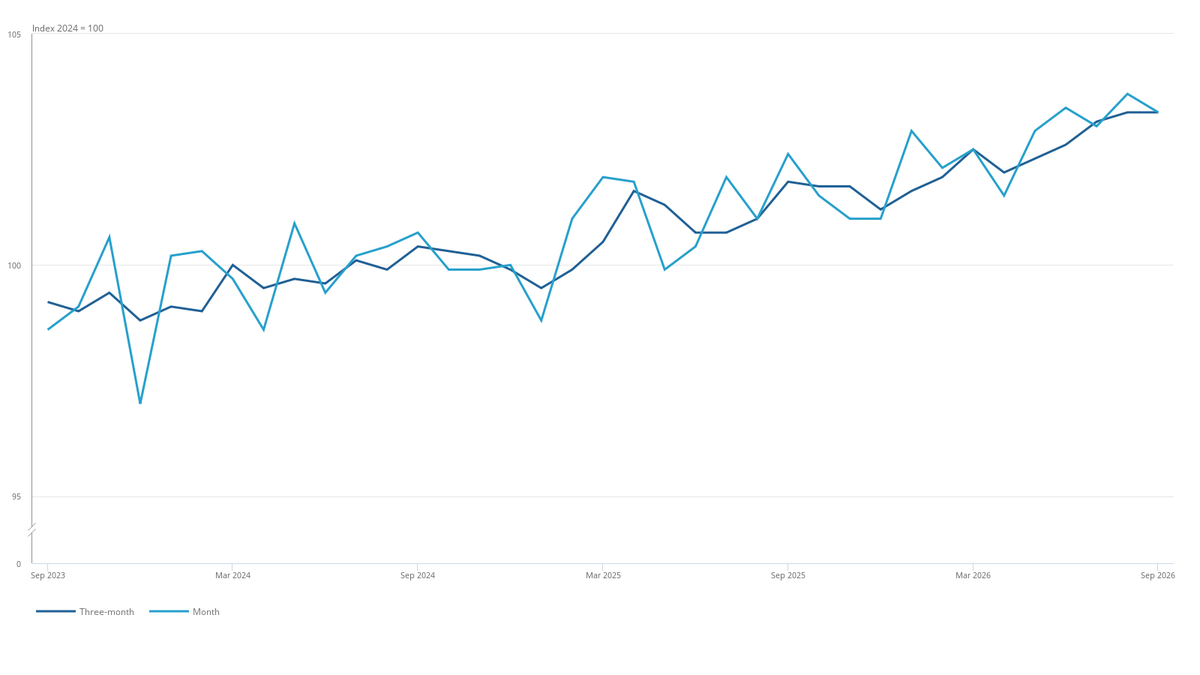
The Bureau of Statistics specifically reminds that the monthly growth fluctuations are significant and should be considered in conjunction with the three-month smoothed trend. This is also why a quarterly increase of +0.7% and a September decrease of -0.4% are not contradictory: the average sales volume for the first three months is still higher than that of the previous quarter, while the most recent month has seen a decline from the higher levels of August. When interpreting market data, it is important to distinguish between three perspectives: “this month compared to last month,” “three months compared to the previous three months,” and “year-on-year compared to the same period last year,” before discussing whether consumption is accelerating or slowing down. Mixing year-on-year and month-on-month comparisons can often mislead readers more than statistical errors.
The report also distinguishes between sales volume and sales amount. If prices rise, customers may spend more money, but the quantity of goods purchased may not necessarily increase; if promotions are intensified, sales volume may rise, but merchants' profits may not keep up. Online sales amount decreased by 0.1% quarter-on-quarter in the third quarter, but still grew by 7.4% year-on-year. These percentages represent nominal spending, not the number of online orders, and cannot be directly considered as changes in online consumption. Retailers need to consider selling prices, discounts, returns, and profit margins when assessing their business conditions; they cannot replace purchase volume with sales amount.
The next step is to observe more than just the sales during the Christmas season.
Retail reports are of reference value for monetary policy and economic growth, but their coverage is limited. They mainly measure retail sales of goods and do not include most service consumption, nor can they directly represent total household spending. Consumers may reduce their purchases of clothing but increase travel or dining expenses; they might also sustain their spending on goods through credit expansion. To get a full picture of demand in the UK, it is necessary to consider retail sales alongside wages, inflation, consumer confidence, the services sector, and household savings, rather than relying solely on a monthly report to explain all these factors.
For merchants, the growth in the third quarter provided a buffer for inventory and revenue, but the decline in September suggests that the transition to autumn and winter products may not go smoothly. Warm weather has led to delayed sales of clothing, which could result in additional purchases next month or may lead to discounted clearance sales; these two scenarios have vastly different impacts on profits. If the rebound in fuel sales is mainly due to a low base, it may not continue to contribute the same increase in the fourth quarter. Therefore, merchants should focus on specific product categories, unit prices, and inventory turnover, rather than mechanically extrapolating the total growth rate from the third quarter.
For investors, what is more worth tracking is the direction of revision and continuity. The upward revision in August indicates that the previous level of consumption was higher than initially reported, while the decline in September suggests that the improvement was not linear. If the monthly data continue to decline in the coming months, the positive growth in the third quarter may be a brief recovery; if clothing and supermarket sales stabilize with seasonal changes, then September's drop will be more like a temporary fluctuation. The National Bureau of Statistics has scheduled the release of the next retail report for November 20th, at which time they may also adjust the preliminary estimates from this time.
The most important takeaway from this data is not to simply label British consumption as “strong” or “weak.” There are distinct trends between quarters and months, as well as between sales volume and amount spent, and between food and fuel versus online clothing purchases. Only by clarifying these differences can we get a more accurate picture: British consumer spending did improve in the third quarter, but it did not show a sustained acceleration as autumn approached. Whether it will remain stable going forward will depend on the next round of data and broader evidence of household spending.
Source: Office for National Statistics, UK, October 23, 2026 " Retail sales , Great Britain : September 2026" https :// www.ons.gov.uk / businessindustryandtrade / retailindustry / bulletins / retailsales / september2026