Key Points
- Ripple collaborates with Arf, the latter processing approximately $10 billion annually.
- RLUSD will provide funding for cross-border payments through short-term credit
- XRPL Native lending still requires approver approval before activation.
Ripple has collaborated with the Swiss financial institution Arf to introduce stablecoin-driven financing into XRP Ledger ( XRPL ), integrating this blockchain into an existing payment service. Arf has an annual settlement volume of approximately 10 billion US dollars.
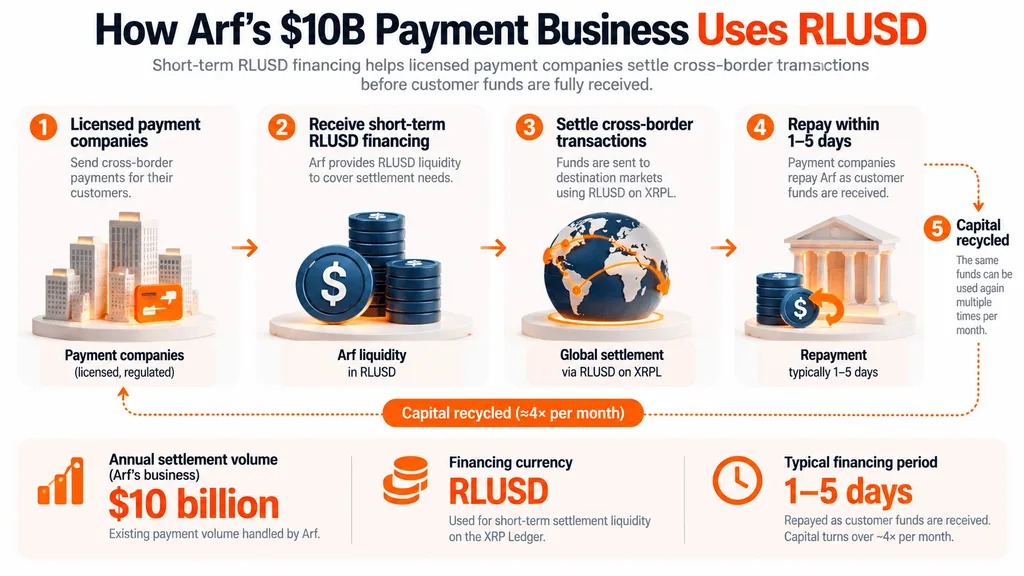
According to the announcement on October 22nd from Arf, this collaboration will utilize the RLUSD stablecoin of Ripple to provide short-term working capital for licensed cross-border payment companies. Such financing typically lasts from one to five days, allowing the funds to be reused during international transaction settlements.
Ripple and Arf How to Provide Financing for a $10 Billion Payment Business
Cross-border payment companies often need to prepare funds in the destination market before the customer's transfer is fully settled. This can present financing challenges, especially when businesses are dealing with billions of dollars in funds across different currencies and banking systems.
Arf addresses this gap by managing liquidity: it advances funds during the payment processing period and then recovers them later. The company states that its working capital is turned over about four times a month, so the same amount of funds can provide financing for multiple transactions.
Under the initial cooperation arrangement, Arf will directly provide settlement liquidity denominated in RLUSD on XRPL, while continuing to be responsible for lending decisions and borrower assessments.
This agreement follows closely on the recent collaboration between Ripple and DriveWealth; the latter has integrated RLUSD into a brokerage financing infrastructure that serves over 100 financial partners.
Ripple has also expanded the payment infrastructure of XRPL through Privy under Stripe, supporting embedded wallets and automated transactions.
XRPL Loan Agreement May Bring Financing onto the Chain
The greater opportunity lies in the native lending infrastructure proposed by XRPL, which could ultimately allow Arf to directly manage more financing activities through this network.
This architecture combines Single Asset Vaults for fund aggregation, as well as a lending protocol designed to support structured loans. Unlike the DeFi system, which relies on re-pledging, this proposed lending model depends on off-chain underwriting and credit assessment.
Arf has already begun development around this proposed infrastructure, but its activation still depends on the approval of the validators.
A vote snapshot on October 20th showed that there were only 19 validators supporting LendingProtocol, whereas 29 were required at that time. SingleAssetVault received 21 votes.
Marcus Hale
Marcus Hale is a cryptocurrency and financial markets contributor who reports on Bitcoin, Ethereum, digital assets, regulation, ETF, and institutional adoption. His work focuses on developments that may impact the market, investor trends, as well as the broader forces that shape the crypto economy.