Key Points
- Neumann recalled that an investment proposal of $4.2 billion changed his priorities.
- WeWork once had a valuation of $47 billion, only to subsequently collapse.
- This founder has now begun to reflect on the way he measures success.
At the end of 2016, when Adam Neumann met with Japanese billionaire Masayoshi Son, the initial expectation was to raise hundreds of millions of dollars for WeWork. Approximately 30 minutes later, he left with an investment proposal worth $4.2 billion and developed a completely different perspective on the company's development vision.
Nearly a decade later, Neumann stated that this meeting helped WeWork embark on a certain path, which ultimately led to it becoming one of the most notable corporate collapses in Silicon Valley.
Neumann stated in the podcast “The Diary of a CEO” that this brief conversation with the founder of SoftBank changed his views on money, ambition, and success.
A 4.2 billion dollar journey
The night before the meeting with Masayoshi Son, Neumann said that the WeWork board of directors had just agreed to a relatively conservative strategy: to raise $300 million to $400 million in financing, slow down expansion, achieve profitability, and ultimately push forward with an initial public offering (IPO).
Sun Zhengyi only had 12 minutes at the WeWork headquarters, after which he had to rush to another meeting. The conversation between the two continued in the car. In the car, this Japanese investor proposed an investment plan of approximately $4.2 billion, and the parties also signed preliminary terms on a iPad.
After leaving that car, Neumann walked for 36 blocks to return to headquarters. He now describes that journey as a turning point: his initial sense of mission began to be overshadowed by the prospect of achieving tremendous financial success.
From $47 billion to bankruptcy
By January 2019, the reported valuation of WeWork had reached $47 billion, which also made Neumann a billionaire with a fortune in the billions of dollars on paper.
However, the company's financial foundation was already deteriorating at that time. WeWork signed costly long-term property leases while offering customers more flexible and shorter-term membership services, which made its business particularly vulnerable when occupancy rates declined.
Its financial disclosure shows that WeWork incurred a net loss of $1.93 billion in 2018, while its revenue during the same period was approximately $1.82 billion.
In 2019, the IPO project, which was originally scheduled to proceed, exposed growing losses, concerns regarding corporate governance, and doubts from the outside world about Neumann's leadership abilities. Investors refused to accept the company's valuation, and Neumann resigned from his position as CEO in September of that year.
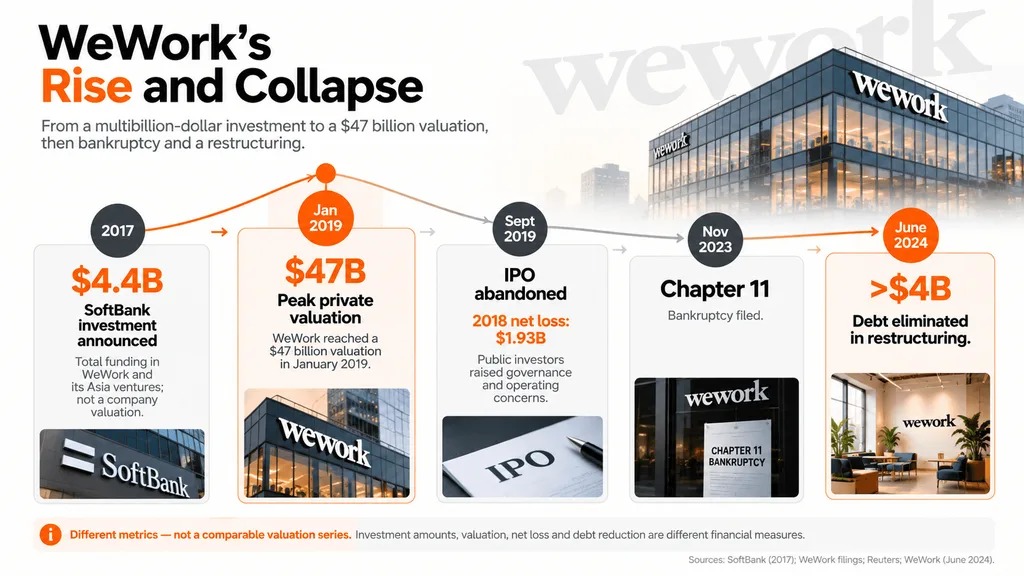
WeWork finally filed for bankruptcy protection under Chapter 11 of the U.S. Bankruptcy Code in November 2023. The subsequent reorganization eliminated billions of dollars in debt and transferred ownership of the company to creditors.
Flow and "A Second Chance"
Neumann's new project Flow applies the community-centered philosophy of WeWork to the residential real estate sector. Anderson Holovitz (Andreessen Horowitz) invested $350 million in this startup in 2022.
In this interview in September, Neumann stated that success on a material level caused him to deviate from his initial aspirations. According to the reports, this account provides a personal explanation for the development trajectory of WeWork, although the company's failure was also related to well-documented financial and governance issues.
The report states that the long-term lesson learned from this experience is that raising more capital can accelerate growth, but it does not solve unsustainable business models.
Author: Adrian Cole
Adrian Cole has been engaged in financial market reporting for over 6 years, with a focus on cryptocurrencies, stocks, and macroeconomic trends. He tracks Bitcoin, major altcoins, the U.S. stock market, interest rates, commodities, and various types of data that drive market changes. Over the years, he has written hundreds of articles on market dynamics and analysis, with an emphasis on price trends, investor sentiment, and the connections between traditional finance and digital assets.