Even if Tesla sells fewer cars, its stock price may still rise. Although vehicle delivery remains at the core of the company's business, investors' valuation of Tesla (NASDAQ : TSLA) is based on expectations for future profits, rather than how many cars it sells today.
Why doesn't Tesla's stock price always move in tandem with car sales?
Stock prices reflect how much investors are willing to pay for a company's expected future cash flows. Current sales are important, but expected changes can sometimes be even more crucial.
One can imagine a hypothetical scenario: Tesla's vehicle deliveries decline by 5%, but investors significantly raise their forecasts for its future software profits. If the expected increase in future earnings outweighs concerns about car sales, the stock price could still rise.
The same goes for the reverse case.
Even if a company sets a delivery record, investors may still be disappointed if its profitability falls short of expectations. This situation occurred after Tesla released its second-quarter financial report; despite stronger revenue and vehicle deliveries, its stock price still saw selling pressure.
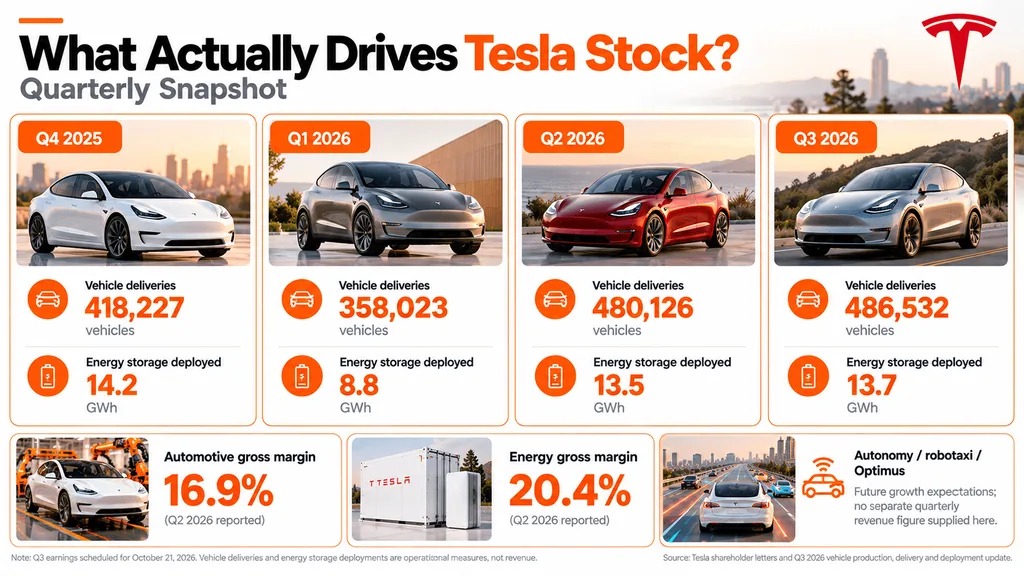
Therefore, the gross profit margin of automobiles, manufacturing costs, vehicle prices, and operating expenses are just as important as sales volume itself.
In the third quarter of 2026, the company delivered 486,532 vehicles and deployed 13.7 gigawatt-hours of energy storage products. These two figures represent different businesses, each with its own growth prospects.
Why Robot Taxis and AI Are Important for Tesla's Valuation
Tesla's investment narrative is not limited to electric vehicle manufacturing.
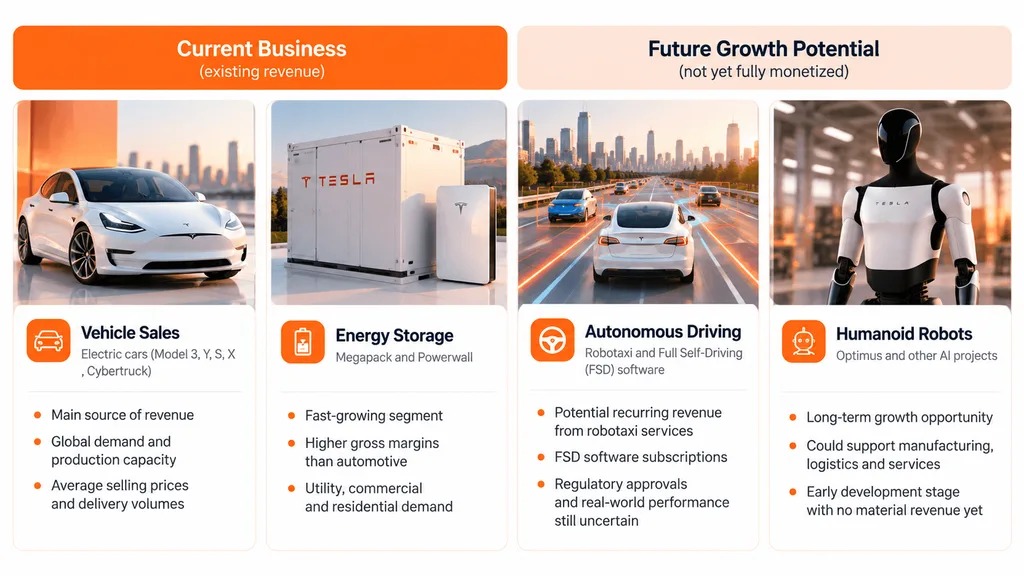
The company is developing autonomous driving technology, robot taxi services, and humanoid robots. These businesses have the potential to generate revenue without requiring Tesla to sell a larger proportion of cars.
For example, the robot taxi business can generate recurring revenue through transportation services. Software subscriptions may also continue to bring in payments after the vehicles are sold.
However, the commercial potential of these businesses remains uncertain. Their profitability depends on technological advancements, regulatory approvals, competition, and operating costs.
Investors have already shown a willingness to respond to these expectations.
This trend indicates that expected progress may affect valuations before the financial impact becomes measurable.
Tesla's energy business provides another source of growth.
Energy storage is another reason why Tesla's financial performance cannot be judged solely by vehicle deliveries.
The company sells Megapack systems for utility-grade energy storage, as well as Powerwall products for residential and commercial applications.
According to Tesla's 2025 annual report, revenue from energy generation and energy storage increased by 27% year-on-year, while the gross margin for this business segment rose from 26.2% to 29.8%.
At the same time, the gross profit margin of the automotive business decreased from 18.4% to 17.8%.
These differences indicate that even if one business is facing profitability pressures, another business may still be able to improve.
However, expectations do not equate to guaranteed profits. If robot taxis, AI, or energy storage businesses fail to generate the expected returns, the valuation assumptions that support the stock price could also reverse.
Adrian Cole
Adrian Cole has been engaged in financial market reporting for over 6 years, with a focus on cryptocurrencies, stocks, and macroeconomic trends. He tracks Bitcoin, major altcoins, the U.S. stock market, interest rates, commodities, as well as data points that drive market fluctuations. Over the years, he has written hundreds of market updates and analysis articles, with an emphasis on price trends, investor sentiment, and the connections between traditional finance and digital assets.