Key Points
- ASML It is expected that by 2028, the demand for devices will continue to exceed supply.
- EUV The annual production capacity of the equipment may be increased to over 110 units.
- NVIDIA and TSMC rely on the continuous expansion of advanced manufacturing capacity.
ASML ( NASDAQ : ASML ) indicates that although this Dutch semiconductor giant is preparing to significantly increase production, the market demand for its advanced chip manufacturing equipment is expected to exceed its production capacity until 2028.
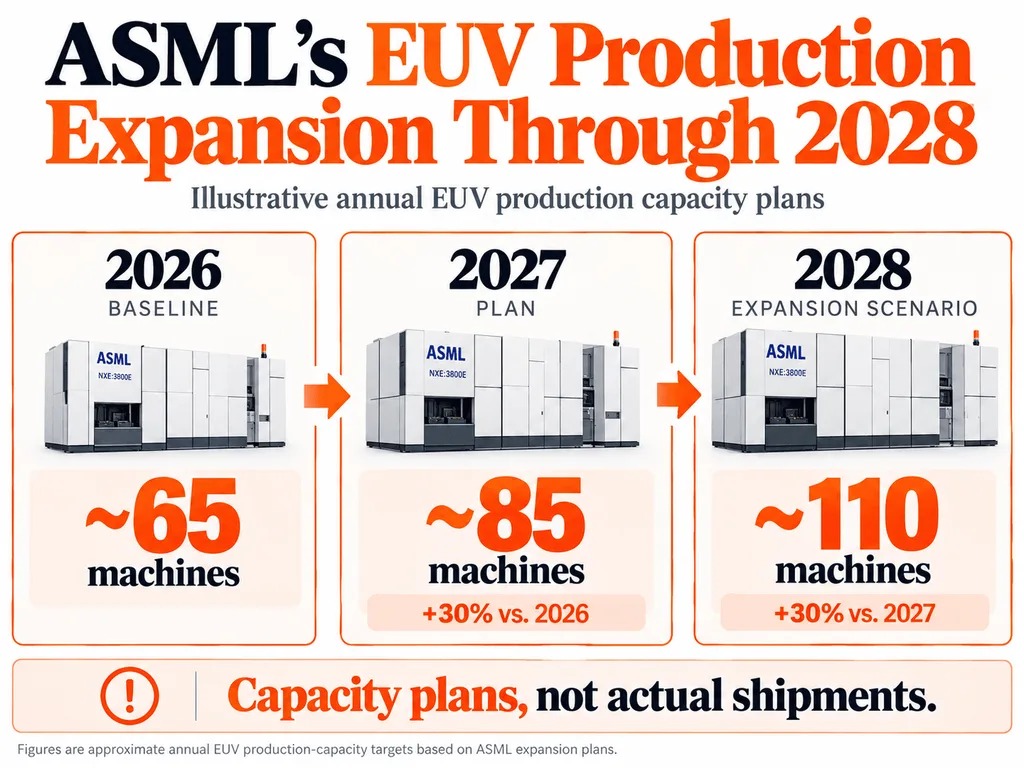
The company plans to expand its manufacturing capacity by 30% in 2027 and is studying further capacity expansion in 2028, which could potentially increase the annual output of its extreme ultraviolet (EUV) lithography machines to over 110 units.
ASML plans to produce over 110 units of EUV equipment, with demand for AI growing faster than supply.
According to the financial report announcement released by ASML on October 14th, the company no longer expects that its current production plan will be able to meet customer demands in 2027 or 2028.
CEO Christophe Fouquet stated that customers have begun to express their intention to lock in device deliveries for 2029 and even 2030, which reflects the market expectation that AI infrastructure investments will continue.
ASML The annual production baseline set for 2026 was approximately 65 units of equipment with low numerical apertures ( low-NA ). EUV If production is expanded by 30% as planned in 2027, this number will increase to around 85 units.
If production is further increased by 30% in 2028, the theoretical annual capacity will rise to approximately 110 units. ASML is currently evaluating whether it is possible to exceed this target.
These numbers represent the planned manufacturing capacity, not the confirmed delivery volume, nor do they guarantee the actual output that will be achieved.
The company also plans to improve the production efficiency of the equipment already installed in customer factories, thereby increasing chip output without relying entirely on new production systems.
Why do NVIDIA and TSMC rely on the manufacturing capacity of ASML
ASML holds a crucial position in the semiconductor industry, as it is currently the only manufacturer to commercially produce EUV lithography systems used for advanced chip manufacturing.
These devices enable manufacturers to engrave extremely tiny circuit patterns on silicon wafers, thereby supporting the production of processors with stronger performance and higher energy efficiency.
TSMC ( TSMC ) uses advanced manufacturing equipment to produce chips for customers including NVIDIA and AMD.
Therefore, even though the demand for AI accelerators remains strong, if the supply of ASML devices is limited, it may also constrain the speed at which semiconductor manufacturers can expand their production capacity.
Samsung and Intel are also investing in next-generation manufacturing technologies, which further intensifies the competition for high-end lithography systems.
However, a shortage of equipment does not necessarily lead to an immediate decrease in NVIDIA GPU production. The actual chip production also depends on factors such as factory utilization, packaging capacity, memory supply, and equipment production efficiency.
Despite market concerns about AI spending, the stock price of ASML has still risen by nearly 70% cumulatively.
The expected shortage of devices highlights the stark contrast between the fundamentals of the semiconductor industry and market sentiment.
ASML reported a net profit of approximately 5 billion euros in the third quarter, and the company also raised the lower limit of its annual revenue forecast to 44 billion euros.
However, as investors question whether the substantial AI infrastructure spending can generate sufficient returns, a broader range of semiconductor stocks are still facing selling pressure in recent times.
ASML Limited production capacity of devices may enhance their pricing power, but expanding production also requires manufacturing investment as well as complex coordination with suppliers.
Maya Bennett
Maya Bennett is a financial journalist who has reported on cryptocurrencies, stocks, and broader market trends. Her coverage focuses on Bitcoin, major digital assets, the stock market, monetary policy, as well as economic developments that influence investor sentiment. She is adept at transforming rapidly changing market events into clear and concise reports.