News from the IT Home on October 15th: The Washington Post has disclosed today a record of internal donations to the White House, revealing the main donors and specific amounts for the White House banquet hall project of U.S. President Donald Trump.
Records show that as of the end of September, there were a total of 67 donations exceeding $10,000 each. The total amount of private donations pledged was approximately $333 million, with both NVIDIA and Apple pledging to donate $25 million each, which is the highest amount for a single donation.
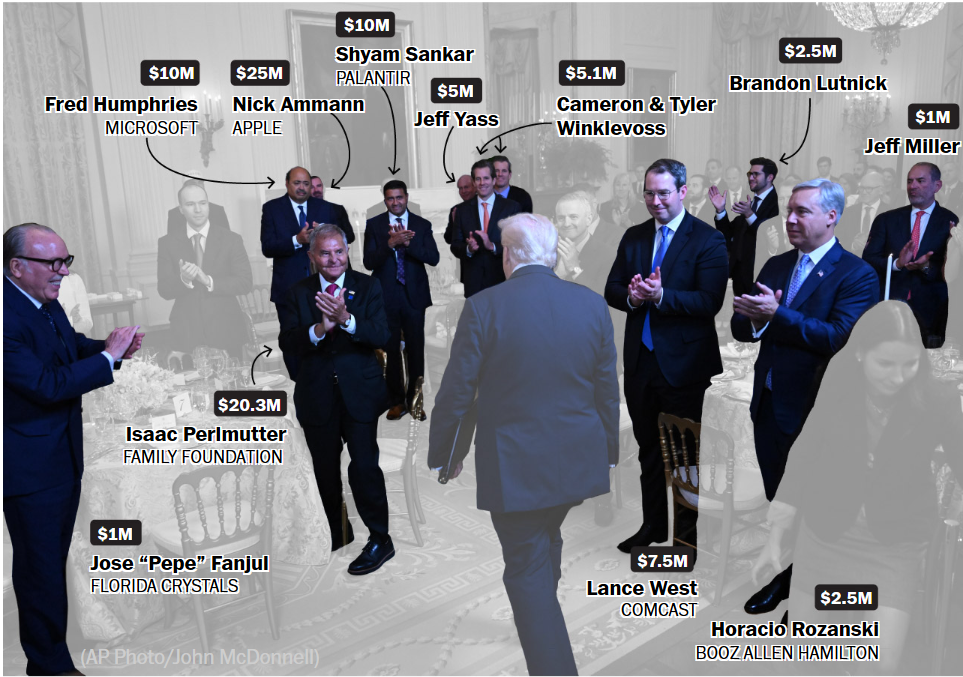
The White House previously announced a list of 37 donors, including individuals, businesses, and foundations, in October 2025, but did not disclose the amount of each donation. This internal spreadsheet records the source, date, and amount of each donation. The records exposed this time also show that at least $77 million came from donors who requested anonymity.
It is worth noting that Trump himself was not listed among the donors this time. A few days after the demolition of the old buildings in the East Wing of the White House began, Trump stated that the project funds were "100% covered by me and some friends."
According to previous reports by The Washington Post, Trump once expressed his hope to raise $400 million for the project, while the cost estimate for the related construction in March 2026 had risen to $600 million, which included banquet halls, office space, and underground military facilities. Relevant records show that some of the construction costs were also funded by taxpayer money.
NVIDIA is one of the main donors disclosed in this announcement. The documents show that the company pledged to donate $25 million in October 2025, with a request for the confidentiality of the donation source. NVIDIA CEO Jensen Huang has previously stated publicly that the company supports the White House banquet hall project on a “small scale,” but did not disclose the specific amount. NVIDIA spokesperson John Rizzo responded that the company’s support for the U.S. position is independent of its business interests, and noted that this donation was made to a non-partisan trust organization that serves all Americans.
The list also disclosed the donation information of other enterprises and individuals. Enterprises such as Amazon, Caterpillar, Comcast, Microsoft, and T-Mobile were among the main donors. Cryptocurrency companies and their investors pledged to donate over $18 million, among which Tyler Winklevoss and Cameron Winklevoss, co-founders of Gemini cryptocurrency exchange, donated a total of Bitcoin worth $5.05018 million.
Some donors are suspected of engaging in exchange for benefits as well. The Washington Post revealed that Charles Ergan, co-founder of Dish Network, pledged a total donation of $25 million to be made in two installments. Previously, the Federal Communications Commission (FCC) of the United States investigated his company EchoStar and threatened to revoke a government license that was crucial to the company's operations; after a meeting between Ergan, Trump, and FCC Chairman Brendan Carr, the investigation was concluded in September 2025. Subsequently, EchoStar reached a deal to sell some of its spectrum licenses and obtained approval from the FCC and the U.S. Department of Justice in May 2026. Ergan and EchoStar refused to comment on the donation issue.
In addition, the documents show that a subsidiary of Rocket pledged to donate $10 million, three weeks after the Federal Housing Finance Agency of the United States approved its acquisition of Mr. Mark Benioff, the CEO of Salesforce, and the company also pledged multiple donations; during this period, in January 2026, the U.S. Army awarded Salesforce a contract with a maximum value of $5.6 billion for a period up to 2035. ServiceNow pledged to donate $5 million in October 2025 after the General Services Administration of the United States announced that a federal procurement agreement had been reached with them. The relevant companies stated that the donations were unrelated to government approvals or contract matters, and government departments also denied that the donations influenced procurement decisions.
White House spokesman David Ingel refused to discuss the specifics of the donations, but said that the donors were from various American companies and individuals, with the aim of improving White House facilities. He also stated that the government would investigate those responsible for leaking the documents.
However, the list published by The Washington Post this time is not a complete roster, but rather a record used internally by the fundraising team to track donations. The report indicates that some donors previously publicly listed by the White House, including Hard Rock International, Tether America, and Paolo Tiramani (an executive from a modular housing company), are not included in this record. The relevant parties have not yet explained the reason for these omissions.