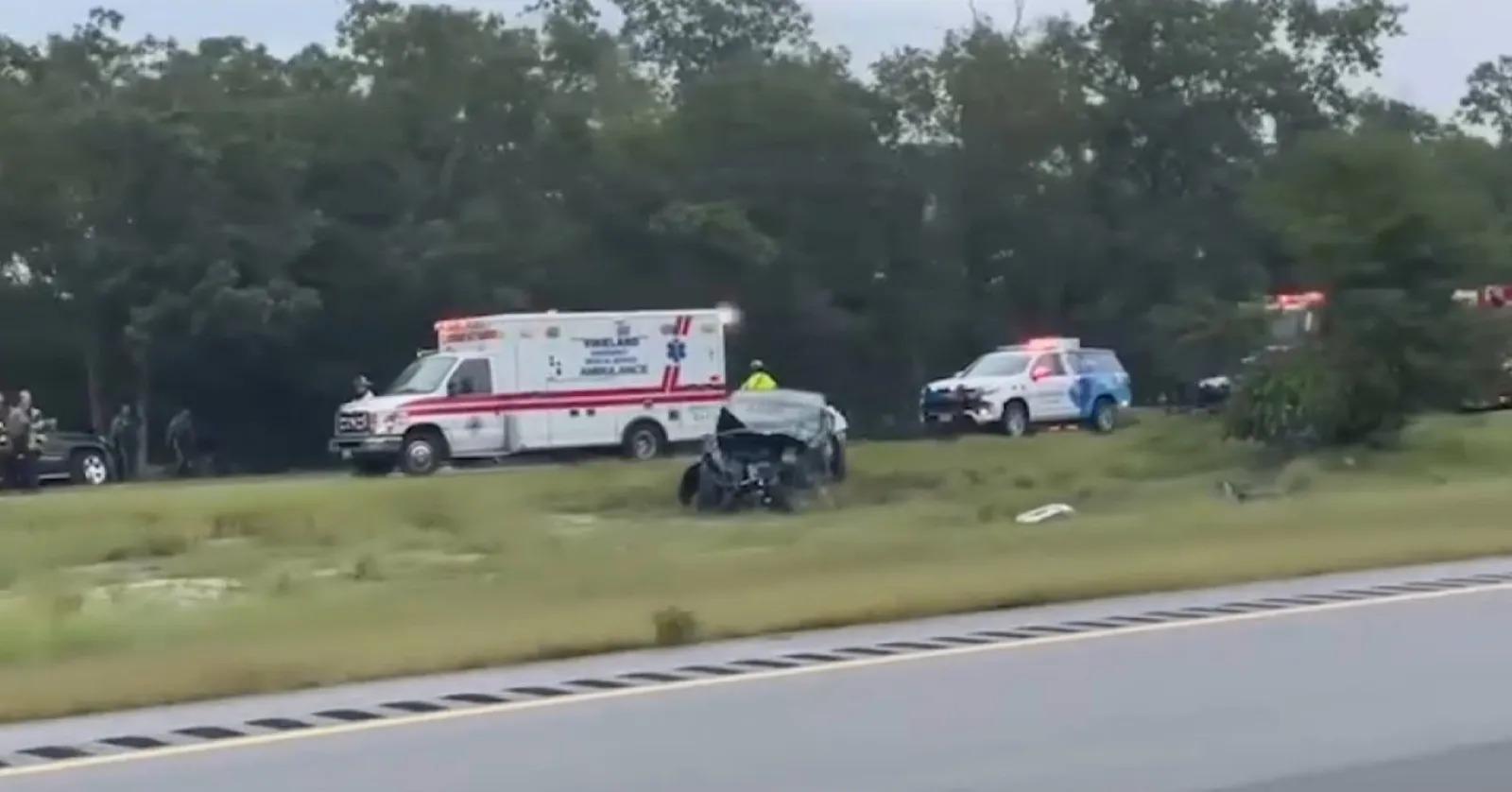
A Tesla crossed the central grassy median on New Jersey State Route 55, hit a tree, then slid into the oncoming lane and collided head-on with a SUV. The driver of the SUV, 68-year-old Phillip Eastman, died.
The police reported it as a driver losing control of the vehicle. However, what they did not explain, and it is also very likely that they were unaware of, is that reports submitted by Tesla to federal regulatory agencies indicated that the vehicle's driving assistance system was activated at the time of the accident. This is part of a ongoing investigation Electrek, which aims to match the reported accidents with Tesla's edited NHTSA data.
What happened on Highway 55?
According to the New Jersey State Police Department, on Saturday, August 22, 2026, at around 8:31 a.m., a Tesla was traveling south near Vineland in Cumberland County, at mile 34.6 of Highway 55. The driver lost control, drove off the left side of the road, crossed through the central grassy median, hit a tree, and then continued to rush into the northbound lane, where it collided with a Chevrolet SUV that was also traveling in the northbound direction.
SUV Driver, 68-year-old Phillip, " Phil ", Eastman from Springfield in Pennsylvania, died in the accident. The Tesla driver and a passenger in the Chevrolet were injured and taken to the hospital with moderate injuries.
Eastman has just taken the oath of office as a member of the board of directors for the Springfield school district. For nearly 30 years prior to that, he has been coaching youth and high school ice hockey, serving as the head coach for the Springfield High school team for 17 of those years. His passing was widely reported in the Philadelphia area.
And in none of these reports is there any mention of Autopilot, “Full Self - Driving” or any driving assistance systems. The accident is described as a driver losing control of the vehicle.
What has Tesla submitted to the federal government?
According to the "General Commands" ( Standing General Order ) of NHTSA, if a primary or secondary driving assistance system is enabled within 30 seconds before a collision and there are fatalities, car manufacturers must report the accident. Tesla has submitted a report regarding this incident.
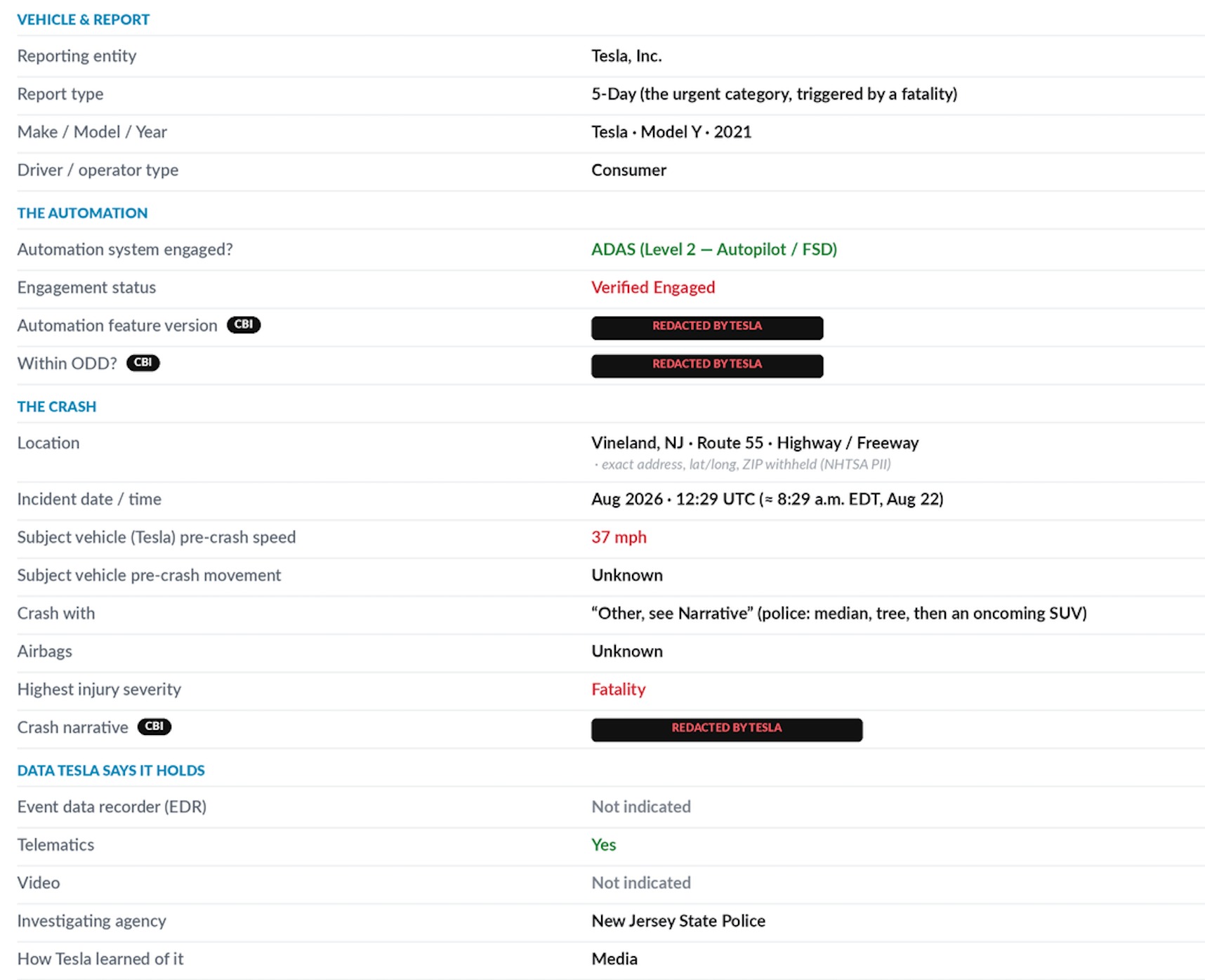
In the report, Tesla identified the vehicle as a 2021 model Model Y, and marked the automation system " Engagement Status " as " Verified Engaged " – which means that Tesla confirmed through its own telematics data that the " Autopilot " or " Full Self - Driving " system was in active mode at the time. The report also listed the New Jersey Police Department as the investigating agency, stating that they learned about the accident through the media.
Subsequently, Tesla deleted and altered all fields that could have explained the vehicle's behavior: accident descriptions, software versions, and whether the road was within the approved operating area of the system. These contents were marked with " confidential business information " and covered with black lines, just as Tesla does with 99.9% of its reports.
These data don't tell us much.
We need to clearly state what this report can and cannot prove. "Being in an activated state within 30 seconds before the collision" is merely a trigger condition for the report, and it does not prove that the system was controlling the direction of the vehicle when it crossed the central divider. The driver may also have intervened manually. Tesla also deleted the software version, so it is impossible to determine whether this is the basic version Autopilot or FSD.
There are two other points worth noting. The vehicle speed recorded by Tesla before the collision was only 37 miles per hour, which is relatively low for a highway. It is more likely to be a remote data snapshot during the period before the collision, rather than the actual speed of the vehicle when it left the road. Moreover, in this report, Tesla has only selected its own vehicle's remote information data and not the event data recorder or video, so there may be less on-board evidence available in this case compared to other cases.
There is no doubt about a fact that the public has never been made aware of: at the time a car crossed the central divider of a highway, resulting in the death of a man, the vehicle's driving assistance system was activated. As for how all of this actually occurred, the relevant information has been sealed off.
Why do we continue to track such incidents?
This is precisely the pattern that emerges repeatedly in this investigation, and it is also a crucial reason for the alteration of information. Tesla is more actively encouraging owners to use its secondary driving assistance systems as if they could drive on their own. The software is marketed as “Full Self - Driving”, and Elon Musk continuously promises that driverless autonomous driving is just around the corner. This brand narrative also helps to build drivers' trust in the vehicles.
But it is still just a secondary system. Humans are always the drivers and bear the responsibility, and Tesla's own practices confirm this: its products aimed at consumers still require supervision, and its services are also just a small fleet that is under close monitoring. At a time when Tesla asks owners to trust their vehicles, it hides records that could show how the system performs in case of errors; someone who coached children's hockey in the previous season becomes just one name in a set of files sealed by the federal government in the next season.
How we identified this incident, and why it is worth noting
Electrek marked this accident as a fatal Tesla car crash several weeks ago based on news reports, but there was no corresponding entry in federal data, and public reports did not mention any driving assistance features. NHTSA The latest released data has included this incident and labeled it as a fatal accident involving a " verified engaged " system issue. The information that has not been altered in the records includes the location ( Vineland ), state, vehicle model (2021 model Model Y ), death toll, and month; the accident time recorded by Tesla is UTC 12:29, which converts to around 8:29 am local time, within two minutes of the 8:31 am reported by the police. Both sources refer to the same accident. Electrek Has contacted the New Jersey State Police Department to request the accident report and vehicle data, and inquired whether investigators received Tesla's original telemetry data or only Tesla's own explanation.
Views of Electrek
If we remove the edited content, it appears that a Tesla was operating its driving assistance software when it crossed the central divider and hit and killed a member of the school district board in the oncoming lane. However, with the edited content included, it portrays the driver as being “out of control.” These two narratives are vastly different, yet the version that reaches the public excludes any responsibility on the part of Tesla.
We remain cautious here. The fact that the system was turned on does not necessarily prove that it caused the accident; the driver may have also intervened manually. We don't even know whether it was Autopilot or FSD at the time. That's precisely the issue. Tesla knows the full circumstances. It possesses remote information data, submitted a report confirming that the system was activated, and decided to treat the behavior of its vehicles in that fatal accident as a trade secret, not even disclosing which software was in use at the time. The family of Phillip Eastman, as well as the officers still investigating the case, deserve a complete explanation, rather than a revised report.
Tesla has already been under NHTSA investigation regarding how it reports these incidents. We will continue to compare them one by one until the records are complete.
Top comment by Wilbur Meinen
JFC, they actually killed those people who had no choice but not to participate in this experiment. That family is definitely going to receive compensation.
If you drive a Tesla, using home solar power is one of the cheapest ways to bring fuel costs down to nearly zero. With electricity prices rising by nearly 10% last year and expected to continue to rise, switching to solar energy is one of the best ways to counter these increasing costs. Through leasing and the PPA program, you can do so with no down payment and start saving money immediately. If you want to find the most cost-effective option, take a look at EnergySage. This is a free service, and hundreds of pre-approved installers will compete for your order, so you can save 20% to 30% compared to searching on your own. There will be no sales calls before you choose an installer. Click here to get a free quote.
FTC: We use automated affiliate links that can generate income. For more information.