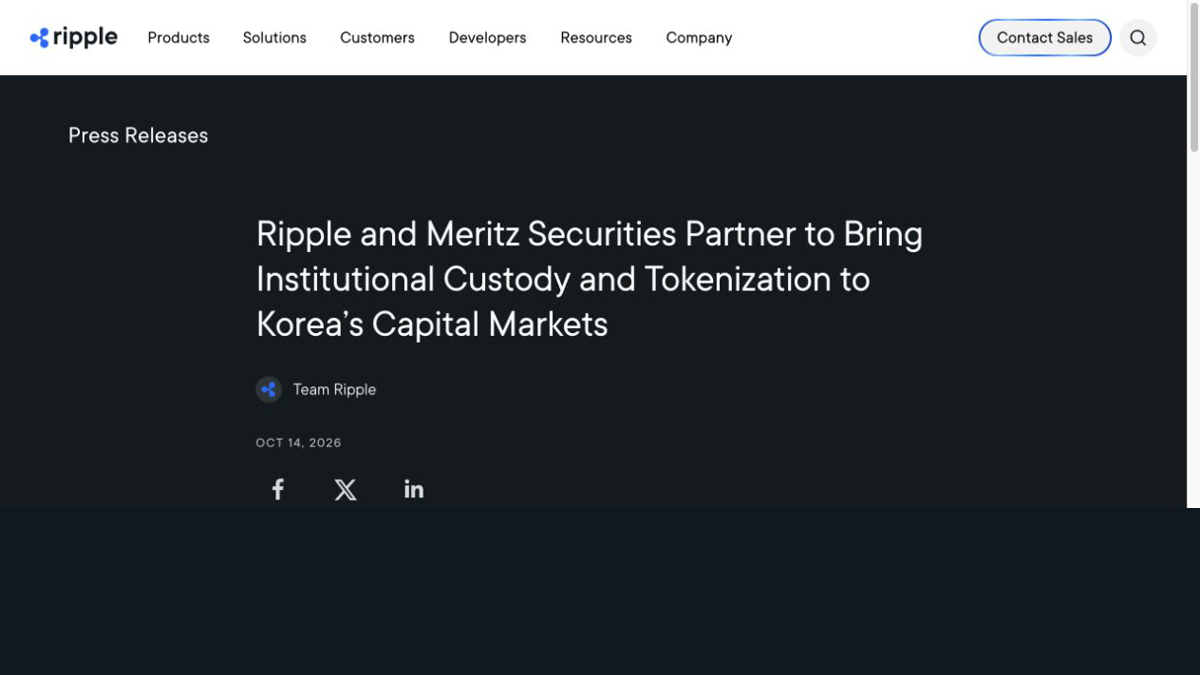


When financial institutions discuss tokenized securities, one of the most easily overlooked issues is: who will hold the assets, who has the authority to transfer them, and who will be responsible in case of any errors. On October 14th, Ripple and South Korea's Meritz Securities announced a strategic partnership, aiming to explore the introduction of Ripple Custody and its tokenization infrastructure into the South Korean capital market. The announcement did not mention that Meritz had already issued securities tokens, nor did it disclose any details about a Korean won-stablecoin or a new retail trading platform. This is a cooperative arrangement that starts from the existing custody and securities business, rather than an announcement of a full product rollout.
According to Ripple, this collaboration is its first partnership with a South Korean securities company. Meritz is exploring directions such as spot trading, micro-investments, security tokens, trading platforms, and Korean won-stablecoins in preparation for digital assets to enter the regulated financial system; these are considerations of opportunities and not all have yet obtained permits or been put into operation by October. Meritz indicates that both parties will initially advance within the current regulations and existing securities business scope, and then gradually expand as South Korea's digital asset system evolves. This sequence of "existing business first, potential expansion later" is key to understanding the entire news item.
Hosting is not about labeling assets with blockchain tags.
For a securities company, custody needs to address issues related to asset control and record-keeping responsibilities. Institutional-level digital asset platforms must handle key authorization, operational division of labor, transfer approval, audit logs, disaster recovery, and customer asset isolation. Even if tokens represent traditional securities, records generated on the blockchain will not automatically replace investor registration, compliance reviews, corporate actions, and regulatory filings. Ripple Custody is positioned as a platform for the custody and transfer of assets for regulated institutions; whether it can be applied to the specific products of Meritz still depends on technical integration, regulatory requirements, and business design.
The trading, settlement, and custody of traditional stocks have developed into a mature division of labor. Tokenization should provide actual improvements; it cannot merely convert ownership certificates into another data format. Instead, it is necessary to clearly define what aspects need to be improved: whether it is to shorten asset transfer times, reduce reconciliation costs, facilitate collateral management, or make cross-institutional transactions more transparent. Each potential benefit comes with new dependencies, such as the availability of on-chain systems, the security of private keys, and the data standards of different institutions. If the Korean market wishes to use this technology in securities business, it must also address the relationship between token records and existing legal registration systems.
Ripple also mentioned in its announcement that it is collaborating with other institutions in South Korea: conducting projects for different purposes with insurance companies, banks, and cross-border payment institutions. By listing these cases together, it is evident that the company is attempting to establish an infrastructure network that covers a variety of financial institutions; however, just because one bank has adopted its payment product, it cannot be inferred that Meritz's tokenized securities have received the same legal and technical approval. The partners, types of assets, and regulatory frameworks are not the same, so cross-scenario experience needs to be re-verified.
Which milestones can indicate that the cooperation is truly making progress?
The first milestone is for both parties to announce the specific scenarios. Will it be for institutions to internally manage digital assets, or to provide customers with securities token issuance and settlement services? Both require different account structures, risk capital arrangements, and consumer protection measures. The second milestone is to clarify the boundaries between pilot projects and full-scale deployment: tests with limited participants, simulated asset transfers, and actual fund settlements cannot replace each other. The third milestone is to disclose the regulatory approach and division of responsibilities, especially in cases where customer assets are lost or there is a discrepancy between on-chain records and those of securities firms.
If in the future we move towards Korean won stablecoins or security tokens, the issues will become even more complex. Stablecoins involve issuers, reserve assets, and redemption arrangements; security tokens involve rights ownership, trading qualifications, and market supervision. Meritz is "researching" these areas, and has not yet issued any corresponding assets. Investors should also not directly regard cooperative relationships as a form of value endorsement for these tokens. The success of such businesses depends on regulatory approval, customer demand, and improvements in actual costs, rather than the fame of the cooperating parties.
What makes this message more valuable for the Web3 industry is that it emphasizes the importance of infrastructure development first. The market often expects that on the day of a token issuance, traditional finance can be “on-chain” immediately, yet it overlooks the construction cycles for hosting, settlement, and the mapping of legal rights. Mature securities firms need to trial new technologies within their existing securities business, which typically requires them to retain the responsibility chains of the old systems and have the new systems undergo internal control inspections item by item. Such a process may not make for sensational headlines, but it is closer to the actual path that institutions choose to follow.
What can be confirmed for now is that Ripple and Meritz have announced a partnership to explore hosting and tokenization infrastructure, with plans to proceed in phases according to South Korea's current regulatory framework. The details that are still uncertain include the specific time of the securities tokens' launch, the issuance of stablecoins, the customer base, and the effectiveness of fund settlement. Only if there are actual pilots, regulatory filings, or official product announcements in the future will it be possible to assess which aspects of South Korea's capital market this collaboration has changed. Clearly distinguishing between "signing a contract" and "completion" not only protects readers but also provides a verifiable baseline for the future progress of this partnership.
Announcements about institutional cooperation often use the term "infrastructure" in a very broad sense. For investors, it may refer to custody and permission management; for issuers, it could be asset registration and corporate actions; for brokers, it might involve post-trade reconciliation. If both parties only disclose that the interfaces have been connected but do not make public the specific types of assets, the number of participants, or the legal rights arrangements, this is not sufficient to prove that the market infrastructure has been fully transformed. Tracking progress through these verifiable issues is more valuable than simply waiting for the name of a particular token.