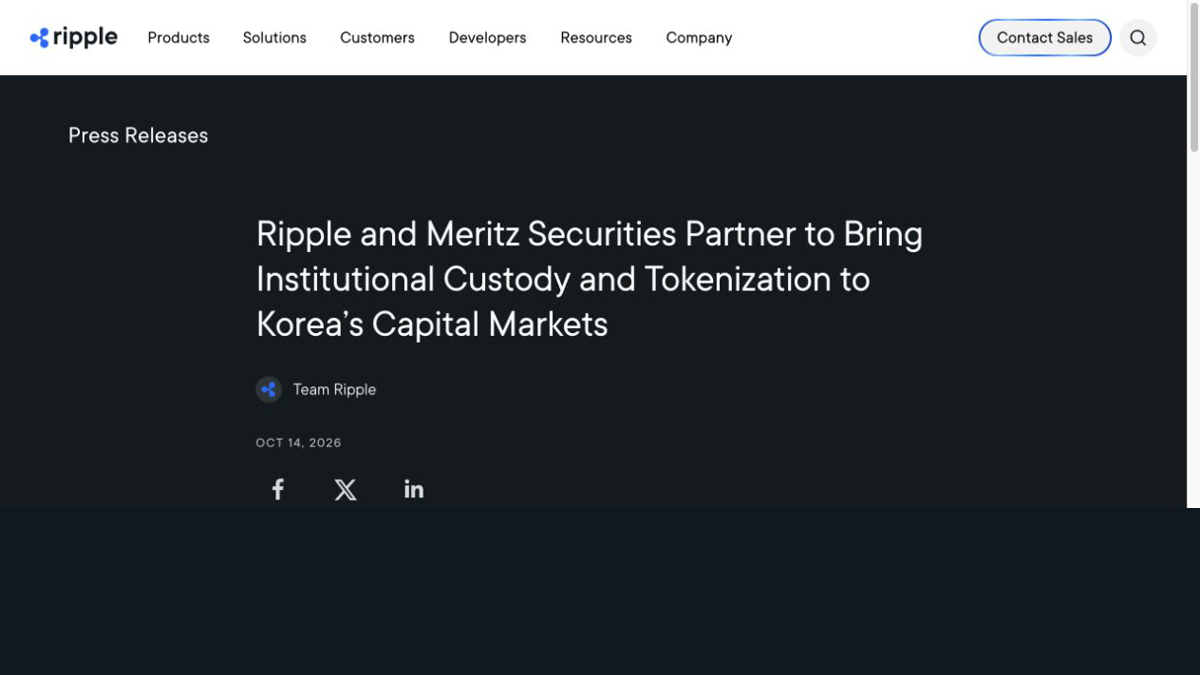


Global brokers allow users to buy and sell US stocks across time zones, but the funds may not be available “24/7” along with the trading interface. On October 14th, DriveWealth and Ripple announced a partnership, planning to integrate stablecoin settlement, cross-border fund transfers, custody, and some institutional services into the brokerage infrastructure of DriveWealth. The focus of the news is not on the price of any particular token, but on a long-standing discrepancy: while the efficiency of US stock trading and settlement is continuously improving, cross-border fund transfers are still subject to the business hours of banks, time zones, and intermediate steps. Both companies are attempting to bridge this gap in the backend processes, but the announcement mentions different stages such as “integrating,” “planning to expand,” and “exploring opportunities,” so it cannot be uniformly stated that the service has been officially launched globally.
DriveWealth provides brokerage infrastructure for fintech companies, digital wallets, and financial institutions, with the company claiming to serve over 100 partners. Ripple offers stablecoins, payment services, custody, and products related to institutional brokerage in its collaborations. Naureen Hassan, the CEO of DriveWealth, mentioned that the company already supports 24/7 trading five days a week and hopes to bring the availability of funds closer to market hours. This demand is practical, but it doesn't mean that any customer can now deposit funds in stablecoins at any time in any country and withdraw them immediately. Funds entering a securities account still have to go through compliance checks, settlement processes, asset custody, and local financial regulations.
The announced integration scope is at different stages respectively.
The announcement states that DriveWealth is integrating the stablecoin infrastructure of Ripple in Europe to support settlements, with plans to expand this to the United States in the future; the scheme intends to utilize RLUSD on XRP Ledger, while also taking advantage of Ripple's capabilities for minting and burning. Since the tenses used for Europe and the United States in the statement differ, the "US expansion plan" should not be misinterpreted as "the US market has been fully launched." The two companies are also integrating Ripple Payments to support cross-border capital inflows for international partners and are working on the digital asset custody needs of DriveWealth in Europe, with other markets remaining part of subsequent plans.
Another aspect is equity financing. The announcement only mentions that DriveWealth and Ripple Prime are exploring opportunities in the Delta One business, which involves US stocks and equity derivatives. Exploration does not equate to the launch of specific financing products, nor does it mean that regulatory authorities have approved all the designs. Reports should categorize this as part of the “scope of cooperation” rather than a “list of ready-made products.” For customers, what is truly important to verify are the available markets, available currencies, legal attributes of the assets, settlement times, and fee details, rather than being convinced by an integrated architecture diagram.
Stablecoin settlement has gained attention because it allows digital assets to be transferred on-chain, theoretically reducing the need for cross-border waiting times and the requirement to pre-deposit funds. However, there are still several steps between “fast on-chain transfers” and “users receiving usable US dollars quickly”: fiat currency exchange, issuance and redemption, anti-money laundering (AML) checks, processing by partner banks, and internal accounting confirmation by securities firms. The completion of an on-chain transaction does not mean that the purchase of securities is also completed, nor does it imply that all counterparties bear the same risks. Only if institutions disclose these steps separately will it be easier for outsiders to verify exactly at which point the so-called efficiency improvement occurs.
Longer transactions, faster capital movement, and risk control must also evolve accordingly.
The U.S. stock market has adopted T+1 settlement, but the settlement cycle is not the same as the time when investors deposit funds into their accounts. The former refers to the standard time required for final delivery after a securities transaction is completed, while the latter involves the source of funds, cross-border routes, and credit arrangements of brokers. The DriveWealth and Ripple initiatives aim to align the movement of funds more closely with the clients' trading times, rather than changing the U.S. securities settlement system. To use “T+1” as direct evidence that stablecoins can ensure real-time delivery of all stocks is a misinterpretation of the existing rules.
If customers are able to replenish funds into their margin accounts more quickly through stablecoins, brokers have the opportunity to reduce the idleness of overnight funds; at the same time, it is also necessary to consider the credit of stablecoin issuers, reserve redemption capabilities, on-chain congestion, wallet control, and private key security. A 24/7 funding channel means that there is also a 24/7 monitoring responsibility in the event of risk incidents. Institutional users need to consider service levels, fault recovery, asset isolation, and exchange restrictions under extreme market conditions, and cannot rely solely on the term "near real-time."
Cooperative news can also easily lead to excessive associations regarding XRP. The stablecoin solution mentioned in the announcement is the use of RLUSD on XRPL. It cannot be inferred from this that all DriveWealth customers must purchase XRP, nor can it be concluded that the price of a certain coin will inevitably rise. Network-native assets, stablecoins, and the fiat currency balances in brokerage accounts each have different legal and economic attributes. If readers treat them all as "on-chain dollars," they will overlook who is responsible for making payments to whom.
The subsequent truly verifiable aspects include the specific market and customer activation scopes announced by both parties, the actual cross-border capital turnover times, cost comparisons, custody arrangements, and the methods of handling during periods of stress. The announcement on October 14 confirmed the cooperation and multiple integration directions, and also described the possible customer experience; however, it is not yet a comprehensive operational audit covering all over 100 partners. Whether stablecoins can be integrated into the brokerage backend ultimately depends on sustainable operational data, rather than the vision presented in a single press release.