Citi Group and JPMorgan Chase kicked off another important trading day in the new round of financial reporting season in the United States. Although both banks maintained high levels of profitability, their narratives for the third quarter were distinctly different.
Citi's profits grew by 40%, driven by services and wealth management
Citi's strong performance this quarter is attributed to increased revenue from services, wealth management, and investment banking. The bank also stated that it returned $4.1 billion to shareholders this quarter, demonstrating management's confidence in its broader business operations.
Performance results indicate that Citibank's restructuring efforts continue to be effective. The bank emphasized that the return on tangible common equity for the quarter was 11.5%, and stated that the performance from the beginning of the year to date still exceeds its target of 11%.
However, not all business lines are improving. With the increase in reward costs and credit provisions, credit card profits have declined, indicating that although the institutional and wealth management departments are performing well, certain areas of the consumer business are still under pressure.
This mixed background of joy and sorrow may help to explain why investors in bank stocks have been more critical this financial reporting season.
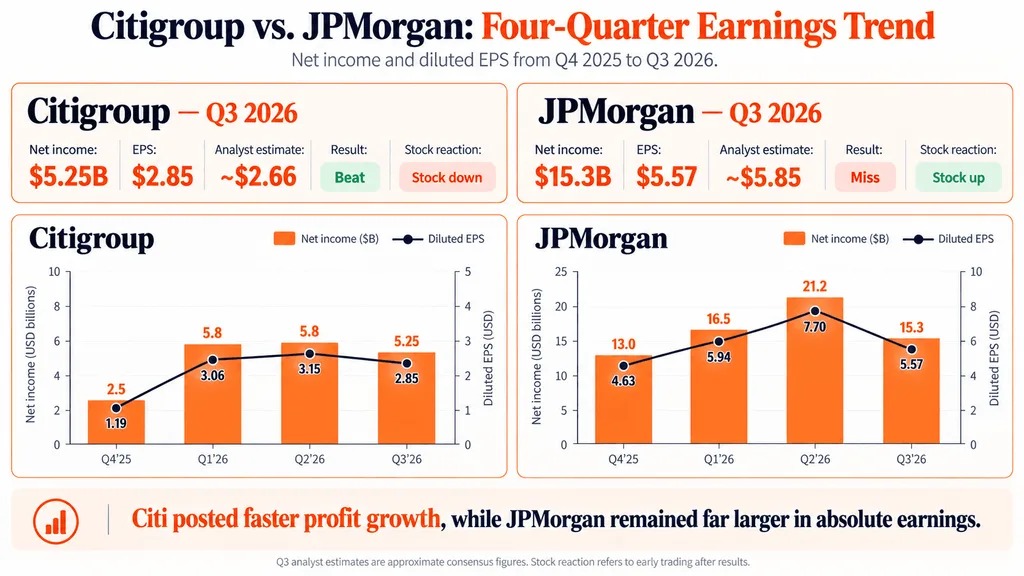
JPMorgan Chase reported profits of $15.3 billion, but still fell short of expectations
The aspect of JPMorgan Chase's earnings that fell short of expectations is that, despite the bank still posting substantial profits, it benefited from a strong stock trading business. Revenue in this area is reported to have soared by 49%, which helped offset the weakness in fixed income and parts of its investment banking operations.
This pattern reflects a broader theme on Wall Street. Market volatility is beneficial for the stock trading sector, whereas higher bond yields and financing costs make trading matching and debt market activities more difficult.
The same tension also affected the broader stock market performance, with volatility and concentration continuing to define investor sentiment.
Why does Citibank's stock price fall while JPMorgan Chase's stock price rises?
The divergence between the two stocks indicates that financial report results are not solely based on apparent profits. Investors also take into account expectations, business quality, valuation, and whether the revenue drivers of each bank seem sustainable.
As for Citibank, the significant increase in profits may have been partially reflected in its stock price, while investors remain cautious about the pressures on consumer credit and the lengthy process required to improve long-term returns. Regarding JPMorgan Chase, the market may be more concerned about its resilience, its strong trading business, and the ability of its management to generate profits even in difficult circumstances.
This approach is also quite common throughout the financial reporting season: the fluctuations in stock prices often depend not only on the raw profit figures, but more so on what these figures imply for the next quarter.
Emir Abyazov
Coinpaper serves as the editor-in-chief, responsible for driving data-driven editorial operations; SEO is in charge of content discovery, as well as crafting narratives that cater to audiences interested in cryptography, artificial intelligence, and fintech.