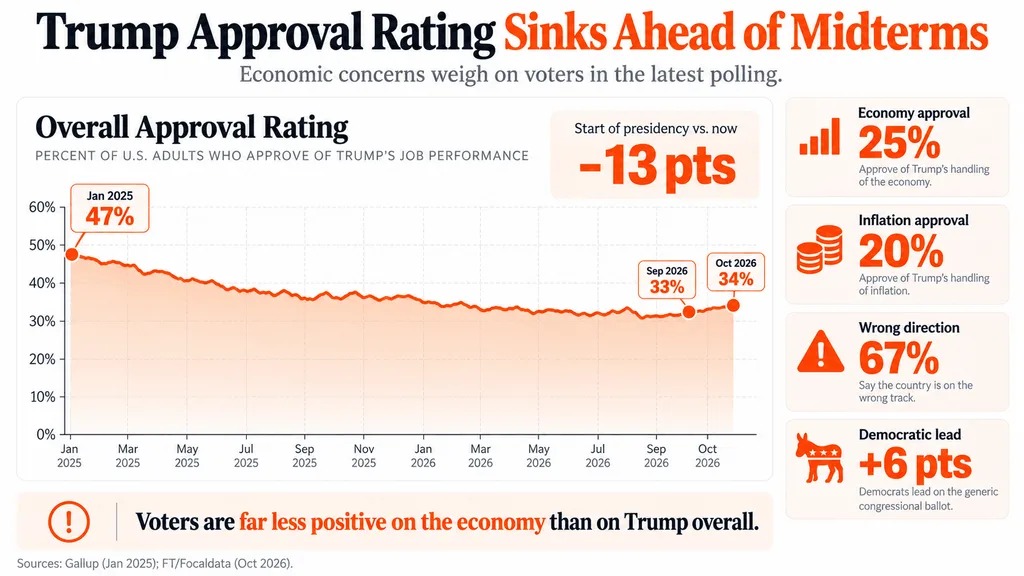
The UK's Financial Times cited a survey conducted by Focaldata from October 2nd to 4th among 2,275 registered voters, which found that 59% of the respondents did not approve of Trump's overall performance.
His support rate is 34%, which is close to 33% in September; more than two-thirds of the respondents believe that the U.S. economy is moving in the wrong direction.
In terms of economic management, Trump has received significantly lower evaluations than his overall performance, with inflation being a particular source of dissatisfaction among respondents.
Additionally, according to the Focaldata poll in October, the Democratic Party led by 8 percentage points among potential voters in the anonymous general election votes ( generic ballot ) in Congress.
Although national surveys cannot determine the results of individual congressional districts, these findings indicate that affordability issues were still an important factor in voters' evaluations before the voting on November 3rd.
Gas prices in the United States have risen by 41%, and diesel prices have exceeded $6 per gallon.
According to data from the American Automobile Association ( AAA ), on October 12th, the average price of regular gasoline was about $4.36 per gallon, compared to about $3.09 per gallon a year ago.
This means an increase of about $1.27 per gallon.
For drivers who purchase 60 gallons of fuel per month, the additional fuel cost compared to October 2025 is approximately $76.
Diesel prices have also risen significantly, with the national average reaching about $6.27 per gallon.
Higher diesel costs have an impact that goes beyond transportation, as trucks are responsible for transporting food, consumer goods, and industrial materials across the country.
The reasons for the rise in oil prices include high crude oil prices and disruptions to the energy infrastructure in the Middle East, although refining capacity and regional fuel supply also affect retail prices at gas stations.
As previously analyzed by Coinpaper, Trump's promise of cheaper gasoline is facing challenges amid global oil prices remaining high.
Inflation and mid-term elections have made economic policy a focal point
Despite estimates indicating that the U.S. economy grew relatively strongly in the third quarter, concerns about affordability continue to rise.
However, the expansion of GDP does not necessarily translate immediately into an improvement in household purchasing power, especially when energy and housing costs remain high.
The Consumer Price Index ( CPI ) report, which will be released on October 14th, will provide another indicator to measure price pressures. Economists expect the annual inflation rate to be around 3.7%.
If employment prospects weaken while price pressures remain high, persistent inflation could further complicate the Federal Reserve's interest rate decisions.
Whether these pressures will ease will, in part, depend on changes in the global energy market and the inflation data that is about to be released.
Author: Emir Abyazov
Author Introduction: Coinpaper serves as the chief editor, responsible for driving data-driven editorial operations, content discovery guided by SEO, as well as reporting on cryptography, artificial intelligence, and fintech that prioritizes the audience.